Cantitate/Preț
Produs

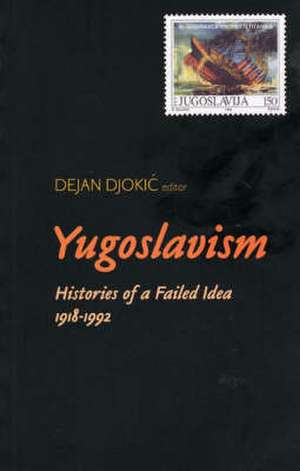
Yugoslavism

Editat de Dejan Djokic
en Limba Engleză Paperback – 11 mar 2003
This work explores the history of the Yugoslav idea, or "Yugoslavism", between the state's creation in 1918 and its dissolution in the early 1990s. It reveals that Yugoslavism was a fluid concept, understood differently at different times by different nations, leaders and social groups.
Citește tot Restrânge

Toate formatele și edițiile

Toate formatele și edițiile Preț Express
Paperback (2) 13988 lei  3-5 săpt.
  University of Wisconsin Press – 9 iun 2003 13988 lei  3-5 săpt.
  C Hurst & Co Publishers Ltd – 11 mar 2003 18600 lei  42-47 zile

Preț: 18600 lei

Preț vechi: 21001 lei
-11% Nou

Puncte Express: 279

Preț estimativ în valută:
3291 3859$ 2890£

Carte tipărită la comandă

Livrare economică 06-11 februarie 26

Preluare comenzi: 021 569.72.76

Specificații

ISBN-13: 9781850656630
ISBN-10: 1850656630
Pagini: 356
Dimensiuni: 157 x 218 x 26 mm
Greutate: 0.47 kg
Editura: C Hurst & Co Publishers Ltd
Locul publicării:United Kingdom

Notă biografică

Dejan Djoki´c  is lecturer in contemporary history at the School of History, Classics and Archaeology, Birkbeck College, University of London. He is a frequent contributor to both scholarly and popular media in Europe, commenting on politics in the Balkans.

Descriere

Descriere de la o altă ediție sau format:
This volume explores historical, political, social, diplomatic, and economic aspects of the Yugoslav idea—"Yugoslavism"—between the creation of the nation in 1918 and its dissolution in the early 1990s. The key theme that emerges is that Yugoslavism was a fluid concept, understood differently at different times by various leaders, social groups, and the member states that comprised Yugoslavia. There never was a single definition of who and what was (or was not) "Yugoslav," and this contributed to the ultimate failure of the Yugoslav idea and the Yugoslav state. These essays, by scholars from the former Yugoslavia and from the West, look at the interplay of the states and peoples of Yugoslavia and at the roles played by intellectuals, leaders, and institutions, both secular and religious.