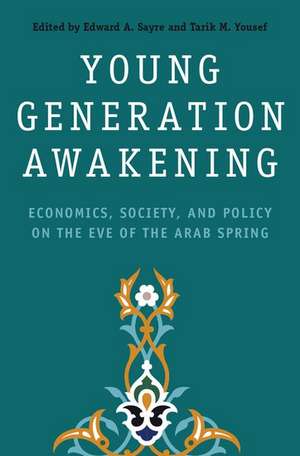
Young Generation Awakening: Economics, Society, and Policy on the Eve of the Arab Spring
Editat de Edward A. Sayre, Tarik M. Yousefen Limba Engleză Hardback – 18 aug 2016
Preț: 661.74 lei
Preț vechi: 960.59 lei
-31%
Puncte Express: 993
Carte tipărită la comandă
Livrare economică 03-09 decembrie
Livrare prin curier în România Termenul estimat este afișat lângă disponibilitate.
Transport gratuit pentru acest produs Plată online sau ramburs, în funcție de opțiunile comenzii.
Retur gratuit în 14 zile Comandă securizată și suport în română.
Specificații
ISBN-13: 9780190224615
ISBN-10: 0190224614
Pagini: 258
Dimensiuni: 157 x 236 x 23 mm
Greutate: 0.5 kg
Editura: Oxford University Press
Colecția OUP USA
Locul publicării:New York, United States
ISBN-10: 0190224614
Pagini: 258
Dimensiuni: 157 x 236 x 23 mm
Greutate: 0.5 kg
Editura: Oxford University Press
Colecția OUP USA
Locul publicării:New York, United States
V-ar putea interesa
-
 Economic TortsTony Weir-31%Preț: 674.24 lei982.78 lei
 -
 -31%Preț: 543.07 lei788.12 lei
 -
 -19%Preț: 352.29 lei436.13 lei
 -
 Volatility and GrowthPhilippe Aghion-31%Preț: 591.54 lei860.97 lei
 -
 Overcoming Developing Country Debt CrisesBarry Herman-14%Preț: 332.02 lei385.34 lei
 -
 Spend $50Billion World Better PlaceBjørn LomborgPreț: 166.74 lei
 -
 Development EconomicsDebraj Ray-23%Preț: 788.72 lei1024.31 lei
 -
 Economics of Development: Theory and EvidenceA. P. Thirlwall-24%Preț: 469.82 lei620.96 lei
 -
 -27%Preț: 701.63 lei961.14 lei
 -
 The Triple Bottom Line: Does It All Add UpAdrian HenriquesPreț: 387.91 lei
 -
 Capitalism as if the World MattersJonathon PorrittPreț: 366.63 lei
 -
 Factor Five: Transforming the Global Economy through 80% Improvements in Resource ProductivityErnst Ulrich von Weizsacker-18%Preț: 1319.89 lei1609.62 lei
Notă biografică
Dr. Edward A. Sayre is an associate professor of Economics and Chair of the Department of Political Science, International Development, and International Affairs at the University of Southern Mississippi (USM). Dr. Sayre's research focuses on the economics of the Palestinian-Israeli conflict, labor market institutions, and Middle East labor markets. Before starting his current position at USM, Sayre was a visiting research associate at the Palestine Economic Policy Research Institute (MAS) in Jerusalem and taught at Kenyon College and Agnes Scott College. Since 1999 Dr. Sayre has served on the Board of Directors the Middle East Economic Association.Dr. Tarik M, Yousef is Senior Fellow at Brookings who served between 2011 and 2015 as Chief Executive Officer at Silatech, a regional organization promoting youth employment in the Arab world. Prior to that he served as Sheikh Al-Sabah Professor of Arab Studies in the School of Foreign Service at Georgetown University and Founding Dean of the Dubai School of Government. He is at present a member of the Boards of Directors of the Arab Banking Corporation and the Central Bank of Libya.