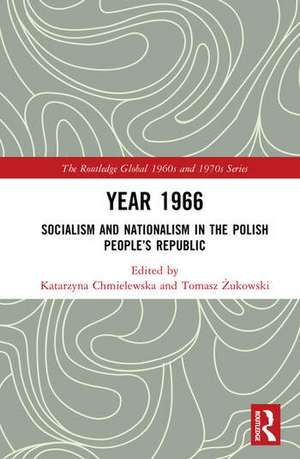
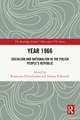
Year 1966: Socialism and Nationalism in the Polish People’s Republic: The Routledge Global 1960s and 1970s Series
Editat de Katarzyna Chmielewska, Tomasz Żukowskien Limba Engleză Hardback – 30 mai 2025
The book explores the question of what happened in Polish culture at that time: how social ties were defined, where sources of legitimization of power for the new order were sought beyond the slogans of the revolution (equality, advancement, or prosperity), how historical politics participated in this process, the fate of the great emancipation projects of the 1950s such as emancipation of women or equality for ethnic minorities, and how the meanings of the related narratives changed. It also shows how all important actors (the diverse power camp, the emerging opposition, the Church) participated in this process, adapted their own narratives, and built a new understanding of society, social ties, history, and collective identity, with effects that would weigh heavily on the democratic transformations of the 1990s.
This volume is intended for researchers interested in the history and culture of Poland, communist Central and Eastern Europe, memory studies, cultural and literary history, social history, and sociology.


Preț: 1117.25 lei
Preț vechi: 1362.50 lei
-18%
Puncte Express: 1676
Carte tipărită la comandă
Livrare economică 30 noiembrie-14 decembrie
Livrare prin curier în România Termenul estimat este afișat lângă disponibilitate.
Transport gratuit pentru acest produs Plată online sau ramburs, în funcție de opțiunile comenzii.
Retur gratuit în 14 zile Comandă securizată și suport în română.
Specificații
ISBN-13: 9781032726038
ISBN-10: 1032726032
Pagini: 230
Dimensiuni: 156 x 234 x 17 mm
Greutate: 0.59 kg
Ediția:1
Editura: Taylor & Francis
Colecția Routledge
Seria The Routledge Global 1960s and 1970s Series
Locul publicării:Oxford, United Kingdom
ISBN-10: 1032726032
Pagini: 230
Dimensiuni: 156 x 234 x 17 mm
Greutate: 0.59 kg
Ediția:1
Editura: Taylor & Francis
Colecția Routledge
Seria The Routledge Global 1960s and 1970s Series
Locul publicării:Oxford, United Kingdom
Public țintă
AcademicCuprins
Introduction Part 1: Nationalist Legitimization 1. The Dispute Between the Party and the Church in 1966 2.The Polish Film Chronicle of 1966: The Millennium of the State versus the Millennium of the Baptism Part 2: Historical Politics 3. Practical Exercises in Historical Politics: Historical Narratives of the 1960s in Poland 4. Colors of Struggle and the Polish Road to Socialism 5. The National Veteran Narrative in War Cinema Part 3: Duration and Withdrawal of Emancipation 6. The Polish Peasant Becomes a Nobleman: The Changing Identity Imaginaries of 1960–1999 and Beyond 7. Mothers, Daughters, and Modernity in the Girls’ Novel of the 1960s 8. Socialism Uncompleted: On the TV Shows Doktor Ewa (1970) and Daleko od szosy (1976) 9. Another Death of Universalism, or How Communist Poland Destroyed Jewish Communism Part 4: Prehistory of the Opposition 10. From Revisionism to Dialogue: An Analysis of the Narrative Transformations of the Left-Wing Opposition in the Polish People’s Republic 11. Leszek Kołakowski’s Political Journalism (1955–1975). Epilogue: The Trauma of March 1968
Notă biografică
Katarzyna Chmielewska is Assistant Professor at the Institute of Literary Research of the Polish Academy of Sciences (IBL PAN). She is co-founder of the Center for Cultural and Literary Studies of Communism at IBL PAN and editor of the series Communism: Ideas – Discourses – Practices.
Tomasz Żukowski is Professor at the Institute of Literary Research of the Polish Academy of Sciences. He is the author of Forgetting Polish Violence Against the Jews: The Great Whitewash (2025) and the co-author of The Holocaust Bystander in Polish Culture, 1942–2015: The Story of Innocence (2021) and Philo-Semitic Violence (2021).
Tomasz Żukowski is Professor at the Institute of Literary Research of the Polish Academy of Sciences. He is the author of Forgetting Polish Violence Against the Jews: The Great Whitewash (2025) and the co-author of The Holocaust Bystander in Polish Culture, 1942–2015: The Story of Innocence (2021) and Philo-Semitic Violence (2021).
Descriere
Year 1966 analyzes the breakthrough moment in the culture of the Polish People’s Republic when revolutionary social and cultural changes slowed down in the mid-1960s, leading to a turn towards the idea of a nation as a field of ideological dispute between different social actors.