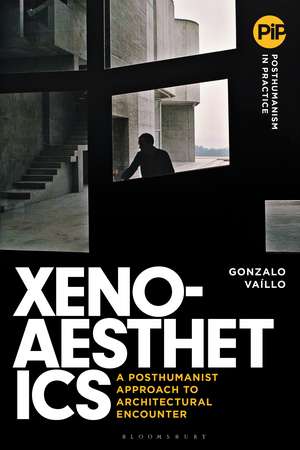
Xenoaesthetics
Autor Gonzalo Vaillo Editat de Matthew Hayler, Danielle Sands, Christine Daigleen Limba Engleză Hardback – 8 iun 2026
Drawing together insights from philosophy and architecture, this book delves into the conditions, roles, and implications of architectural encounters, conceptualising the architectural project as a site of unity-multiplicity tension, and introducing the concept of xenoaesthetics as a cognitive mode attuned to this structure. This approach invites readers to reimagine architectural experience as a dual action that reveals the project to us and realizes itself through us.
As well as implying disciplinary consequences for design questions, Vaillo's work holds socio-political significance for our everyday architectural interactions, contributing to the quest for practices and discourses on equality. Methodologically, his argument draws from Object-Oriented Ontology and the architect Enric Miralles, offering an additional retrospective crossover that enriches both references.
A resource for students, architects, scholars, and enthusiasts interested in exploring architecture beyond assumptions and prescribed value systems, Xenoaesthetics encourages a deeper understanding of the intricate relationship between humans and the architectural project.
Preț: 524.05 lei
Preț vechi: 790.74 lei
-34% Precomandă
Puncte Express: 786
Preț estimativ în valută:
92.68€ • 109.89$ • 80.69£
92.68€ • 109.89$ • 80.69£
Carte nepublicată încă
Doresc să fiu notificat când acest titlu va fi disponibil:
Se trimite...
Specificații
ISBN-13: 9781350515031
ISBN-10: 1350515035
Pagini: 304
Ilustrații: 10 bw illus
Dimensiuni: 28 x 28 x 28 mm
Greutate: 0.45 kg
Editura: BLOOMSBURY ACADEMIC
Locul publicării:London, United Kingdom
ISBN-10: 1350515035
Pagini: 304
Ilustrații: 10 bw illus
Dimensiuni: 28 x 28 x 28 mm
Greutate: 0.45 kg
Editura: BLOOMSBURY ACADEMIC
Locul publicării:London, United Kingdom
Cuprins
Prologue by Graham Harman
Acknowledgements
Introduction
Part I: The Xenological Framework
1. The Architectural Project as Object
2. The Cognitive-unit
3. The Xenoaesthetic Approach
Part II: Deep cognition
4. The Immaterial Experience of Unity
5. The Role of the Cognizer
6. Vertical techne
Part III: Open Cognition
7. The Infrastructure of Experience
8. Designing
9. Inhabiting
Conclusion
Bibliography
Acknowledgements
Introduction
Part I: The Xenological Framework
1. The Architectural Project as Object
2. The Cognitive-unit
3. The Xenoaesthetic Approach
Part II: Deep cognition
4. The Immaterial Experience of Unity
5. The Role of the Cognizer
6. Vertical techne
Part III: Open Cognition
7. The Infrastructure of Experience
8. Designing
9. Inhabiting
Conclusion
Bibliography