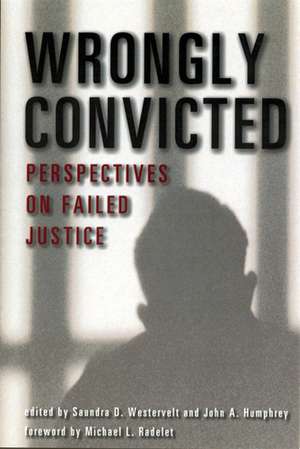
Wrongly Convicted: Perspectives on Failed Justice: Critical Issues in Crime and Society
Editat de Saundra D. Westervelt, Professor John A Humphrey Cuvânt înainte de Professor Michael L Radeleten Limba Engleză Paperback – iun 2001 – vârsta ani
The American criminal justice system contains numerous safeguards to prevent the conviction of innocent persons. The Bill of Rights provides nineteen separate rights for the alleged criminal offender, including the right to effective legal representation and the right to be judged without regard to race or creed. Despite these safeguards, wrongful convictions persist, and the issue has reverberated in the national debate over capital punishment.
The essays in this volume are written from a cross-disciplinary perspective by some of the most eminent lawyers, criminologists, and social scientists in the field today. The articles are divided into four sections: the causes of wrongful convictions, the social characteristics of the wrongly convicted, case studies and personal histories, and suggestions for changes in the criminal justice system to prevent wrongful convictions. Contributors examine a broad range of issues, including the fallibility of eyewitness testimony, particularly in cross-racial identifications; the disadvantages faced by racial and ethnic minorities in the criminal justice system; and the impact of new technologies, especially DNA evidence, in freeing the innocent and bringing the guilty to justice. The book also asks such questions as: What legal characteristics do wrongful convictions share? What are the mechanisms that defendants and their attorneys use to overturn wrongful convictions? The book also provides case studies that offer specific examples of what can and does go wrong in the criminal justice system.
The essays in this volume are written from a cross-disciplinary perspective by some of the most eminent lawyers, criminologists, and social scientists in the field today. The articles are divided into four sections: the causes of wrongful convictions, the social characteristics of the wrongly convicted, case studies and personal histories, and suggestions for changes in the criminal justice system to prevent wrongful convictions. Contributors examine a broad range of issues, including the fallibility of eyewitness testimony, particularly in cross-racial identifications; the disadvantages faced by racial and ethnic minorities in the criminal justice system; and the impact of new technologies, especially DNA evidence, in freeing the innocent and bringing the guilty to justice. The book also asks such questions as: What legal characteristics do wrongful convictions share? What are the mechanisms that defendants and their attorneys use to overturn wrongful convictions? The book also provides case studies that offer specific examples of what can and does go wrong in the criminal justice system.
Din seria Critical Issues in Crime and Society
- 19%
 Preț: 430.85 lei
 -
 Preț: 275.56 lei
 -
 Preț: 177.92 lei
 -
 Preț: 154.31 lei
 - 19%
 Preț: 672.87 lei
 -
 Preț: 182.48 lei
 -
 Preț: 343.64 lei
 -
 Preț: 303.03 lei
 -
 Preț: 253.77 lei
 -
 Preț: 271.55 lei
 - 27%
 Preț: 794.65 lei
 -
 Preț: 264.82 lei
 -
 Preț: 275.07 lei
 -
 Preț: 275.02 lei
 - 27%
 Preț: 799.71 lei
 -
 Preț: 300.95 lei
 -
 Preț: 294.05 lei
 -
 Preț: 267.23 lei
 -
 Preț: 270.46 lei
 -
 Preț: 297.51 lei
 -
 Preț: 303.03 lei
 -
 Preț: 304.34 lei
 -
 Preț: 299.64 lei
 -
 Preț: 254.87 lei
 -
 Preț: 278.93 lei
 -
 Preț: 486.90 lei
 -
 Preț: 400.87 lei
 -
 Preț: 304.34 lei
 -
 Preț: 277.28 lei
 -
 Preț: 295.20 lei
 - 27%
 Preț: 796.36 lei
 -
 Preț: 276.17 lei
 -
 Preț: 271.55 lei
 -
 Preț: 296.30 lei
 - 27%
 Preț: 795.58 lei
 -
 Preț: 326.78 lei
Preț: 210.53 lei
Preț vechi: 291.69 lei
-28%
Puncte Express: 316
Preț estimativ în valută:
37.27€ • 43.40$ • 32.38£
37.27€ • 43.40$ • 32.38£
Carte indisponibilă temporar
Doresc să fiu notificat când acest titlu va fi disponibil:
Se trimite...
Preluare comenzi: 021 569.72.76
Specificații
ISBN-13: 9780813529523
ISBN-10: 0813529522
Pagini: 301
Dimensiuni: 152 x 229 x 20 mm
Greutate: 0.51 kg
Ediția:None
Editura: Rutgers University Press
Colecția Rutgers University Press
Seria Critical Issues in Crime and Society
ISBN-10: 0813529522
Pagini: 301
Dimensiuni: 152 x 229 x 20 mm
Greutate: 0.51 kg
Ediția:None
Editura: Rutgers University Press
Colecția Rutgers University Press
Seria Critical Issues in Crime and Society
Notă biografică
SAUNDRA D. WESTERVELT is an assistant professor of sociology at the University of North Carolina at Greensboro and is author of Shifting the Blame: How Victimization Became a Criminal Defense (Rutgers University Press).
JOHN A. HUMPHREY is a professor of sociology at the University of North Carolina at Greensboro and coauthor of Deviant Behavior and The Administration of Justice.
JOHN A. HUMPHREY is a professor of sociology at the University of North Carolina at Greensboro and coauthor of Deviant Behavior and The Administration of Justice.
Recenzii
The contributors to this collection discuss the many ways in which innocent criminal defendants can be convicted in a system that places great emphasis on protecting them. Some involve culpability: brutal or racially biased police and other officials, treacherous informants, and incompetent attorneys. . . . Recommended for upper-division undergraduates, graduate students, and faculty.
An all-star set of contributors and clearly written essays make this a worthwhile addition to anti-death penalty literatures. Westervelt and Humphrey take a practical approach to the topic. Essays in Part 1 show that eyewitnesses are often wrong, police trick suspects into making confessions, informants lie to gain benefits, and police can be incompetent or venal. Part 2 argues that those who are unpopular, uneducated, or members of a racial minority invite harsher treatment by authorities. The next section offers case studies on convictions that were wrongly obtained. . . . This excellent introduction to a controversial topic is highly recommended.
A very powerful addition to the debate on capital punishment.
Descriere
The American criminal justice system contains numerous safeguards to prevent the conviction of innocent persons. The Bill of Rights provides nineteen separate rights for the alleged criminal offender. Despite these safeguards, wrongful convictions persist, and the issue has reverberated in the national debate over capital punishment. The essays in this volume are written from a cross-disciplinary perspective by some of the most eminent lawyers, criminologists, and social scientists in the field today. The most important single characteristic among wrongful conviction cases, the contributors argue, is chronic denial of the existence of a problem by politicians and prosecutors and their failure to act decisively when evidence of a possible wrongful conviction comes to light.