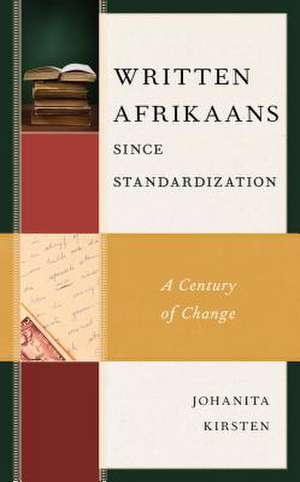
Written Afrikaans since Standardization: A Century of Change
Autor Johanita Kirstenen Limba Engleză Hardback – 14 feb 2019
Preț: 610.60 lei
Preț vechi: 913.13 lei
-33%
Puncte Express: 916
Carte tipărită la comandă
Livrare economică 21 noiembrie-05 decembrie
Livrare prin curier în România Termenul estimat este afișat lângă disponibilitate.
Transport gratuit pentru acest produs Plată online sau ramburs, în funcție de opțiunile comenzii.
Retur gratuit în 14 zile Comandă securizată și suport în română.
Specificații
ISBN-13: 9781498577205
ISBN-10: 1498577202
Pagini: 264
Ilustrații: 5 BW Illustrations, 12 BW Photos, 43 Tables
Dimensiuni: 162 x 232 x 22 mm
Greutate: 0.53 kg
Editura: Bloomsbury Publishing
Colecția Lexington Books
Locul publicării:New York, United States
ISBN-10: 1498577202
Pagini: 264
Ilustrații: 5 BW Illustrations, 12 BW Photos, 43 Tables
Dimensiuni: 162 x 232 x 22 mm
Greutate: 0.53 kg
Editura: Bloomsbury Publishing
Colecția Lexington Books
Locul publicării:New York, United States
Cuprins
Acknowledgements
List of Tables
List of Figures
List of Abbreviations
Chapter 1: Introduction
Chapter 2: The Theory of Language Change
Chapter 3: Afrikaans Standardization in Context
Chapter 4: Diachronic Corpus Linguistics
Chapter 5: Paradigmatic Changes
Chapter 6: Grammaticalization
Chapter 7: Discursive and Socio-Cultural Changes
Chapter 8: Conclusion
References
List of Tables
List of Figures
List of Abbreviations
Chapter 1: Introduction
Chapter 2: The Theory of Language Change
Chapter 3: Afrikaans Standardization in Context
Chapter 4: Diachronic Corpus Linguistics
Chapter 5: Paradigmatic Changes
Chapter 6: Grammaticalization
Chapter 7: Discursive and Socio-Cultural Changes
Chapter 8: Conclusion
References
Recenzii
Written Afrikaans since Standardization is a descriptive study at its core, but also eloquently succeeds to tie descriptive insights to more general theoretical insights. In as such, it is certainly an authoritative book that is not only relevant to scholars interested in Afrikaans, but also researchers interested in the general theme of language change. This ground-breaking corpus linguistic study of historical Afrikaans data is a welcoming and worthy addition to the small body of English literature on Afrikaans. Kirsten's articulate scholarly style, together with her painstaking and elaborate analyses make for a convincing and compelling read. Kirsten's work is inspiring to other authors. The corpus she has created, has already been used by numerous other scholars in their work on grammatical change. I will most definitely use the book as a seminal work in Afrikaans, and I can imagine that I will quote from it extensively in future.
In Written Afrikaans since Standardization: A Century of Change by Johanita Kirsten various themes from the 20th century development of Afrikaans in its written form are explored against the background of theories of language change, and meticulously tested against four corpora spanning the period from 1911 to 2010. In Chapter 2 the most important theories of language change are discussed in considerable depth. In Chapter 3 new perspectives are opened on the standardization of Afrikaans against the background of recent studies of standardization as a world-wide phenomenon. Chapter 4 is an explication of the methodology applicable to the construction and interpretation of linguistic corpora, with special reference to the problems presented by the Afrikaans data. The themes discussed are typologically subsumed under paradigmatic changes (Chapter 5), grammaticalization (Chapter 6) and discursive and socio-cultural changes (Chapter 7). For instance, in Chapter 5 changes in the pronominal system are extensively discussed. In Chapter 6, the development of the Afrikaans se genitive is analyzed from the point of view of grammaticalization. The most important complementizers of Afrikaans are discussed in Chapter 7 from the perspective of colloquialization vs formalization. Finally, this book is proof that new knowledge and perspectives can be opened up by rigorously subjecting hypotheses to the appropriate corpora.
Dr. Kirsten's book is a major contribution to Afrikaans historical linguistics. At one level, it tracks syntactic change in written Afrikaans from its establishment as a literary medium in the early decades of the twentieth century through the first decade of twenty-first century. The author's corpus-based analysis, deploying quantitative methods, sheds light on language structure in actual use and its connection to language change. At another level, it advances our understanding of a standard language culture in motion, the story of which has been characterized by intense language contact, the racial separation of mother-tongue users, nationalist aspirations on the part of one user group, stigmatization, a strong tradition of purism, and a radically altered landscape in post-apartheid South Africa.
In Written Afrikaans since Standardization: A Century of Change by Johanita Kirsten various themes from the 20th century development of Afrikaans in its written form are explored against the background of theories of language change, and meticulously tested against four corpora spanning the period from 1911 to 2010. In Chapter 2 the most important theories of language change are discussed in considerable depth. In Chapter 3 new perspectives are opened on the standardization of Afrikaans against the background of recent studies of standardization as a world-wide phenomenon. Chapter 4 is an explication of the methodology applicable to the construction and interpretation of linguistic corpora, with special reference to the problems presented by the Afrikaans data. The themes discussed are typologically subsumed under paradigmatic changes (Chapter 5), grammaticalization (Chapter 6) and discursive and socio-cultural changes (Chapter 7). For instance, in Chapter 5 changes in the pronominal system are extensively discussed. In Chapter 6, the development of the Afrikaans se genitive is analyzed from the point of view of grammaticalization. The most important complementizers of Afrikaans are discussed in Chapter 7 from the perspective of colloquialization vs formalization. Finally, this book is proof that new knowledge and perspectives can be opened up by rigorously subjecting hypotheses to the appropriate corpora.
Dr. Kirsten's book is a major contribution to Afrikaans historical linguistics. At one level, it tracks syntactic change in written Afrikaans from its establishment as a literary medium in the early decades of the twentieth century through the first decade of twenty-first century. The author's corpus-based analysis, deploying quantitative methods, sheds light on language structure in actual use and its connection to language change. At another level, it advances our understanding of a standard language culture in motion, the story of which has been characterized by intense language contact, the racial separation of mother-tongue users, nationalist aspirations on the part of one user group, stigmatization, a strong tradition of purism, and a radically altered landscape in post-apartheid South Africa.