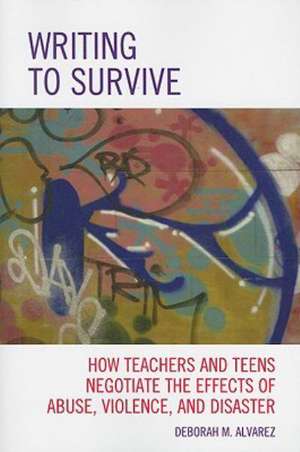
Writing to Survive: How Teachers and Teens Negotiate the Effects of Abuse, Violence, and Disaster
Autor Deborah M. Alvarezen Limba Engleză Paperback – 16 feb 2011
Alvarez outlines an alternative Expressivist plan for teaching writing to adolescents. This writing program builds upon the evidence from the case studies, brain theory and research on traumatic stresses to offer teachers and thereby their students a more effective way to teach writing with greater impact for those who need it most.
| Toate formatele și edițiile | Preț | Express |
|---|---|---|
| Paperback (1) | 329.63 lei 6-8 săpt. | |
| Bloomsbury Publishing – 16 feb 2011 | 329.63 lei 6-8 săpt. | |
| Hardback (1) | 551.39 lei 6-8 săpt. | |
| Bloomsbury Publishing – 16 feb 2011 | 551.39 lei 6-8 săpt. |
Preț: 329.63 lei
Preț vechi: 423.41 lei
-22%
Puncte Express: 494
Preț estimativ în valută:
58.34€ • 68.18$ • 50.65£
58.34€ • 68.18$ • 50.65£
Carte tipărită la comandă
Livrare economică 19 februarie-05 martie
Preluare comenzi: 021 569.72.76
Specificații
ISBN-13: 9781607097846
ISBN-10: 1607097842
Pagini: 269
Dimensiuni: 155 x 234 x 17 mm
Greutate: 0.43 kg
Editura: Bloomsbury Publishing
Colecția R&L Education
Locul publicării:New York, United States
ISBN-10: 1607097842
Pagini: 269
Dimensiuni: 155 x 234 x 17 mm
Greutate: 0.43 kg
Editura: Bloomsbury Publishing
Colecția R&L Education
Locul publicării:New York, United States
V-ar putea interesa
-
 -20%Preț: 284.49 lei355.85 lei
 -
 The Psychology of EducationMartyn Long-20%Preț: 287.49 lei357.51 lei
 -
 Psychology for the Classroom: BehaviourismJohn Woollard-25%Preț: 178.89 lei239.03 lei
 -
 -21%Preț: 277.10 lei351.79 lei
 -
 Educational Psychology: Concepts, Research and ChallengesChristine M. Rubie-Davies-21%Preț: 266.79 lei336.90 lei
 -
 -17%Preț: 362.49 lei435.75 lei
 -
 -28%Preț: 352.99 lei493.28 lei
 -
 Developmental Cognitive Science Goes to SchoolNancy L. Stein-15%Preț: 411.63 lei484.27 lei
 -
 Constructivist Instruction: Success or Failure?Sigmund Tobias-26%Preț: 385.40 lei519.47 lei
 -
 Preț: 122.06 lei
 -
 Making Thinking VisibleRon RitchhartPreț: 181.13 lei
 -
 Theory of Mind: Beyond the Preschool YearsScott A. Miller-17%Preț: 345.41 lei417.40 lei
 -
 The Anti-Bullying HandbookKeith SullivanPreț: 395.57 lei
Cuprins
Chapter 1 Writing to Survive
Chapter 2 Research Methodology for Prairie High School
Chapter 3 Danielle- "I'm Safe Now."
Chapter 4 Chase - "When I am Happy, I Have No Problems Thinking"
Chapter 5 Diana -"Hell of a Life, Isn't It?"
Chapter 6 Research Methodology in New Orleans Public High Schools
Chapter 7 Lydia - "In Then I New My Friend was Dead."
Chapter 8 Tyrone - "Doing Me is What I Do Best"
Chapter 9 Writing Across Trauma, Tragedy and Adolescence
Chapter 2 Research Methodology for Prairie High School
Chapter 3 Danielle- "I'm Safe Now."
Chapter 4 Chase - "When I am Happy, I Have No Problems Thinking"
Chapter 5 Diana -"Hell of a Life, Isn't It?"
Chapter 6 Research Methodology in New Orleans Public High Schools
Chapter 7 Lydia - "In Then I New My Friend was Dead."
Chapter 8 Tyrone - "Doing Me is What I Do Best"
Chapter 9 Writing Across Trauma, Tragedy and Adolescence
Recenzii
In her compelling book, Writing to Survive, Deborah Alvarez demonstrates that high school students not only can but do use writing to navigate the confusing, dangerous, and emotionally and physically challenging experiences that many adolescents endure. Professor Alvarez understands that affective responses that are connected to thinking through language cannot be ignored in the educational process if we want that process to be successful. As she demonstrates with the voices of the young people she researched, the more desperate the situation, the more students need to empower themselves through creative uses of language. Every high school teacher should read this book.
Debra Alvarez's Writing to Survive is a stellar and timely book. In this complex age of radical change it is critical to enable students to survive such 'storms' as we have not yet imagined. Professor Alvarez makes a case for the value of 'expressivist writing' in English classrooms, demonstrating what happens when we use the English classroom productively to help our students not only to survive-but to thrive-by meeting the challenges of an uncertain world-in sum, teaching students to confront increasingly frequent personal, natural, and national disasters with appropriate written tools for expression.
Grounded in qualitative methods dominated by ethnography, case study, and poststructuralist interpretive styles, Alvarez (Univ. of Delaware) shares her research on five traumatized adolescents and their compensatory literacy strategies in their English language high school classes. Alvarez states the thesis of the book is that "the private violences and public disasters [Katrina] affect adolescents' ability to learn, and the trauma and stresses alter the ways in which adolescents construct literacy--called compensatory strategies." After a detailed description of literacy, writing, compensatory strategies, adolescent crises, social constructivism, modern brain theory, trauma, and her research design, Alvarez presents five case studies on the power of writing for adolescents traumatized by personal violence or a natural disaster. In the final chapter, Alvarez proposes a writing pedagogy, neo-expressivist, for all adolescents. The appendixes present additional details from the case studies, a class schedule, writing from three of the adolescents, a persuasive speech assessment, a hurricane information survey, and an English IV literacy portfolio project. The extensive bibliography clarifies works cited in the book.
Debra Alvarez's Writing to Survive is a stellar and timely book. In this complex age of radical change it is critical to enable students to survive such 'storms' as we have not yet imagined. Professor Alvarez makes a case for the value of 'expressivist writing' in English classrooms, demonstrating what happens when we use the English classroom productively to help our students not only to survive-but to thrive-by meeting the challenges of an uncertain world-in sum, teaching students to confront increasingly frequent personal, natural, and national disasters with appropriate written tools for expression.
Grounded in qualitative methods dominated by ethnography, case study, and poststructuralist interpretive styles, Alvarez (Univ. of Delaware) shares her research on five traumatized adolescents and their compensatory literacy strategies in their English language high school classes. Alvarez states the thesis of the book is that "the private violences and public disasters [Katrina] affect adolescents' ability to learn, and the trauma and stresses alter the ways in which adolescents construct literacy--called compensatory strategies." After a detailed description of literacy, writing, compensatory strategies, adolescent crises, social constructivism, modern brain theory, trauma, and her research design, Alvarez presents five case studies on the power of writing for adolescents traumatized by personal violence or a natural disaster. In the final chapter, Alvarez proposes a writing pedagogy, neo-expressivist, for all adolescents. The appendixes present additional details from the case studies, a class schedule, writing from three of the adolescents, a persuasive speech assessment, a hurricane information survey, and an English IV literacy portfolio project. The extensive bibliography clarifies works cited in the book.