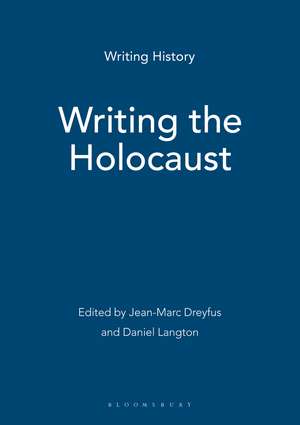
Writing the Holocaust: Writing History
Autor Dr Jean-Marc Dreyfus, Dr Daniel Langtonen Limba Engleză Paperback – sep 2011
Holocaust studies is at a paradox: while historians of the Holocaust defend it as a legitimate and well-defined area of research, they write against a complex political and ideological background that undermines any claim for it as a normative field of historical study. Writing the Holocaust offers a lucid enquiry into this complex field by demonstrating the impact of current theories from the humanities and social sciences upon the treatment of Holocaust studies.
Din seria Writing History
- 25%
 Preț: 183.63 lei
 - 21%
 Preț: 183.08 lei
 - 18%
 Preț: 148.37 lei
 - 16%
 Preț: 186.10 lei
 - 16%
 Preț: 182.16 lei
 - 22%
 Preț: 183.15 lei
 -
 Preț: 203.55 lei
 - 22%
 Preț: 181.66 lei
 - 16%
 Preț: 284.19 lei
 - 22%
 Preț: 213.66 lei
 - 14%
 Preț: 229.33 lei
 - 25%
 Preț: 197.00 lei
 - 17%
 Preț: 192.59 lei
 - 24%
 Preț: 195.88 lei
 - 25%
 Preț: 180.66 lei
 - 24%
 Preț: 197.79 lei
 - 22%
 Preț: 221.05 lei
 - 22%
 Preț: 205.87 lei
 -
 Preț: 223.82 lei
 -
 Preț: 213.20 lei
Preț: 213.66 lei
Puncte Express: 320
Carte tipărită la comandă
Livrare economică 05-19 decembrie
Livrare prin curier în România Termenul estimat este afișat lângă disponibilitate.
Transport gratuit de la 400.00 lei Plată online sau ramburs, în funcție de opțiunile comenzii.
Retur gratuit în 14 zile Comandă securizată și suport în română.
Specificații
ISBN-13: 9780340991893
ISBN-10: 0340991895
Pagini: 256
Ilustrații: None
Dimensiuni: 150 x 232 x 14 mm
Greutate: 0.34 kg
Editura: Bloomsbury Publishing
Colecția Bloomsbury Academic
Seria Writing History
Locul publicării:London, United Kingdom
ISBN-10: 0340991895
Pagini: 256
Ilustrații: None
Dimensiuni: 150 x 232 x 14 mm
Greutate: 0.34 kg
Editura: Bloomsbury Publishing
Colecția Bloomsbury Academic
Seria Writing History
Locul publicării:London, United Kingdom
Cuprins
Introduction/ Sociology/ Psychiatry/ Cinematic Representations of the Holocaust/ Psychoanalysis/ Theology/ Gender/ Jewish History/ Comparative Genocide/ The Body/ Museums
Recenzii
This diversity in theoretical perspectives and the way each of them confronts and addresses the Holocaust results in a highly readable and accessible introduction to the field of Holocaust studies. In all articles the reader is introduced to the developments, trends and major debates within the respective disciplines regarding the writing of the history of the Holocaust during the last 60 years. Besides, at the end of each chapter there is a short list with suggestions for further reading, which offers the reader the possibility to further dive into the subject s/he is interested in...In conclusion, the volume gives a good overview of how the thinking about ways to deal with the Holocaust has progressed. It is highly useful for scholars who want to take it as a basis to find out what literature has been published in the field of Holocaust writing, what perspectives have been taken, what problems have been debated, and what is the current state of the art. It is a broad overview and offers many openings for those who want to dig deeper into the material.