
Writing Science in the Twenty-First Century
Autor Christopher Thaissen Limba Engleză Paperback – 8 aug 2019
Preț: 362.70 lei
Preț vechi: 412.70 lei
-12%
Puncte Express: 544
Preț estimativ în valută:
64.14€ • 76.05$ • 55.85£
64.14€ • 76.05$ • 55.85£
Carte disponibilă
Livrare economică 10-24 martie
Specificații
ISBN-13: 9781554813049
ISBN-10: 1554813042
Pagini: 275
Dimensiuni: 152 x 229 x 19 mm
Greutate: 0.6 kg
Editura: BROADVIEW PR
Colecția Broadview Press
Locul publicării:Peterborough, Canada
ISBN-10: 1554813042
Pagini: 275
Dimensiuni: 152 x 229 x 19 mm
Greutate: 0.6 kg
Editura: BROADVIEW PR
Colecția Broadview Press
Locul publicării:Peterborough, Canada
V-ar putea interesa
-
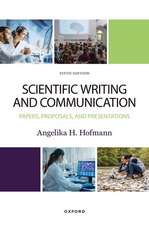 Scientific Writing and CommunicationAngie Hofmann-8%Preț: 436.77 lei474.76 lei
 -
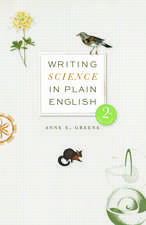 Writing Science in Plain English, Second EditionAnne E. GreenePreț: 126.98 lei
 -
 Preț: 108.31 lei
 -
 Preț: 105.75 lei
 -
 Teaching and Mentoring Writers in the Sciences: An Evidence-Based ApproachBethann Garramon MerklePreț: 151.02 lei
 -
 Sharing Our ScienceBrandon R Brown-24%Preț: 131.91 lei172.66 lei
 -
 Preț: 214.73 lei
 -
 -5%Preț: 262.69 lei276.52 lei
 -
 -13%Preț: 497.31 lei571.63 lei
 -
 -12%Preț: 105.96 lei120.60 lei
 -
 Writing for Science StudentsJennifer Boyle-18%Preț: 118.07 lei143.60 lei
 -
 Writing for Biomedical Sciences StudentsHarry Witchel-25%Preț: 126.84 lei169.62 lei
 -
 Writing Graphic Novels for DummiesKensuke OkabayashiPreț: 109.85 lei
 -
 Preț: 132.43 lei
 -
 The Mad Scientist’s Guide to Composition - MLA 2021 UpdateJeffrey Andrew WeinstockPreț: 201.17 lei
 -
 Writing and Presenting Scientific PapersBirgitta MalmforsPreț: 188.07 lei
 -
 Life Sciences Research and Scientific WritingBenno ter Kuile-5%Preț: 219.27 lei230.81 lei
 -
 -15%Preț: 221.33 lei261.85 lei
 -
 Scientific Writing 3.0: A Reader and Writer's GuideJean-Luc LebrunPreț: 268.18 lei
Recenzii
Writing Science in the Twenty-First Century offers guidance to help writers succeed in a broad range of writing tasks and purposes in science and other STEM fields. Concise and current, the book takes most of its examples and lessons from scientific fields such as the life sciences, chemistry, physics, and geology, but some examples are taken from mathematics and engineering. The book emphasizes building confidence and rhetorical expertise in fields where diverse audiences, high ethical stakes, and multiple modes of presentation provide unique writing challenges. Using a systematic approach—assessing purpose, audience, order of information, tone, evidence, and graphics—it gives readers a clear road map to becoming accurate, persuasive, and rhetorically savvy writers.
“In Writing Science in the Twenty-First Century, Christopher Thaiss combines rhetorical and process approaches to instruct readers in the constantly evolving art of scientific writing. Thaiss’s rhetorical focus also informs the helpful exercises guiding students through the recursive and interactive writing process he promotes. Emphasizing the growing pre-eminence of digital and multimodal writing, Thaiss includes lively chapters on texts as generically diverse as the traditional journal article, Twitter postings, and online infographics. For each of these genres, Thaiss analyzes professional models to show students exactly how writers achieve rhetorical effects like ‘audience splitting’ and ethos building. He extends this granular analysis to each section, teaching readers effectively how to make persuasive, ethical scientific arguments. With its conversational, coach-like tone, the book will be accessible for any undergraduate.” — Leslie Bruce, WAC Director, California State University, Fullerton
“Science communication in the twenty-first century requires a sophisticated repertoire of rhetorical strategies in order to communicate with diverse audiences across a variety of genres and media. Thaiss deploys the 2000-year-old tradition of rhetoric in discussions of familiar and emerging genres. Covering the scientific research article, abstracts, and other well-established genres, he provides a strong foundational text for students of science communication. For the twenty-first century, the proliferation of science-focused blogs, tweets, and even infographics provides a good introduction to how science is communicated online. Writing Science in the Twenty-First Century packages the explanatory power of rhetoric in a manner digestible for those new to the field, showing the importance of purpose, audience, style, ethics, and other foundational rhetorical principles.” — Ashley Rose Mehlenbacher, University of Waterloo
“In Writing Science in the Twenty-First Century, Christopher Thaiss combines rhetorical and process approaches to instruct readers in the constantly evolving art of scientific writing. Thaiss’s rhetorical focus also informs the helpful exercises guiding students through the recursive and interactive writing process he promotes. Emphasizing the growing pre-eminence of digital and multimodal writing, Thaiss includes lively chapters on texts as generically diverse as the traditional journal article, Twitter postings, and online infographics. For each of these genres, Thaiss analyzes professional models to show students exactly how writers achieve rhetorical effects like ‘audience splitting’ and ethos building. He extends this granular analysis to each section, teaching readers effectively how to make persuasive, ethical scientific arguments. With its conversational, coach-like tone, the book will be accessible for any undergraduate.” — Leslie Bruce, WAC Director, California State University, Fullerton
“Science communication in the twenty-first century requires a sophisticated repertoire of rhetorical strategies in order to communicate with diverse audiences across a variety of genres and media. Thaiss deploys the 2000-year-old tradition of rhetoric in discussions of familiar and emerging genres. Covering the scientific research article, abstracts, and other well-established genres, he provides a strong foundational text for students of science communication. For the twenty-first century, the proliferation of science-focused blogs, tweets, and even infographics provides a good introduction to how science is communicated online. Writing Science in the Twenty-First Century packages the explanatory power of rhetoric in a manner digestible for those new to the field, showing the importance of purpose, audience, style, ethics, and other foundational rhetorical principles.” — Ashley Rose Mehlenbacher, University of Waterloo
Cuprins
Acknowledgments
INTRODUCTION : Writing Science for New Readers, with New Technologies, in New Genres
ONE : Writing to Reach Readers
TWO : Building Experience and Confidence in Writing Science
THREE : “Writing” Redefined Multimodally
FOUR : Writing Science Ethically
FIVE : Writing the Research Article, Part I: Abstract, Introduction, and Methods and Materials
SIX : Writing the Research Article, Part II: Results and Discussion
SEVEN : Writing the Research Review
EIGHT : STEM Journalism—Writing, Reading, and Connecting with Broader Audiences
NINE : Science Blogs—New Readers, New Voices, New Tools
TEN : Creating Posters and Infographics
ELEVEN : Creating Oral-Visual Presentations
TWELVE : Writing Science with Style and Styles
THIRTEEN : Editing Sentences
Reference List
Permissions Acknowledgments
Index
INTRODUCTION : Writing Science for New Readers, with New Technologies, in New Genres
ONE : Writing to Reach Readers
TWO : Building Experience and Confidence in Writing Science
THREE : “Writing” Redefined Multimodally
FOUR : Writing Science Ethically
FIVE : Writing the Research Article, Part I: Abstract, Introduction, and Methods and Materials
SIX : Writing the Research Article, Part II: Results and Discussion
SEVEN : Writing the Research Review
EIGHT : STEM Journalism—Writing, Reading, and Connecting with Broader Audiences
NINE : Science Blogs—New Readers, New Voices, New Tools
TEN : Creating Posters and Infographics
ELEVEN : Creating Oral-Visual Presentations
TWELVE : Writing Science with Style and Styles
THIRTEEN : Editing Sentences
Reference List
Permissions Acknowledgments
Index