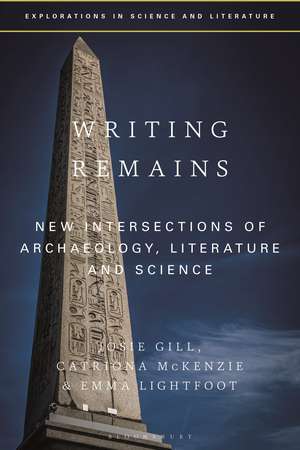
Writing Remains: New Intersections of Archaeology, Literature and Science: Explorations in Science and Literature
Editat de Dr Josie Gill, Dr Catriona McKenzie, Dr Emma Lightfooten Limba Engleză Paperback – 30 iun 2022
The book's eight chapters explore a wide array of archaeological approaches and methods, including scientific archaeology, identifying intersections with literature and literary studies which are textual, conceptual, spatial, temporal and material. Examining literary authors from Thomas Hardy and Bram Stoker to Sarah Moss and Paul Beatty, scholars from across disciplines are brought into dialogue to consider fictional narrative both as a site of new archaeological knowledge and as a source and object of archaeological investigation.
| Toate formatele și edițiile | Preț | Express |
|---|---|---|
| Paperback (1) | 203.09 lei 6-8 săpt. | |
| Bloomsbury Publishing – 30 iun 2022 | 203.09 lei 6-8 săpt. | |
| Hardback (1) | 584.18 lei 6-8 săpt. | |
| Bloomsbury Publishing – 28 ian 2021 | 584.18 lei 6-8 săpt. |



Preț: 203.09 lei
Preț vechi: 215.84 lei
-6%
Puncte Express: 305
Preț estimativ în valută:
35.94€ • 42.01$ • 31.20£
35.94€ • 42.01$ • 31.20£
Carte tipărită la comandă
Livrare economică 20 februarie-06 martie
Preluare comenzi: 021 569.72.76
Specificații
ISBN-13: 9781350202511
ISBN-10: 1350202517
Pagini: 248
Ilustrații: 5 bw illus
Dimensiuni: 156 x 234 mm
Greutate: 0.35 kg
Editura: Bloomsbury Publishing
Colecția Bloomsbury Academic
Seria Explorations in Science and Literature
Locul publicării:London, United Kingdom
ISBN-10: 1350202517
Pagini: 248
Ilustrații: 5 bw illus
Dimensiuni: 156 x 234 mm
Greutate: 0.35 kg
Editura: Bloomsbury Publishing
Colecția Bloomsbury Academic
Seria Explorations in Science and Literature
Locul publicării:London, United Kingdom
Cuprins
List of Figures
List of Tables
Introduction: New Intersections of Archaeology, Literature and Science. Josie Gill, University of Bristol, UK, Catriona McKenzie, University of Exeter, UK and Emma Lightfoot, University of Cambridge, UK
Genetics and Human Inheritance
1. New Materialism, Archaeogenetics and Tracing the Human. Jerome de Groot, University of Manchester, UK
2. Jack London and Before Adam: Ahead of his Time, or a Cautionary Tale in the Study of Prehistoric Hominins? James Walker, University of Bradford, UK and David Clinnick, St Mary's College of California, USA
Innovations in Practice through Collaborative Projects
3. 'Handle with Care': Literature, Archaeology, Slavery. Josie Gill, Catriona McKenzie and Emma Lightfoot
4. Creative Facticity and 'Hyper-Archaeology': The Spatial and Performative Textualities of Psychogeography. Spencer Jordan, University of Nottingham, UK
Literature, Archaeology and Layering the Past
5. Deciphering the City: Ancient Egypt in Victorian London and Psychogeographical Archaeology. Eleanor Dobson, University of Birmingham, UK
6. From the Great Castle of the Hill to the Great Mound on the River: Imperialism and Transatlantic Archaeology in Thomas Hardy's 'Ancient Earthworks'. Anna West, independent scholar
Narrative Archaeology and the Narratives of Archaeologists
7. Something More than Imagination: Archaeology and Fiction. Robert E.Witcher, Durham University, UK and Daniël P. van Helden, University of Leicester, UK
8. The Death of the Archaeologist: Imagining Science, Storytelling and Self-Understanding in Contemporary Archaeofiction. Anna Auguscik, University og Oldenburg, Germany
Index
List of Tables
Introduction: New Intersections of Archaeology, Literature and Science. Josie Gill, University of Bristol, UK, Catriona McKenzie, University of Exeter, UK and Emma Lightfoot, University of Cambridge, UK
Genetics and Human Inheritance
1. New Materialism, Archaeogenetics and Tracing the Human. Jerome de Groot, University of Manchester, UK
2. Jack London and Before Adam: Ahead of his Time, or a Cautionary Tale in the Study of Prehistoric Hominins? James Walker, University of Bradford, UK and David Clinnick, St Mary's College of California, USA
Innovations in Practice through Collaborative Projects
3. 'Handle with Care': Literature, Archaeology, Slavery. Josie Gill, Catriona McKenzie and Emma Lightfoot
4. Creative Facticity and 'Hyper-Archaeology': The Spatial and Performative Textualities of Psychogeography. Spencer Jordan, University of Nottingham, UK
Literature, Archaeology and Layering the Past
5. Deciphering the City: Ancient Egypt in Victorian London and Psychogeographical Archaeology. Eleanor Dobson, University of Birmingham, UK
6. From the Great Castle of the Hill to the Great Mound on the River: Imperialism and Transatlantic Archaeology in Thomas Hardy's 'Ancient Earthworks'. Anna West, independent scholar
Narrative Archaeology and the Narratives of Archaeologists
7. Something More than Imagination: Archaeology and Fiction. Robert E.Witcher, Durham University, UK and Daniël P. van Helden, University of Leicester, UK
8. The Death of the Archaeologist: Imagining Science, Storytelling and Self-Understanding in Contemporary Archaeofiction. Anna Auguscik, University og Oldenburg, Germany
Index
Recenzii
Drawing on fields as diverse as archaeogenetics and narrative theory, Writing Remains is a much-needed, truly interdisciplinary excavation of the rich ground where archaeology and literature meet. Moving well beyond the conventional treatment of archaeology as metaphor, the editors persuasively argue for the ethical function of literary and archaeological narrative in examining not only the past but also what it means to be human. With special attention to the role of race in these narratives, Writing Remains has a special urgency for our own time.