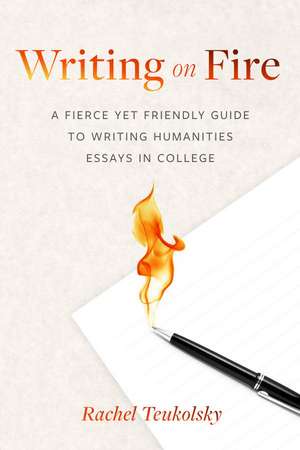
Writing on Fire: A Fierce Yet Friendly Guide to Writing Humanities Essays in College
Autor Rachel Teukolskyen Limba Engleză Paperback – 30 aug 2024
Preț: 193.06 lei
Preț vechi: 249.56 lei
-23%
Puncte Express: 290
Carte disponibilă
Livrare economică 02-16 noiembrie
Livrare express 16-22 octombrie pentru 90.62 lei
Livrare prin curier în România Termenul estimat este afișat lângă disponibilitate.
Transport gratuit de la 400.00 lei Plată online sau ramburs, în funcție de opțiunile comenzii.
Retur gratuit în 14 zile Comandă securizată și suport în română.
Specificații
ISBN-13: 9781554816644
ISBN-10: 1554816645
Pagini: 366
Dimensiuni: 152 x 203 x 18 mm
Greutate: 0.49 kg
Editura: BROADVIEW PR
Colecția Broadview Press
Locul publicării:Peterborough, Canada
ISBN-10: 1554816645
Pagini: 366
Dimensiuni: 152 x 203 x 18 mm
Greutate: 0.49 kg
Editura: BROADVIEW PR
Colecția Broadview Press
Locul publicării:Peterborough, Canada
Recenzii
What’s the best way to write a paper that analyzes a novel, a poem, a work of art, a film, or a set of historical documents? Writing on Fire focuses intensively on the fundamentals of writing college humanities papers. Each chapter offers tips, tricks, and templates that students won’t find anywhere else. The book speaks directly to young writers in language that’s fun and accessible, and is designed to work in the classroom, in the dorm room, or at the kitchen table—anywhere that writing work takes place.
“In Writing on Fire, Rachel Teukolsky asserts that real writing, by real humans, matters. Her wise and useful guide for college writers speaks to them as equal partners in the humanistic mission. If you are invested in what you write, she says, your writing will have the power to engage and change minds. Teukolsky’s tone is approachable, practical, and personal. With a light touch, she shows students that it is both possible and desirable to move beyond the reductive transaction of papers for grades. I’m looking forward to including this book in my undergraduate writing classes.” — Megan A. Stephan, University of California Los Angeles
“There are a lot of books out there that teach students how to analyze works of literature and how to write about them, but I know of none that are so focused on the practical details of the writing and revising process: from how to recognize patterns and generate ideas to how to write a thesis, organize a paragraph, and structure a larger argument—and finally, if necessary, how to blow it all up and start over. For the student, Teukolsky’s book will be like having your favorite teacher at your elbow, coaching you at every step of the way. For the instructor, it’s a Swiss Army knife, a resource for teaching courses in multiple genres, across the humanities, and at every level from introductory surveys to senior seminars.” — Brooke Conti, Cleveland State University
“In Writing on Fire, Rachel Teukolsky asserts that real writing, by real humans, matters. Her wise and useful guide for college writers speaks to them as equal partners in the humanistic mission. If you are invested in what you write, she says, your writing will have the power to engage and change minds. Teukolsky’s tone is approachable, practical, and personal. With a light touch, she shows students that it is both possible and desirable to move beyond the reductive transaction of papers for grades. I’m looking forward to including this book in my undergraduate writing classes.” — Megan A. Stephan, University of California Los Angeles
“There are a lot of books out there that teach students how to analyze works of literature and how to write about them, but I know of none that are so focused on the practical details of the writing and revising process: from how to recognize patterns and generate ideas to how to write a thesis, organize a paragraph, and structure a larger argument—and finally, if necessary, how to blow it all up and start over. For the student, Teukolsky’s book will be like having your favorite teacher at your elbow, coaching you at every step of the way. For the instructor, it’s a Swiss Army knife, a resource for teaching courses in multiple genres, across the humanities, and at every level from introductory surveys to senior seminars.” — Brooke Conti, Cleveland State University
Cuprins
Acknowledgements
Note to Instructors
Part One: Basic Assumptions
Index
Note to Instructors
Part One: Basic Assumptions
- 1. Why We’re Here: The Art of the Essay
- 2. What Is an Argument?
- 3. Your Reader: Not Just Your Professor, but Also Your Roommate
- 4. Keywords: Defining the Paper’s Themes and Sub-Themes
- 5. Close-Reading: The Power of a Single Word
- 6. Drafting: A Few Techniques for Assembling Your Paper
- 7. How to Analyze a Novel
- 8. How to Analyze a Poem
- 9. How to Analyze a Play
- 10. How to Analyze a Film
- 11. How to Analyze Historical Documents
- 12. How to Analyze a Work of Visual Art
- 13. The Introduction: The Most Important Thing You Will Ever Write
- 14. Thesis Statement: Make Us Care
- 15. Structure I: Ordering Your Ideas
- 16. Structure II: Ordering Compare/Contrast and Research Papers
- 17. Paragraph: Chiseling the Paper’s Building Blocks
- 18. Quotation: Managing Other People’s Words
- 19. Evidence: What to Put Inside Your Paragraphs
- 20. Counter-Argument: Finessing Your Analysis
- 21. Diction and Tone: Creating Your Persona as a Writer
- 22. Revision: Don’t Be Afraid to Tear it All Up
- 23. Style: Sentences of Force and Beauty
- 24. Paper Title: Surprisingly Important
- 25. The Conclusion: Making It Memorable
- 26. A Sample Essay, Dissected
Index