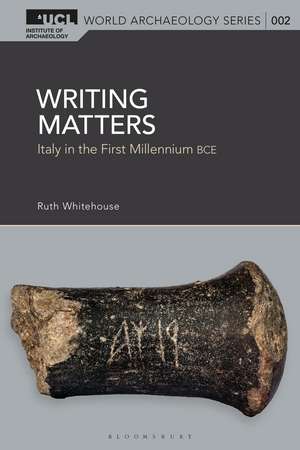
Writing Matters: Italy in the First Millennium BCE: UCL World Archaeology Series
Autor Professor Ruth Whitehouseen Limba Engleză Paperback – 30 apr 2026
Această monografie academică, semnată de Professor Ruth Whitehouse, propune o schimbare de paradigmă în studiul epigrafiei Italiei din primul mileniu î.Hr. Dacă abordările tradiționale s-au concentrat predominant pe lingvistică și descifrarea sensurilor semantice, Writing Matters introduce o metodologie holistică. Suntem de părere că noutatea absolută a volumului rezidă în plasarea „materialității” în centrul analizei: scrisul nu este privit doar ca un cod de comunicare, ci ca un obiect fizic, integrat în contexte arheologice specifice și pe suporturi materiale care îi influențează semnificația.
Structura volumului este una riguroasă, debutând cu o tipologie materială și avansând spre analize interpretative complexe. Capitolul dedicat abordării de tip „chaîne opératoire” este esențial pentru înțelegerea procesului de producție, în timp ce secțiunile despre gen și „fetișizarea” scrisului oferă perspective sociologice inedite asupra comunităților indigene. Comparabil cu A History of Earliest Italy (Routledge Revivals) de Missimo Pallottino în ceea ce privește rigoarea istorică, volumul de față este actualizat pentru cerințele arheologiei contemporane, punând un accent mult mai mare pe interacțiunea dintre obiect, text și identitatea socială.
Analizând date despre grupuri precum etruscii, veneții sau mesapii, autoarea reușește să identifice atât trăsături comune ale utilizării alfabetelor introduse de fenicieni și greci, cât și idiosincrazii locale. Putem afirma că lucrarea completează lacunele lăsate de manualele generale, precum The Oxford Handbook of Pre-Roman Italy (1000--49 BCE), oferind un studiu de caz aprofundat asupra modului în care scrierea a modelat viața cotidiană înainte de hegemonia latină.
Preț: 200.01 lei
Preț vechi: 271.24 lei
-26% Precomandă
Carte nepublicată încă
Specificații
ISBN-10: 135041252X
Pagini: 296
Ilustrații: 62 bw illus
Dimensiuni: 152 x 232 x 14 mm
Greutate: 0.44 kg
Editura: Bloomsbury Publishing
Colecția Bloomsbury Academic
Seria UCL World Archaeology Series
Locul publicării:London, United Kingdom
De ce să citești această carte
Recomandăm această carte cercetătorilor și studenților la arheologie sau istorie antică. Cititorul câștigă o înțelegere profundă a modului în care scrierea a funcționat ca tehnologie socială în Italia pre-romană. Este o lectură esențială pentru cei care doresc să depășească simpla traducere a textelor vechi, învățând să descifreze relația complexă dintre artefact, contextul descoperirii și mesajul scris.
Descriere
The first writing in Italy was not a local invention, but was introduced by the Phoenicians and Greeks in the 9th-8th centuries BCE. It was taken up by number of indigenous communities over the subsequent centuries to write their own languages, before these were eventually submerged by the spread of Latin.
In a series of theoretical, methodological and interpretative essays, Ruth Whitehouse explores what can be learned about how writing was used by these communities and what it meant to them. The bodies of data considered relate to Venetic and Raetic (the northeast), Lepontic (the northwest), Messapic (the southeast) and Etruscan (west central Italy, extending also into Campania in the south and the Po plain in the north). While not a comprehensive survey, there are enough different groups to allow a comparative approach to be adopted. Analysis of the datasets is able to reveal the similarities and differences between them, as well as identify features that were widespread in 1st-millennium-BCE Italy and others that were more idiosyncratic and specific to particular cultural groups. Placing materiality at the centre of study allows a reconsideration of the roles writing played in the lives of the individuals and groups who occupied Italy in the 1st millennium BCE.
Cuprins
List of Tables
Acknowledgements
Prologue
1. Introduction
2. Approaches to the Study of Writing
3. A Material Typology
4. Archaeological Context, Materiality and Content in the Italian Databases
5. Agency and Production: A Chaîne Opératoire Approach
6. What Difference Does Writing Make?
7. Objects That Speak
8. The Fetishisation of Writing
9. What's in a Name?
10. Gender, Writing and Objects
11. Writing in Society
12. Conclusions
Bibliography
Index