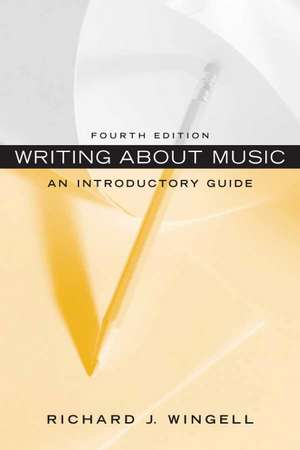
Writing about Music: An Introductory Guide
Autor Richard Wingellen Limba Engleză Paperback – 31 dec 2007
Preț: 703.44 lei
Preț vechi: 913.56 lei
-23%
Puncte Express: 1055
Carte tipărită la comandă
Livrare economică 04-18 iunie
Specificații
ISBN-13: 9780136157786
ISBN-10: 0136157785
Pagini: 190
Dimensiuni: 162 x 229 x 8 mm
Greutate: 0.25 kg
Ediția:4Nouă
Editura: Prentice Hall
Locul publicării:Upper Saddle River, United States
ISBN-10: 0136157785
Pagini: 190
Dimensiuni: 162 x 229 x 8 mm
Greutate: 0.25 kg
Ediția:4Nouă
Editura: Prentice Hall
Locul publicării:Upper Saddle River, United States
V-ar putea interesa
-
 The Penguin Writer's ManualMartin Manser-20%Preț: 71.17 lei89.13 lei
 -
 Preț: 236.57 lei
 -
 Preț: 227.97 lei
 -
 How to Write Dissertations & Project ReportsJonathan WeyersPreț: 135.73 lei
 -
 The AuthorAndrew BennettPreț: 199.26 lei
 -
 Writing a Dissertation for Dummies, UK EditionCarrie WinstanleyPreț: 94.18 lei
 -
 Writing Essays for Dummies, UK EditionMary PagePreț: 92.46 lei
 -
 Finding The Funny FastJan McInnisPreț: 99.16 lei
 -
 -18%Preț: 156.21 lei190.29 lei
 -
 -27%Preț: 75.88 lei103.65 lei
 -
 Essay Writing: A Student's GuideMunLing ShieldsPreț: 230.06 lei
 -
 Perfect Written EnglishChris WestPreț: 68.39 lei
 -
 -29%Preț: 80.77 lei114.31 lei
 -
 Preț: 83.75 lei
Descriere
For classes in Music Writing and Research, as well as a supplement to Music Appreciation and History courses.
How do you put into the words the experience of hearing Beethoven’s Ninth or the Hallelujah Chorus? Describe a John Coltrane solo or the Jimi Hendrix’s blazing guitar work? For many students, the task of writing about musical experiences is a daunting one. Writing About Music, 4/e offers practical advice and guidance to help students master the special skills needed to write about this most-elusive of arts. The text serves as a guide for each phase in the process of researching and writing a paper on a musical topic, and preparing for other projects such as seminar presentations, concert reports, program notes and essay examinations. Innovative, comprehensive, and internet-savvy, this step-by-step text will remain on music students’ shelves as a handy reference and resource for years to come.
How do you put into the words the experience of hearing Beethoven’s Ninth or the Hallelujah Chorus? Describe a John Coltrane solo or the Jimi Hendrix’s blazing guitar work? For many students, the task of writing about musical experiences is a daunting one. Writing About Music, 4/e offers practical advice and guidance to help students master the special skills needed to write about this most-elusive of arts. The text serves as a guide for each phase in the process of researching and writing a paper on a musical topic, and preparing for other projects such as seminar presentations, concert reports, program notes and essay examinations. Innovative, comprehensive, and internet-savvy, this step-by-step text will remain on music students’ shelves as a handy reference and resource for years to come.
Cuprins
Preface to The Fourth Edition
Purpose of the Fourth Edition
Changes in the Fourth Edition
Other Resources
How to Use This Book
Conclusion
Chapter 1. Writing about Music Why We Write about Music
The Special Challenges of Writing about Music
Inappropriate Ways to Write about Music
Musicological Research and Writing
Chapter 2. Analysis and Research Analysis
Questions to Consider
Examples of Works and Research Directions
Carlo Gesualdo: “Moro, lasso”
J. S. Bach: Opening Chorus of Cantata No. 80, Ein’ feste Burg ist unser Gott
W. A. Mozart: Concerto for Piano and Orchestra in C Minor, K. 491, First Movement
Giuseppe Verdi: Otello, Act I, Scene 3
Franz Liszt: “Faust” Symphony, First Movement
Igor Stravinsky: The Rite of Spring, Opening Sections
Karlheinz Stockhausen: Gesang der Jünglinge
Chapter 3. Getting Started: Research Choosing a Topic
Kinds of Topics
What Research Means
Gathering Materials
Places to Start: Print Resources
Library Catalogues
Dictionaries and Encyclopedias
Histories of Music
Biographies
Thematic Catalogues
Articles
Dissertations
Scores and Recordings
Places to Start: Electronic Resources
Search Engines
Databases
Lexicons
Online Journals
JSTOR
Evaluating Resources
Foreign-Language Resources
When to Stop: How Much Research Is Enough?
Chapter 4. Writing a Research Paper The Outline
Topic and Thesis
Topic Outline versus Sentence Outline
Introduction
Body
Conclusion
Revising the Outline
Writing the Draft
Musical Examples
Diagrams, Graphics, and Tables
Footnotes
Bibliography
Revising and Editing the Draft
Computers and Editing
Checking Spelling and Grammar
The Editing Process
Printing
Proofreading
Keep Your File
Quotation, Paraphrase, and Plagiarism
Conclusion
Chapter 5. Questions of Format Format for College Papers
Paper
Page Format
Fonts
Spacing
Justification
Page Numbers
Format for Quotations
Short Quotations
Block Quotations
Ellipsis and Editorial Additions
Bibliography and Footnote Form: Humanities Style
Books
Additional Notes for Both Bibliography Entries and Footnotes
Dissertations
Articles in Dictionaries and Encyclopedias
Articles in Periodicals
Notes
Notes on Articles in Lexicons
Articles in Collections of Essays
Scores
Sound Recordings
Citing Interviews, Correspondence, etc.
Citing Electronic resources
The Author-Date System of Citation
Reference Lists (Lists of Works Cited)
Parenthetical Citations in the Text
Format Issues Related to Writing about Music
Stylistic Periods
Referring to Centuries
Referring to Musical Works
Naming Notes and Keys
Foreign terms
Musical Examples
Conclusion
Chapter 6. Other Kinds of Writing Projects
Seminar Presentations
Research
Organizing the Presentation
Tone and Approach
Concert Reports
Purpose
Research
Writing the Report
Program Notes
Purpose
Who is the Audience?
Research
Working within Limits
Special Problems
Texts and Translations
Conclusion
Essay Examinations
Purpose
Preparing for Essay Examinations
How to Proceed
Common Errors
Conclusion
Chapter 7. Writing Style
Some Basic Ideas about Writing
Different Kinds of Prose
Tone
The Stance of the Writer
Referring to Yourself
Writing Effective Sentences
Word Choice
Word Combinations
Sentence Structure
Effective Paragraphs
The Effective Essay
Introduction
Transitions
Conclusion
Summary
Chapter 8. Common Writing Problems Errors in Basic Grammar and Writing
Incomplete Sentences
Run-on Sentences
Agreement: Subject and Verb
Agreement: Pronoun and Antecedent
Proper Cases of Pronouns
Relative Pronouns
Misplaced Modifiers
The Split Infinitive
Mixed Metaphors
Spelling Issues
Using a Dictionary
Forming Possessives
Plurals of Borrowed Latin and Greek Words
Foreign Words
Medieval and Renaissance Names
Some Troublesome Word Pairs
Its and It’s
Your and You’re
Whose andWho’s
Affect and Effect
Due to andBecause of
Fewer and Less
Like andSuch as
Predominant andPredominate
Principal andPrinciple
Punctuation
The Period
The Comma
The Semicolon
The Colon
Quotation Marks
The Hyphen
The Dash
Parentheses
Special Problems Involved in Writing about Music
Technical Terms
Describing Musical Events
Summary
CONCLUSION
APPENDIX: SAMPLE PAPER
INDEX
Purpose of the Fourth Edition
Changes in the Fourth Edition
Other Resources
How to Use This Book
Conclusion
Chapter 1. Writing about Music Why We Write about Music
The Special Challenges of Writing about Music
Inappropriate Ways to Write about Music
Musicological Research and Writing
Chapter 2. Analysis and Research Analysis
Questions to Consider
Examples of Works and Research Directions
Carlo Gesualdo: “Moro, lasso”
J. S. Bach: Opening Chorus of Cantata No. 80, Ein’ feste Burg ist unser Gott
W. A. Mozart: Concerto for Piano and Orchestra in C Minor, K. 491, First Movement
Giuseppe Verdi: Otello, Act I, Scene 3
Franz Liszt: “Faust” Symphony, First Movement
Igor Stravinsky: The Rite of Spring, Opening Sections
Karlheinz Stockhausen: Gesang der Jünglinge
Chapter 3. Getting Started: Research Choosing a Topic
Kinds of Topics
What Research Means
Gathering Materials
Places to Start: Print Resources
Library Catalogues
Dictionaries and Encyclopedias
Histories of Music
Biographies
Thematic Catalogues
Articles
Dissertations
Scores and Recordings
Places to Start: Electronic Resources
Search Engines
Databases
Lexicons
Online Journals
JSTOR
Evaluating Resources
Foreign-Language Resources
When to Stop: How Much Research Is Enough?
Chapter 4. Writing a Research Paper The Outline
Topic and Thesis
Topic Outline versus Sentence Outline
Introduction
Body
Conclusion
Revising the Outline
Writing the Draft
Musical Examples
Diagrams, Graphics, and Tables
Footnotes
Bibliography
Revising and Editing the Draft
Computers and Editing
Checking Spelling and Grammar
The Editing Process
Printing
Proofreading
Keep Your File
Quotation, Paraphrase, and Plagiarism
Conclusion
Chapter 5. Questions of Format Format for College Papers
Paper
Page Format
Fonts
Spacing
Justification
Page Numbers
Format for Quotations
Short Quotations
Block Quotations
Ellipsis and Editorial Additions
Bibliography and Footnote Form: Humanities Style
Books
Additional Notes for Both Bibliography Entries and Footnotes
Dissertations
Articles in Dictionaries and Encyclopedias
Articles in Periodicals
Notes
Notes on Articles in Lexicons
Articles in Collections of Essays
Scores
Sound Recordings
Citing Interviews, Correspondence, etc.
Citing Electronic resources
The Author-Date System of Citation
Reference Lists (Lists of Works Cited)
Parenthetical Citations in the Text
Format Issues Related to Writing about Music
Stylistic Periods
Referring to Centuries
Referring to Musical Works
Naming Notes and Keys
Foreign terms
Musical Examples
Conclusion
Chapter 6. Other Kinds of Writing Projects
Seminar Presentations
Research
Organizing the Presentation
Tone and Approach
Concert Reports
Purpose
Research
Writing the Report
Program Notes
Purpose
Who is the Audience?
Research
Working within Limits
Special Problems
Texts and Translations
Conclusion
Essay Examinations
Purpose
Preparing for Essay Examinations
How to Proceed
Common Errors
Conclusion
Chapter 7. Writing Style
Some Basic Ideas about Writing
Different Kinds of Prose
Tone
The Stance of the Writer
Referring to Yourself
Writing Effective Sentences
Word Choice
Word Combinations
Sentence Structure
Effective Paragraphs
The Effective Essay
Introduction
Transitions
Conclusion
Summary
Chapter 8. Common Writing Problems Errors in Basic Grammar and Writing
Incomplete Sentences
Run-on Sentences
Agreement: Subject and Verb
Agreement: Pronoun and Antecedent
Proper Cases of Pronouns
Relative Pronouns
Misplaced Modifiers
The Split Infinitive
Mixed Metaphors
Spelling Issues
Using a Dictionary
Forming Possessives
Plurals of Borrowed Latin and Greek Words
Foreign Words
Medieval and Renaissance Names
Some Troublesome Word Pairs
Its and It’s
Your and You’re
Whose andWho’s
Affect and Effect
Due to andBecause of
Fewer and Less
Like andSuch as
Predominant andPredominate
Principal andPrinciple
Punctuation
The Period
The Comma
The Semicolon
The Colon
Quotation Marks
The Hyphen
The Dash
Parentheses
Special Problems Involved in Writing about Music
Technical Terms
Describing Musical Events
Summary
CONCLUSION
APPENDIX: SAMPLE PAPER
INDEX
Caracteristici
- Customized Guidance throughout the writing process, starting with choosing a topic, designing an outline, writing the draft, through what research means, incorporating musical examples, revising and proofreading to the completion of a final, quality paper.
- Extensively Updated with several new additions that include important recent works such as Burkholder, Bonds, Wright and Simms, lexicon and multivolume histories revisions, and exciting new links to key internet resources.
- A Flexible and Efficient Approach allows the text to serve as a useful reference tool for instructors and students seeking advice and reference on research and writing issues.
- A Unique Span of Coverage that includes a guide to writing styles and common writing errors, sample papers and questions that help portray the teaching material clearly, and important print and electronic resources for music research.
- Dynamic and User-Friendly Style makes this a market leading text for undergraduate students of music, but useful to all students, including new graduate students, and those enrolled in introductory appreciation and history courses.
Caracteristici noi
- NEW — Invaluable Electronic & Print Resources include the revised one-volume, lexicon and multivolume histories now accessible online. Students are connected to online journals and databases previously available only on CD-ROM, and key resources like Grove Music Online and JSTOR that make current encyclopedia articles, full texts of back issued articles in scholarly journals, and scores readily available online.
- NEW — Resourceful Revisions and Additions on advising how to avoid plagiarism in a digital age, using the new author-date system of citation, formatting for citing electronic resources, updated references to the Chicago Manual of Style, and a list of entertaining educational references to guides like, Eats, Shoots and Leaves for students to learn and enjoy.
- NEW — Scope of Discussion has been expanded to include material on musical works in relation to analytical approaches and broader cultural topics. Works like Stockhausen’s Gesang der Junglinge illustrates ways to approach research related to a modernist work.
- NEW — Critical Thinking Section recognizes the importance of critical thinking in the learning process, and its relevance to research and writing at the undergraduate level.