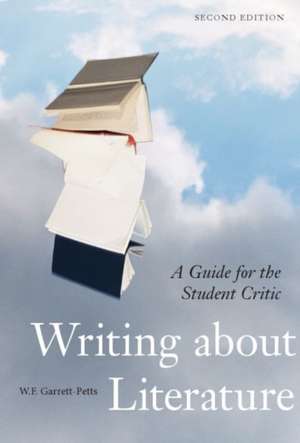
Writing about Literature - Second Edition: A Guide for the Student Critic
Autor W.F. Garrett-Pettsen Limba Engleză Paperback – 13 iun 2013
Much of the discussion is structured around ways to analyze and respond to a single work, Stephen Crane’s story “The Bride Comes to Yellow Sky.” This second edition is updated throughout and includes a new chapter on “Reading and Writing About Poetry”; the chapter uses Robert Kroetsch’s poem “This Part of the Country” as the unit of analysis and includes an interview with the poet about his process.
Preț: 222.58 lei
Preț vechi: 286.94 lei
-22%
Puncte Express: 334
Carte disponibilă
Livrare economică 31 octombrie-14 noiembrie
Livrare prin curier în România Termenul estimat este afișat lângă disponibilitate.
Transport gratuit de la 400.00 lei Plată online sau ramburs, în funcție de opțiunile comenzii.
Retur gratuit în 14 zile Comandă securizată și suport în română.
Specificații
ISBN-13: 9781551117430
ISBN-10: 1551117436
Pagini: 200
Dimensiuni: 152 x 229 x 12 mm
Greutate: 0.34 kg
Ediția:Revised
Editura: BROADVIEW PR
Colecția Broadview Press
Locul publicării:Peterborough, Canada
ISBN-10: 1551117436
Pagini: 200
Dimensiuni: 152 x 229 x 12 mm
Greutate: 0.34 kg
Ediția:Revised
Editura: BROADVIEW PR
Colecția Broadview Press
Locul publicării:Peterborough, Canada
V-ar putea interesa
-
 The Logic of Pronominal ResumptionAsh Asudeh-21%Preț: 536.04 lei679.28 lei
 -
 Semantic Analysis: A Practical IntroductionCliff Goddard-10%Preț: 392.52 lei436.76 lei
 -
 Donald Davidson's Truth-Theoretic SemanticsErnest Lepore-21%Preț: 512.81 lei651.87 lei
 -
 Negative IndefinitesDoris Penka-23%Preț: 503.75 lei651.56 lei
 -
 Language and StyleDan McIntyrePreț: 347.51 lei
 -
 SemanticsKate Kearns-23%Preț: 258.55 lei337.21 lei
 -
 Political Discourse Analysis: A Method for Advanced StudentsIsabela Fairclough-15%Preț: 441.31 lei519.19 lei
 -
 Preț: 431.15 lei
 -
 Meaning and HumourAndrew GoatlyPreț: 247.82 lei
 -
 StylisticsLesley JeffriesPreț: 282.16 lei
 -
 Meaning and RelevanceDeirdre WilsonPreț: 436.11 lei
 -
 Critical Discourse Analysis: The Critical Study of LanguageNorman FaircloughPreț: 395.74 lei
 -
 Contemporary StylisticsProfessor Marina Lambrou-37%Preț: 236.37 lei373.88 lei
 -
 Preț: 91.22 lei
 -
 Discourse StudiesTeun A. van Dijk-8%Preț: 525.49 lei571.18 lei
Recenzii
Writing about Literature introduces students to critical reading and writing through a thorough and engaging discussion of the field, but also through exercises, interviews, exemplary student and scholarly essays, and visual material. It offers students an insider’s guide to the language, issues, approaches, styles, assumptions, and traditions that inform the writing of successful critical essays, and aims to make student writers a part of the world of professional literary criticism.
Much of the discussion is structured around ways to analyze and respond to a single work, Stephen Crane’s story “The Bride Comes to Yellow Sky.” This second edition is updated throughout and includes a new chapter on “Reading and Writing About Poetry”; the chapter uses Robert Kroetsch’s poem “This Part of the Country” as the unit of analysis and includes an interview with the poet about his process.
“I have used Writing about Literature a number of times to great success. As it progressively takes students from being uninformed readers of a literary text to becoming engaged critics in conversation with advanced scholars, it provides an invaluable framework for introducing students to the fundamental goals and techniques of critical writing, the kinds of issues that critics explore and evidence that they use, strategies for presenting and organizing critical arguments, and the necessity of revision in the writing of criticism. This new edition’s section on writing about poetry will certainly broaden the appeal of the book to students and instructors.” — Paul C. Jones, Ohio University
“Covering topics from close reading to theory, and from visually mapping drafts to final revisions, this book is ideal for introductory courses in literature or composition. But Writing about Literature does more than serve as a guide for students seeking to become careful readers and clear writers: it teaches them how to be students at university and scholars in the field. The addition of poetry in the second edition widens the scope of the book in terms of genre and methodologies, while it retains the deep conceptional framework of the first.” — Emily Kugler, Colby College
Praise for the first edition:
“For every student who has stared hopelessly at a blank screen, waiting for a literary essay miraculously to appear; and for every instructor who has looked upon a set of just-graded student essays with a sense of failure verging on despair—this book offers immediate help.” — Andrea Lunsford, Stanford University
Much of the discussion is structured around ways to analyze and respond to a single work, Stephen Crane’s story “The Bride Comes to Yellow Sky.” This second edition is updated throughout and includes a new chapter on “Reading and Writing About Poetry”; the chapter uses Robert Kroetsch’s poem “This Part of the Country” as the unit of analysis and includes an interview with the poet about his process.
“I have used Writing about Literature a number of times to great success. As it progressively takes students from being uninformed readers of a literary text to becoming engaged critics in conversation with advanced scholars, it provides an invaluable framework for introducing students to the fundamental goals and techniques of critical writing, the kinds of issues that critics explore and evidence that they use, strategies for presenting and organizing critical arguments, and the necessity of revision in the writing of criticism. This new edition’s section on writing about poetry will certainly broaden the appeal of the book to students and instructors.” — Paul C. Jones, Ohio University
“Covering topics from close reading to theory, and from visually mapping drafts to final revisions, this book is ideal for introductory courses in literature or composition. But Writing about Literature does more than serve as a guide for students seeking to become careful readers and clear writers: it teaches them how to be students at university and scholars in the field. The addition of poetry in the second edition widens the scope of the book in terms of genre and methodologies, while it retains the deep conceptional framework of the first.” — Emily Kugler, Colby College
Praise for the first edition:
“For every student who has stared hopelessly at a blank screen, waiting for a literary essay miraculously to appear; and for every instructor who has looked upon a set of just-graded student essays with a sense of failure verging on despair—this book offers immediate help.” — Andrea Lunsford, Stanford University
Cuprins
Acknowledgements
Preface to the Second Edition—to the Instructor
Getting Started: From Personal Response to Field Stance
Reading and Responding to Stephen Crane’s “The Bride Comesto Yellow Sky”
Writing the Critical Essay: Form and the Critical Process
Model Essays
Reading and Writing about Poetry
Some Final Words on Writing about Literature
Resources for Further Study
Works Cited
Index
Preface to the Second Edition—to the Instructor
- Initiating Students into Literary Study
A Brief History of English Studies
This Book’s Form and Philosophy
- What Is Academic Discourse?
A Method for Learning Academic Discourse
How to Use This Book
Getting Started: From Personal Response to Field Stance
- Overview
Writing Is Rhetorical
Documenting Your Personal Response
How to Use Your Personal Response
Box 1.1: Field Notes from Critical Theory andPsycholinguistics: “How We Read”
Becoming a Literacy Researcher
New Contexts for Reading and Writing - The Social Stance
The Institutional Stance
The Textual Stance - Box 1.2: Field Notes from Composition Studies: The Five-Paragraph Theme
- The Field Stance
- Summary: Why It Is so Important to Become Aware of All Four Stances
Box 1.3: Field Notes from Linguistics: The Effect of Context on Reading
An Interview with a Literary Critic
Exercises
Reading and Responding to Stephen Crane’s “The Bride Comesto Yellow Sky”
- Overview
Response Notes
The Critical Conversation
Box 2.1: Field Notes from Literary Criticism: How Readers Have Responded to Crane’s “The Bride Comes to Yellow Sky”
“Fielding” Some Questions
Exercises
Writing the Critical Essay: Form and the Critical Process
- Overview
Form
Box 3.1: Field Notes from the Visual Arts: Visual Mapping Exercises
How to Move from an “F” to an “A”: Modelling the Process - Writing and Rewriting
Commentary - The Six Common Places of Literary Criticism
- Contemptus Mundi and Complexity
Appearance/Reality
Everywhereness
Paradigm
Paradox - Critical Approaches
- Formalism: New Criticism and Deconstruction
Reader-Response Criticism
Cultural Criticism - Finding a Place for Your Interpretation in the CriticalConversation
Exercises
Model Essays
- Student Essays
- Michelle Demers
Ryan Miller
Lydia Marston - Professional Essays
- Alice Farley
Katherine Sutherland
Harold H. Kolb, Jr. - Exercises
Reading and Writing about Poetry
- Overview
Some Opening Thoughts about Poetry - “Poetry Should Not Mean / But Be”
- Reading a Poem
- “This Part of the Country”
Entering into the Poem - An Interview with a Poet
Exercises
A Critical Tool Kit for Writing about Poetry - Caedmon’s Hymn
Box 5.1: Field Notes from a Literary Critic: Anglo-SaxonAccentual Meter - Re-entering into the Poem
- Parts of a Poem
Types of Feet
Types of Rhythm
Types of Rhyme
Types of Poetic Device - Integrating Quotations
How to Move from an “F” to an “A”: Modelling theProcess - Commentary
- Box 5.2: Field Notes from a Writing Teacher: Thirteen Ways ofThinking about a Poem
Complete Texts for the Poems Referenced in This Chapter - “Sonnet 116”
“A Valediction Forbidding Mourning”
“On His Blindness”
“To His Coy Mistress”
“Ode on a Grecian Urn”
“My Last Duchess”
“Come Down, O Maid”
“O Captain! My Captain!”
Some Final Words on Writing about Literature
- Four Critics Speak on Their Personal Approaches to Critical Writing
- Alice Farley
Katherine Sutherland
Michael Jarrett
Helen Gilbert
Resources for Further Study
Works Cited
Index