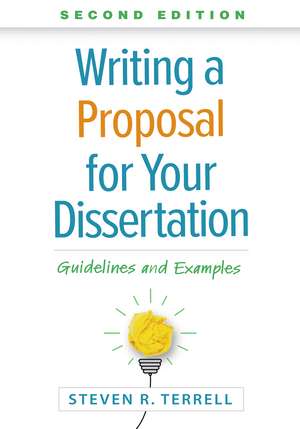
Writing a Proposal for Your Dissertation, Second Edition: Guidelines and Examples
Autor Steven R. Terrellen Limba Engleză Hardback – 13 oct 2022
Interdisciplinaritatea stă la baza volumului Writing a Proposal for Your Dissertation, Second Edition, o resursă concepută să sprijine studenții din domenii diverse, de la psihologie și științe sociale până la sănătate publică și educație. Putem afirma că forța acestui ghid rezidă în capacitatea de a traduce rigoarea academică în pași executabili, oferind exemple concrete din realitatea contemporană, precum studiile privind impactul COVID-19 sau metodele de reducere a recidivei infracționale. Reținem că această a doua ediție nu este doar o actualizare, ci o recalibrare a procesului de scriere, punând un accent sporit pe diferențierea dintre sursele primare și cele secundare în cadrul recenziei literaturii.
Structura cărții urmărește progresia logică a unei propuneri de cercetare, de la definirea problemei și formularea ipotezelor, până la planuri detaliate pentru colectarea datelor. Capitolele dedicate metodologiilor cantitative, calitative și mixte sunt completate de exerciții de tipul „Let's Start Writing”, care transformă teoria în fragmente de text gata de a fi integrate în manuscris. Considerăm acest titlu o alternativă solidă la How to Design, Write, and Present a Successful Dissertation Proposal de Elizabeth A. Wentz pentru cursurile de metodologie, având avantajul major de a include îndrumări specifice atât pentru modelul de dizertație cu cinci capitole, cât și pentru cel cu patru, adaptându-se astfel cerințelor variate ale facultăților moderne. În plus, anexele oferă modele de propuneri scrise în trei variante metodologice diferite, oferind claritate acolo unde manualele standard rămân adesea la nivel teoretic.
Preț: 349.21 lei
Preț vechi: 464.20 lei
-25%
Carte indisponibilă temporar
Specificații
ISBN-10: 1462550258
Pagini: 320
Dimensiuni: 178 x 254 x 23 mm
Greutate: 0.86 kg
Ediția:2nd edition
Editura: Guilford Publications
Colecția Guilford Press
De ce să citești această carte
Această carte este instrumentul ideal pentru doctoranzii care se simt blocați în faza de proiectare a cercetării. Cititorul câștigă o structură clară și instrumente de autoevaluare care reduc anxietatea paginii albe. Este o recomandare esențială deoarece transformă scrierea propunerii dintr-o sarcină abstractă într-un proces dirijat, oferind siguranța că metodologia aleasă este corect fundamentată și argumentată în fața comisiei.
Despre autor
Steven R. Terrell este un expert recunoscut în metodologii de cercetare, cu o vastă experiență în ghidarea studenților la nivel doctoral. Activitatea sa se concentrează pe simplificarea conceptelor complexe de design de cercetare, fiind un promotor al metodelor mixte. Prin publicațiile sale la Guilford Press, acesta a sprijinit mii de studenți să depășească obstacolele birocratice și academice ale redactării tezei, punând accent pe claritatea argumentației și pe rigoarea analizei datelor în științele sociale și comportamentale.
Cuprins
1. Developing the Problem Statement for Your Dissertation Proposal
2. Writing Purpose Statements, Research Questions, and Hypotheses
3. Writing the Review of Literature for Your Dissertation Proposal
4. The First Part of Your Dissertation Research Method
5. Quantitative Research Methods
6. Qualitative Research Methods
7. Mixed Methods Research Designs
Epilogue: Have We Accomplished What We Set Out to Do?
Appendix A. Progress Check for Chapter 1 of a Dissertation Proposal: The Introduction
Appendix B. Progress Check for Chapter 2 of a Dissertation Proposal: The Review of Literature
Appendix C. Progress Check for Chapter 3 of a Quantitative Dissertation Proposal
Appendix D. Progress Check for Chapter 3 of a Qualitative Dissertation Proposal
Appendix E. Progress Check for Chapter 3 of a Mixed Methods Dissertation Proposal
Appendix F. Sample Proposal for a Four-Chapter Dissertation
Answers to Review Questions
Glossary
References
Index
About the Author
Notă biografică
Recenzii
"This book can be used at multiple stages in the dissertation development process, beginning with the first time a topic is considered. This book helps take the guesswork out of the dissertation process, fills in details that seasoned writers may forget to mention, and answers questions that students are sometimes afraid to ask. The second edition includes a broader range of examples and adds emphasis to navigating the 'people' portion of writing the proposal and maximizing the use of technologies and other resources. It is written like a conversation, which makes the advice seem like it is coming from an old friend. This book aligns well with the process we are already using to help students develop their dissertation proposals and offers details that help to reinforce the next steps for students."--Pamela K. Brown, EdD, Department of Kinesiology, University of North Carolina at Greensboro
"Useful changes in the second edition include an expanded discussion of the purpose statement and the review of literature, as well as more attention to ethical research, data collection, data analysis, and research designs. Terrell continues to cover such important research topics as sampling, instrumentation, reliability, validity, and different levels of measurement. The book is comprehensive in its coverage of topics, provides clear and concise examples, is affordable, and is a valuable asset for my doctoral students."--Steven B. Mertens, PhD, School of Teaching and Learning, Illinois State University
"A good book for students who have taken a comprehensive research methods course and are now embarking on their own original research project. The second edition provides a wider array of examples from a number of disciplines, as well as expanded information on purpose statements and writing the review of literature. It retains such strengths from the first edition as progress checks and review questions in each chapter, and detailed descriptions of threats to internal and external validity."--Katherine K. Rose, PhD, Department of Human Development, Family Studies, and Counseling, Texas Woman’s University
“The most difficult objective students have is development of their methods, followed by conducting a properly synthesized literature review. This text does an excellent job in covering both of these topics. My students find it both approachable and very useful.”--Tobin Hindle, PhD, Scientist and Graduate Program Director, Department of Geosciences, Florida Atlantic University-
Descriere scurtă
New to This Edition
- Introduction offering a concise overview of the entire proposal-writing process and the doctoral experience.
- Additional help with tailoring problem and purpose statements for quantitative, qualitative, and mixed-methods studies.
- Expanded discussion of the review of literature, including a criterion for judging the quality of primary versus secondary sources.
- Many new examples from different disciplines, such as studies of depression treatments, approaches to reducing offender recidivism, health effects of irradiated crops, strength training in college football, and remote teaching and learning during COVID-19.
- Focus on the five-chapter model is broadened to include specific guidance for four-chapter dissertations.
- Broader, more detailed reference list and glossary.