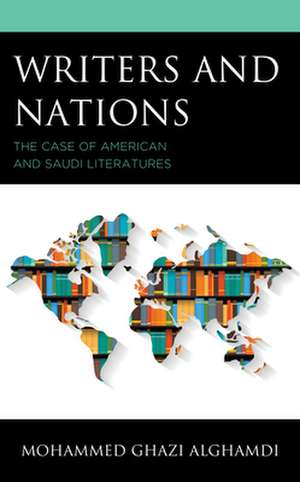
Writers and Nations: The Case of American and Saudi Literatures
Autor Mohammed Ghazi Alghamdien Limba Engleză Hardback – 12 oct 2021
Preț: 524.99 lei
Preț vechi: 815.82 lei
-36%
Puncte Express: 787
Carte tipărită la comandă
Livrare economică 26 noiembrie-10 decembrie
Livrare prin curier în România Termenul estimat este afișat lângă disponibilitate.
Transport gratuit pentru acest produs Plată online sau ramburs, în funcție de opțiunile comenzii.
Retur gratuit în 14 zile Comandă securizată și suport în română.
Specificații
ISBN-13: 9781793650832
ISBN-10: 1793650837
Pagini: 198
Dimensiuni: 164 x 226 x 20 mm
Greutate: 0.45 kg
Editura: Bloomsbury Publishing
Colecția Lexington Books
Locul publicării:New York, United States
ISBN-10: 1793650837
Pagini: 198
Dimensiuni: 164 x 226 x 20 mm
Greutate: 0.45 kg
Editura: Bloomsbury Publishing
Colecția Lexington Books
Locul publicării:New York, United States
Cuprins
Part I: A Hypothesis of Inscribing the Nation
Chapter I: Introduction: Nation and Literature
Chapter II: Contextualizing U.S and Saudi Nations and Literatures
Part II: Reading the Nation
Chapter III: Politics and the Nation
Chapter IV: Religion and the Nation
Chapter V: Women and the Nation
Chapter VI: Race and the Nation
Conclusion: The Evolution of the Nation
Chapter I: Introduction: Nation and Literature
Chapter II: Contextualizing U.S and Saudi Nations and Literatures
Part II: Reading the Nation
Chapter III: Politics and the Nation
Chapter IV: Religion and the Nation
Chapter V: Women and the Nation
Chapter VI: Race and the Nation
Conclusion: The Evolution of the Nation
Recenzii
Mohammed G. Alghamdi's Writers and Nations: The Case of American and Saudi Literatures offers a unique and illuminating comparative study of two national literatures during critical formative periods: American literature of the nineteenth century and Saudi Arabian literature of the late twentieth century to the present. Alghamdi's cross-cultural perspective yields original insights into how literature contributes to nation formation by mediating differences between dominant and marginalized communities. With its astute and surprising comparisons, Alghamdi's book will be of interest to scholars of both national literatures and should serve to elevate the global profile of the underappreciated Saudi authors it treats.
Books on Saudi literature in English, or for that matter in any language other than Arabic are so rare that the publication of a study that offers the English speaking world an overview of that literature is welcome enough. But when that study is presented from a comparative perspective that illuminates the ties between Saudi and American literature, it assumes an even higher value. I am quite impressed to see Dr. Alghamdi's book published.
In this groundbreaking study of the development of U.S. and Saudi national literatures, Mohammed Alghamdi argues that writers continually challenge and thus re-inscribe the boundaries of who is included within the privileges of citizenship nations provide and withhold. Comparative analyses of work by Henry David Thoreau and Hamza Shehata, Nathaniel Hawthorne and Abdo Khal, Kate Chopin and Raja Alem, Charles Chesnutt and Alwan Alsuhaymi focus on critiques of political injustice, religious intolerance, gender inequalities, and racial prejudice. Alghamdi shines the light on Saudi writers who are not widely known, even in the Arab world, showing us that a rich and distinctive modern literary tradition is emerging on the Saudi peninsula. His work productively stresses the dynamic potential of nation and the power of literature to effect social change.
Books on Saudi literature in English, or for that matter in any language other than Arabic are so rare that the publication of a study that offers the English speaking world an overview of that literature is welcome enough. But when that study is presented from a comparative perspective that illuminates the ties between Saudi and American literature, it assumes an even higher value. I am quite impressed to see Dr. Alghamdi's book published.
In this groundbreaking study of the development of U.S. and Saudi national literatures, Mohammed Alghamdi argues that writers continually challenge and thus re-inscribe the boundaries of who is included within the privileges of citizenship nations provide and withhold. Comparative analyses of work by Henry David Thoreau and Hamza Shehata, Nathaniel Hawthorne and Abdo Khal, Kate Chopin and Raja Alem, Charles Chesnutt and Alwan Alsuhaymi focus on critiques of political injustice, religious intolerance, gender inequalities, and racial prejudice. Alghamdi shines the light on Saudi writers who are not widely known, even in the Arab world, showing us that a rich and distinctive modern literary tradition is emerging on the Saudi peninsula. His work productively stresses the dynamic potential of nation and the power of literature to effect social change.