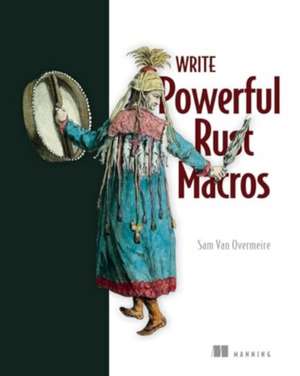
Write Powerfull Rust Macros
Autor Sam Overmeireen Limba Engleză Hardback – 24 iun 2024
Complementar volumului Rust for Rustaceans de Jon Gjengset, care explorează în profunzime conceptele de bază precum ownership și concurență, Write Powerful Rust Macros acoperă zona specifică a metaprogramării, un domeniu pe care alte ghiduri generale îl ating doar tangențial. Considerăm că această lucrare de la Manning Publications umple un gol critic în literatura de specialitate pentru dezvoltatorii care au depășit stadiul de începător. În timp ce Creative Projects for Rust Programmers oferă o privire de ansamblu asupra ecosistemului prin proiecte variate, Sam Van Overmeire se concentrează exclusiv pe mecanismele interne ale macrocomenzilor declarative și procedurale. Remarcăm structura tehnică riguroasă a celor 320 de pagini, care ghidează cititorul de la simpla înlocuire de text la manipularea arborelui de sintaxă abstractă (AST). Abordarea este una practică, axată pe reducerea codului repetitiv și pe crearea de interfețe de programare (API) mai expresive. Stilul de scriere este direct, orientat spre implementare, oferind soluții concrete pentru generarea de cod în timpul compilării, fără a sacrifica siguranța tipurilor specifică limbajului Rust.
Preț: 341.97 lei
Preț vechi: 427.46 lei
-20%
Carte disponibilă
Livrare economică 05-19 noiembrie
Livrare express 21-27 octombrie pentru 122.94 lei
Specificații
ISBN-10: 1633437493
Pagini: 320
Dimensiuni: 251 x 370 x 2 mm
Greutate: 0.6 kg
Editura: Manning Publications
V-ar putea interesa
-
 Programming with RustDonis Marshall-20%Preț: 278.53 lei348.16 lei
 -
 MeditationsMarcus AureliusPreț: 34.00 lei
 -
 Beginning Rust ProgrammingRic Messier-20%Preț: 250.06 lei312.58 lei
 -
 macOS Sequoia For DummiesG. Hart-DavisPreț: 211.39 lei
 -
 macOS Tahoe For DummiesHart-DavisPreț: 173.89 lei
 -
 RustNouman Azam-20%Preț: 308.77 lei385.96 lei
 -
 Refactoring to RustLily Mara-20%Preț: 278.20 lei347.75 lei
 -
 Code Like a Pro in RustBrenden Matthews-20%Preț: 328.07 lei410.09 lei
 -
 Rust Design PatternsBrenden Matthews-20%Preț: 336.23 lei420.29 lei
 -
 AI-Powered DeveloperNathan B Crocker-20%Preț: 281.01 lei351.26 lei
 -
 Learn Rust in a Month of LunchesDavid Macleod-20%Preț: 398.07 lei497.58 lei
 -
 -36%Preț: 236.59 lei367.67 lei
 -
 The Rust Programming Language: 2nd EditionSteve Klabnik-35%Preț: 254.46 lei392.60 lei
 -
 -34%Preț: 293.51 lei447.85 lei
 -
 -36%Preț: 283.89 lei440.71 lei
 -
 Building a DebuggerSy Brand-35%Preț: 337.38 lei518.40 lei
 -
 The Rust Programming Language, 3rd EditionCarol Nichols-35%Preț: 289.49 lei444.87 lei
 -
 The Macrame CompanionCaroline Bayol-LavouxPreț: 72.07 lei
 -
 Mastering ASP.NET Core 10Mabrouk Mahdhi-20%Preț: 250.42 lei313.02 lei
De ce să citești această carte
Recomandăm această carte programatorilor care doresc să stăpânească metaprogramarea în Rust pentru a scrie cod mai curat și mai eficient. Cititorul câștigă abilitatea de a automatiza sarcini complexe de codare și de a extinde funcționalitatea limbajului prin macrocomenzi procedurale. Este un instrument esențial pentru cei care construiesc biblioteci sau framework-uri unde abstractizarea și performanța sunt prioritare.
Descriere scurtă
In Write Powerful Rust Macros you’ll learn how to use these amazing metaprogramming tools to push Rust to its full potential. This hands-on guide takes you from the absolute basics to advanced macro techniques, exploring Rust macros through interesting and engaging examples.
Inside Write Powerful Rust Macros you’ll discover:
- Writing declarative macros
- Procedural macros
- Reading and debugging macro code
- Improving the type system with newtypes and zero-sized types
- How common Rust libraries use macros
Write Powerful Rust Macros teaches you how to write, test, debug, and publish macros for Rust. It’s perfect for Rust practitioners who want to master this powerful development technique. Build your knowledge chapter-by-chapter. You’ll start with declarative macros before diving into the real power: procedural macros that can generate code, augment data structures, and even create domain-specific languages.
About the technology
Macros are one of Rust’s most important and powerful tools. Although notoriously challenging, this metaprogramming technique has a big payoff. Using macros to generate new Rust code at compile-time can save you hours of tedious coding with negligible runtime performance impact. This book shows you exactly how to master this Rust superpower.
About the book
Write Powerful Rust Macros opens up the world of macros to intermediate Rust programmers. You’ll start with declarative macros to get the basics under your belt. Then, you’ll advance to procedural macros as you automatically generate a builder, learn to create your own domain-specific languages, and more. As you go, you’ll develop practical skills like testing macros, integrating macros with crates, and even sharing your macros with other developers.
What's inside
- How Rust libraries use macros
- Reading and debugging macro code
- newtypes and the type state pattern
For intermediate Rust programmers.
About the author
Sam Van Overmeire is an experienced Rust developer and the author of multiple books, scientific articles and blog posts.
The technical editor on this book was Andrew Lilley Brinker.
Table of contents
1 Going meta
2 Declarative macros
3 A “Hello, World” procedural macro
4 Making fields public with attribute macros
5 Hiding information and creating mini-DSLs with function-like macros
6 Testing a builder macro
7 From panic to result: Error handling
8 Builder with attributes
9 Writing an infrastructure DSL
10 Macros and the outside world