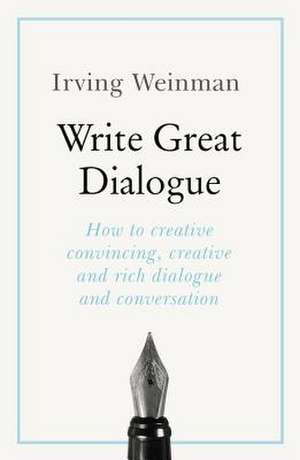
Write Great Dialogue: How to write convincing dialogue, conversation and dialect in your fiction
Autor Irving Weinmanen Limba Engleză Paperback – 23 ian 2019
Commissioning editors say good dialogue is one of the first things that make a book stand out from the crowd - and similarly, that clunky direct speech is one of the first things that will send a book straight from the slushpile to the rejections bin.
But while many other aspects of writing are pored over in intense detail, there have been very few books on the art of writing successful dialogue. In this practical guide for aspiring writers of all levels, Irving Weinman, himself a published writer and well-known creative writing tutor, uses case studies to help you explore how to write good dialogue, and gives you a range of fun and challenging exercises that will help you to write great dialogue.
ABOUT THE SERIES
The Teach Yourself Creative Writing series helps aspiring authors tell their story. Covering a range of genres from science fiction and romantic novels, to illustrated children's books and comedy, this series is packed with advice, exercises and tips for unlocking creativity and improving your writing. And because we know how daunting the blank page can be, we set up the Just Write online community at tyjustwrite, for budding authors and successful writers to connect and share.
Preț: 78.91 lei
Preț vechi: 106.99 lei
-26%
Puncte Express: 118
Carte disponibilă
Livrare economică 16-30 noiembrie
Livrare prin curier în România Termenul estimat este afișat lângă disponibilitate.
Transport gratuit de la 400.00 lei Plată online sau ramburs, în funcție de opțiunile comenzii.
Retur gratuit în 14 zile Comandă securizată și suport în română.
Specificații
ISBN-13: 9781473688513
ISBN-10: 1473688515
Pagini: 256
Dimensiuni: 134 x 214 x 20 mm
Greutate: 0.23 kg
Editura: John Murray Press
Colecția Teach Yourself
Locul publicării:London, United Kingdom
ISBN-10: 1473688515
Pagini: 256
Dimensiuni: 134 x 214 x 20 mm
Greutate: 0.23 kg
Editura: John Murray Press
Colecția Teach Yourself
Locul publicării:London, United Kingdom
V-ar putea interesa
-
 How NOT to Write a NovelHoward Mittelmark-31%Preț: 64.05 lei92.84 lei
 -
 -19%Preț: 74.84 lei92.77 lei
 -
 Writing Fiction, Tenth Edition: A Guide to Narrative CraftJanet BurrowayPreț: 185.38 lei
 -
 Swallowed by a WhaleHuw Lewis-JonesPreț: 93.70 leiNou
 -
 Creative Writing For Dummies, 2nd EditionMaggie HamandPreț: 118.60 lei
 -
 -14%Preț: 97.24 lei112.92 lei
 -
 -27%Preț: 67.42 lei92.60 lei
 -
 -45%Preț: 93.32 lei169.53 lei
 -
 DialogueRobert McKeePreț: 210.53 lei
 -
 How to Write Short Stories and Get Them PublishedAshley Lister-26%Preț: 68.99 lei93.11 lei
 -
 Writers' & Artists' Guide to How to WriteWilliam Ryan-26%Preț: 87.50 lei118.84 lei
 -
 -28%Preț: 65.95 lei91.19 lei
 -
 -17%Preț: 67.00 lei80.66 leiRecomandat
 -
 -20%Preț: 78.84 lei98.89 lei
 -
 -17%Preț: 92.10 lei110.49 lei
 -
 Writing Coach in a BoxAlan AndersonPreț: 108.19 lei
 -
 -27%Preț: 67.44 lei92.17 lei
 -
 How To Write Your First NovelSophie King-27%Preț: 67.21 lei92.46 lei
 -
 Let's Get Creative: Writing Fiction that Sells!William F. NolanPreț: 87.51 lei
Cuprins
- : 1 An Overview of Dialogue
- :
1 An Overview of Dialogue - : 2 Character in Dialogue I (dialogue in character)
- : 2 Character in Dialogue I (dialogue in character)
- : 3 Narrative in Dialogue
- : 3 Narrative in Dialogue
- : 4 Dialogue in Narrative (non 'scene' dialogue)
- : 4 Dialogue in Narrative (non 'scene' dialogue)
- : 5 Versions of Dialogue (monologue, thoughts, letters, diaries, voice messages)
- : 5 Versions of Dialogue (monologue, thoughts, letters, diaries, voice messages)
- : 6 Dialogue and Indirect Speech
- : 6 Dialogue and Indirect Speech
- : 7 Transitions in and out of Dialogue
- : 7 Transitions in and out of Dialogue
- : 8 Dialogue Imitations of Reality (crowds, multiple speech, interrupted speech, foreign languages)
- : 8 Dialogue Imitations of Reality (crowds, multiple speech, interrupted speech, foreign languages)
- : 9 Character in Dialogue II (using dialogue to learn about your characters: the art of not listening, getting them angry, letting their hair down)
- : 9 Character in Dialogue II (using dialogue to learn about your characters: the art of not listening, getting them angry, letting their hair down)
- : 10 The Far Reaches of Dialogue (experimental approaches, shifting dialogue
- : 10 The Far Reaches of Dialogue (experimental approaches, shifting dialogue between characters)
- : 11 Dialogue in Summary (some exercises, some suggested reading)
- : between characters)
- : 11 Dialogue in Summary (some exercises, some suggested reading)
- : 11 Dialogue in Summary (some exercises, some suggested reading)