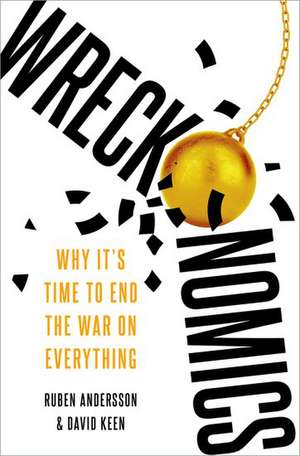
Wreckonomics: Why It's Time to End the War on Everything
Autor Ruben Andersson, David Keenen Limba Engleză Hardback – dec 2023
Preț: 190.96 lei
Preț vechi: 221.19 lei
-14%
Puncte Express: 286
Carte disponibilă
Livrare economică 19-25 noiembrie
Livrare express 03-07 noiembrie pentru 65.99 lei
Livrare prin curier în România Termenul estimat este afișat lângă disponibilitate.
Transport gratuit de la 400.00 lei Plată online sau ramburs, în funcție de opțiunile comenzii.
Retur gratuit în 14 zile Comandă securizată și suport în română.
Specificații
ISBN-13: 9780197645925
ISBN-10: 0197645925
Pagini: 352
Dimensiuni: 226 x 163 x 56 mm
Greutate: 0.59 kg
Editura: Oxford University Press
Colecția OUP USA
Locul publicării:New York, United States
ISBN-10: 0197645925
Pagini: 352
Dimensiuni: 226 x 163 x 56 mm
Greutate: 0.59 kg
Editura: Oxford University Press
Colecția OUP USA
Locul publicării:New York, United States
V-ar putea interesa
-
 QuicksandGeoffrey WawroPreț: 202.31 lei
 -
 -9%Preț: 268.20 lei293.32 lei
 -
 Preț: 319.26 lei
 -
 -15%Preț: 667.48 lei785.27 lei
 -
 Preț: 432.23 lei
 -
 Preț: 437.08 lei
 -
 Routledge Handbook of Postcolonial PoliticsOlivia U. RutazibwaPreț: 445.50 lei
 -
 Medieval Foundations of International RelationsWilliam BainPreț: 435.91 lei
 -
 Preț: 422.12 lei
 -
 Preț: 424.32 lei
 -
 Preț: 424.32 lei
 -
 Regional Security Structures in AsiaAshok KaporPreț: 297.78 lei
 -
 Federalism, Feminism and Multilevel GovernanceMarian SawerPreț: 414.53 lei
 -
 International Order in a Globalizing WorldYannis A. StivachtisPreț: 285.87 lei
 -
 Preț: 215.07 lei
 -
 No Go WorldRuben AnderssonPreț: 211.10 lei
 -
 Human TraffickingLouise ShelleyPreț: 242.09 lei
 -
 The International Monetary Fund in the Global EconomyMark CopelovitchPreț: 344.23 lei
 -
 Realist ConstructivismJ. Samuel Barkin-11%Preț: 659.06 lei740.53 lei
 -
 Shame - The Politics and Power of an EmotionDavid KeenPreț: 255.46 lei
 -
 Selling War and PeaceJack Holland-11%Preț: 672.63 lei755.77 lei
 -
 Preț: 381.54 lei
 -
 Preț: 303.06 lei
 -
 Preț: 500.65 lei
Recenzii
Something's terribly wrong with our public policy. Tasked with managing migration, countering terrorism, and protecting us from pandemic disease, among other things, our institutions seem to thrive amid the wreckage. Ruben Andersson and David Keen explain why. Lively and cogent, Wreckonomics provides us with the lens and the language to make sense of how failure can be success, over and over again.
To understand the perverse logic of why failing policies are nevertheless politically successful-ranging from the war on drugs to the war on terror-I cannot think of a better introduction than Wreckonomics. In this highly accessible and engaging book, Andersson and Keen provide a damning dissection of our extraordinarily costly and counterproductive addiction to militarized interventions. As we've reached the 20th anniversary of the 2003 invasion of Iraq and continue to live with its disastrous consequences-with the perpetrators not only not held accountable but highly rewarded-the book could not be a more timely and important contribution.
Elegantly written, thought-provoking and persuasively argued. Andersson and Keen offer a powerful and incisive critique of the conventional narratives that have tended to dominate debate about the motives, dynamics, and effects of contemporary "wars and security interventions", forcing the reader to discard lazy assumptions and drawing their attention instead to mechanisms and logics that have served to perpetuate rather than meaningfully address many of the most urgent challenges facing humanity.
Applying a sophisticated systems approach to issues spanning the globe, Wreckonomics makes major contributions to international relations and policy analysis.
Based on outstanding original research, thought provoking in its conclusions and challenging in every chapter.
[A] deeply-researched and wide-ranging account of how, despite manifest failings, the wars on terror, drugs and migration are entrenched in Western policy as a kind of perma-crisis for which its principal architects are never held responsible.
Provocative and thought-provoking ... the authors make their important case made with verve and style.
A remarkable new book [that] paints a searing portrait of our era of sham politics and fake wars... couldn't be more timely as the world stumbles into 2024.
Wreckonomics is not only an extensively researched argument against the war on everything; at its heart, it is a manifesto against simplicity ... it truly is a challenging read in the best sense of the word: we could all to with thinking more deeply about how to move beyond the war on everything.
Valuable.
An impressive book ... full of striking information and intelligent insights.
Everyone should, however, be wiser for considering their explanations, because they ring true ... Well, written... For those still interested in understanding how the world works, this book is a good start.
well written, informative book.
To understand the perverse logic of why failing policies are nevertheless politically successful-ranging from the war on drugs to the war on terror-I cannot think of a better introduction than Wreckonomics. In this highly accessible and engaging book, Andersson and Keen provide a damning dissection of our extraordinarily costly and counterproductive addiction to militarized interventions. As we've reached the 20th anniversary of the 2003 invasion of Iraq and continue to live with its disastrous consequences-with the perpetrators not only not held accountable but highly rewarded-the book could not be a more timely and important contribution.
Elegantly written, thought-provoking and persuasively argued. Andersson and Keen offer a powerful and incisive critique of the conventional narratives that have tended to dominate debate about the motives, dynamics, and effects of contemporary "wars and security interventions", forcing the reader to discard lazy assumptions and drawing their attention instead to mechanisms and logics that have served to perpetuate rather than meaningfully address many of the most urgent challenges facing humanity.
Applying a sophisticated systems approach to issues spanning the globe, Wreckonomics makes major contributions to international relations and policy analysis.
Based on outstanding original research, thought provoking in its conclusions and challenging in every chapter.
[A] deeply-researched and wide-ranging account of how, despite manifest failings, the wars on terror, drugs and migration are entrenched in Western policy as a kind of perma-crisis for which its principal architects are never held responsible.
Provocative and thought-provoking ... the authors make their important case made with verve and style.
A remarkable new book [that] paints a searing portrait of our era of sham politics and fake wars... couldn't be more timely as the world stumbles into 2024.
Wreckonomics is not only an extensively researched argument against the war on everything; at its heart, it is a manifesto against simplicity ... it truly is a challenging read in the best sense of the word: we could all to with thinking more deeply about how to move beyond the war on everything.
Valuable.
An impressive book ... full of striking information and intelligent insights.
Everyone should, however, be wiser for considering their explanations, because they ring true ... Well, written... For those still interested in understanding how the world works, this book is a good start.
well written, informative book.
Notă biografică
Ruben Andersson is a professor of social anthropology at the Department of International Development at the University of Oxford. His research has been concerned with borders, migration and security, and he is the author of No Go World (2019) and Illegality, Inc. (2014), winner of the 2015 BBC Ethnography Award. David Keen is a professor of conflict studies at the Department of International Development at the London School of Economics and Political Science. He has researched civil wars, global wars and disasters. He is the author of The Benefits of Famine (1994) and Useful Enemies (2012), among other books, and winner of the Edgar Graham prize.
Cuprins
- 1: Crime Scene Investigation
- 2: Wreckonomics 101: How Failure Became the New Success
- 3: Cold War Games: When War Is a Self-Licking Ice-Cream Cone
- 4: A Life of Its Own: The "War on Terror" as Frankenstein's Monster
- 5: Double Games: Fear and Fraud in the Fight against Migration
- 6: Warriors on Drugs: How States Got Hooked on Narcotics and Crime
- 7: The Hall of Mirrors: The Distortion of Disastrous Interventions
- 8: Wreckonomics Goes Viral? The Costs of Laissez-Faire and Lockdown
- 9: How to End the War on Everything (In Four Complex Steps)
- 10: Waging Peace: How (Not) to Fight the System