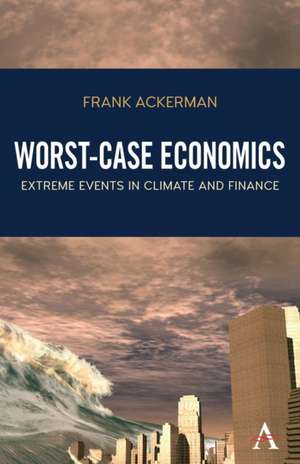
Worst-Case Economics
Autor Frank Ackermanen Limba Engleză Paperback – 20 sep 2018
The erratic rhythm of boom and bust in financial markets could be explained either by the patterns of crowd-following behaviour among investors, or by the unequal distribution of wealth (and the impact of the largest investors on the markets). Climate crises reflect the fact that natural systems can reach tipping points or critical transitions, where gradual change gives way to large-scale discontinuous changes. The economics of climate change has lagged behind the science, understating the severity of the problem and the likelihood of a crash.
While the causes of climate and financial extremes are distinct, the implications for public policy have much in common. The frequency of extreme events, of varying sizes, means that there is no way to predict the likely size of future crises. The traditional approach to risk aversion cannot account for longstanding patterns in financial markets. Better theories of risk call for more precautionary approaches to both financial and climate policy. In the frequent cases in which potential outcomes have unknown probabilities, the best policy is based on the worst-case credible scenario. When a single catastrophic risk commands everyone's attention, a World War II-style, costs-be-damned mobilization is the right response. There is no formula for perfect responses to extreme risks, but there are important guideposts that point toward better answers.
| Toate formatele și edițiile | Preț | Express |
|---|---|---|
| Paperback (1) | 172.06 lei 3-5 săpt. | |
| Anthem Press – 20 sep 2018 | 172.06 lei 3-5 săpt. | |
| Hardback (1) | 260.42 lei 3-5 săpt. | |
| Anthem Press – 23 oct 2017 | 260.42 lei 3-5 săpt. |
Preț: 172.06 lei
Puncte Express: 258
Preț estimativ în valută:
30.43€ • 35.94$ • 26.22£
30.43€ • 35.94$ • 26.22£
Carte disponibilă
Livrare economică 27 februarie-13 martie
Specificații
ISBN-13: 9781783087136
ISBN-10: 1783087137
Pagini: 210
Dimensiuni: 140 x 216 x 13 mm
Greutate: 0.3 kg
Editura: Anthem Press
ISBN-10: 1783087137
Pagini: 210
Dimensiuni: 140 x 216 x 13 mm
Greutate: 0.3 kg
Editura: Anthem Press
Notă biografică
Frank Ackerman is an economist whose extensive research and writing focus on climate change and energy, environmental policy and cost-benefit analysis.