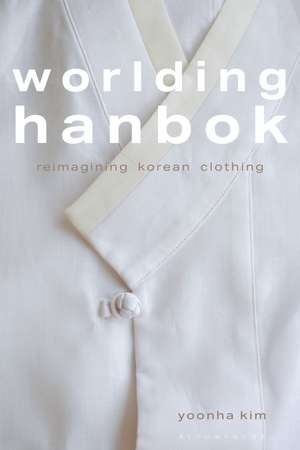
Worlding Hanbok: Reimagining Korean Clothing
Autor Yoonha Kimen Limba Engleză Hardback – 11 dec 2026
Once an everyday attire shaped by climate and agrarian life, hanboks have been pushed to the margins of museums and fashion shows. Yet grassroots movements and experimental practices are reviving the hanbok as a site of resistance.
At the heart of Worlding Hanbok is Lee Ki-Yeon, an activist, who during South Korea's 1980s dictatorship initiated a movement of wearing earth-toned, oversized hanboks as a symbol of solidarity and renewal. These hanboks were not only structurally ecological - they were crafted to enable generous sharing of garments, embodying values of energetic circulation, material activity, and collaborative inhabitation.
Through embodied ethnography and fieldwork across hanbok workshops, a weaving facility, online hanbok communities, and a textile lab in Potsdam, anthropologist Yoonha Kim shows how the making and wearing of hanboks enact alternative ways of knowing, being, and relating.
Preț: 583.11 lei
Preț vechi: 863.95 lei
-33% Precomandă
Puncte Express: 875
Carte nepublicată încă
Livrare prin curier în România Precomanda se expediază când titlul devine disponibil.
Transport gratuit pentru acest produs Plată online sau ramburs, în funcție de opțiunile comenzii.
Retur gratuit în 14 zile Comandă securizată și suport în română.
Doresc să fiu notificat când acest titlu va fi disponibil:
Se trimite...
Specificații
ISBN-13: 9798216452225
Pagini: 256
Dimensiuni: 152 x 229 mm
Editura: Bloomsbury Publishing
Colecția Bloomsbury Academic
Locul publicării:New York, United States
Pagini: 256
Dimensiuni: 152 x 229 mm
Editura: Bloomsbury Publishing
Colecția Bloomsbury Academic
Locul publicării:New York, United States
Cuprins
Preface: Flow of the Wind
Part I. Framing the Practice
1. Introduction - Worlding Hanbok
2. Enclothed Exploration: Wearing as a Method
Interlude: Meeting Lee Ki-Yeon
Part II. Politics and Practices of Making
3. Dressing as Everyday Resistance: The Working-Class Hanbok Movement (1980s-2000s)
4. Ready-to-Wear Hanbok
5. Ot-Jieum as Practice: Cycle of Cutting, Stitching, Wearing, Mending
6. "Between Beings" Sai-Jonjae: Humans as In-between Beings
7. You Cannot Make Clothes Without Understanding the Body: Clothes Follow the Flow of Five Viscera
Interlude: Breath in Fabric
Part III. Weaving as Worlding
8. Salim on a Fabric Level: Mulkkuri Myeongju
9. Usage Salim
Part IV. Toward an Otherwise
10. From Hanbok to Uriot: Daily Embodied Transformation
11. Worlding Through Wearing: Exploring Alternative Perspectives
References
Part I. Framing the Practice
1. Introduction - Worlding Hanbok
2. Enclothed Exploration: Wearing as a Method
Interlude: Meeting Lee Ki-Yeon
Part II. Politics and Practices of Making
3. Dressing as Everyday Resistance: The Working-Class Hanbok Movement (1980s-2000s)
4. Ready-to-Wear Hanbok
5. Ot-Jieum as Practice: Cycle of Cutting, Stitching, Wearing, Mending
6. "Between Beings" Sai-Jonjae: Humans as In-between Beings
7. You Cannot Make Clothes Without Understanding the Body: Clothes Follow the Flow of Five Viscera
Interlude: Breath in Fabric
Part III. Weaving as Worlding
8. Salim on a Fabric Level: Mulkkuri Myeongju
9. Usage Salim
Part IV. Toward an Otherwise
10. From Hanbok to Uriot: Daily Embodied Transformation
11. Worlding Through Wearing: Exploring Alternative Perspectives
References
Recenzii
Through the lens of a unique garmet - the loose, airy hanbok - designer and anthropologist Kim Yoonha boldly offers us unique insights into the ways in which people in Korea, drawing on the historical physicality and materiality of their sartorial heritage, position themselves today amid the country's difficult history, ecological crisis, activism, and future.