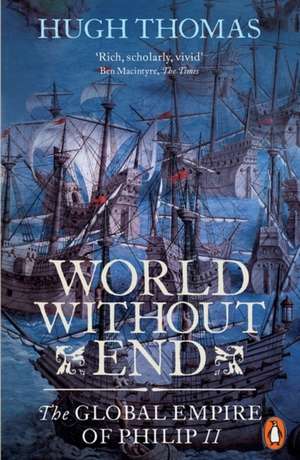
World Without End
Autor Hugh Thomasen Limba Engleză Paperback – 2 iul 2015
Structura acestui volum urmează o cronologie riguroasă a apogeului imperial, de la cucerirea Yucatanului și a Paraguayului până la proiecția surprinzătoare a puterii spaniole peste Pacific, în Filipine. Găsim în această carte o succesiune densă de portrete ale administratorilor care au modelat Lumea Nouă — viceregi, judecători și episcopi — oferind o perspectivă ce depășește simpla narațiune a bătăliilor pentru a explora construcția instituțională a orașelor, catedralelor și universităților. Subliniem modul în care autorul echilibrează cruzimea cuceririi cu eforturile misionarilor franciscani sau iezuiți, totul sub supravegherea distantă a regelui Filip al II-lea din palatul Escorial. Ca și Spain and Its World, 1500-1700 de J. H. Elliott, lucrarea acoperă perioada de maximă expansiune a Casei de Austria, dar cu o metodologie care pune accent pe detaliul biografic și pe „epopeea imaginației” europene, nu doar pe analize geopolitice reci. Merită menționat că acest volum încheie magistral trilogia începută cu Rivers of Gold și The Golden Age, consolidând viziunea lui Hugh Thomas asupra unui imperiu definit deopotrivă prin rigoare administrativă și fervoare religioasă. În contextul operei sale, World Without End rafinează temele explorate în Conquest, trecând de la căderea Mexicului la gestionarea unui teritoriu global pe care soarele nu apunea niciodată.
Preț: 88.77 lei
Preț vechi: 122.61 lei
-28%
Carte disponibilă
Livrare economică 06-17 noiembrie
Livrare express 21-27 octombrie pentru 61.40 lei
Specificații
ISBN-10: 0141034475
Pagini: 496
Ilustrații: 16 pp colour
Dimensiuni: 126 x 198 x 27 mm
Greutate: 0.38 kg
Editura: Penguin Books
Locul publicării:London, United Kingdom
V-ar putea interesa
-
 The Bach ManuscriptScott MarianiPreț: 72.14 lei
 -
 The Ugly RenaissanceAlexander Lee-17%Preț: 80.19 lei96.18 lei
 -
 La Vie en bleuRod KedwardPreț: 130.17 lei
 -
 The Penguin History of EuropeJ. Roberts-18%Preț: 114.13 lei138.46 lei
 -
 The Peninsular WarCharles Esdaile-19%Preț: 115.44 lei142.14 lei
 -
 The Penguin Historical Atlas of the VikingsJohn Haywood-18%Preț: 111.73 lei137.04 lei
 -
 Stalin and His HangmenDonald RayfieldPreț: 130.19 lei
 -
 The Voice of WarGuy WaltersPreț: 130.36 lei
 -
 Rivers of GoldHugh Thomas-22%Preț: 112.78 lei143.70 lei
 -
 CubaHugh ThomasPreț: 147.30 lei
 -
 The Holy Roman EmpirePeter H. Wilson-20%Preț: 118.29 lei147.92 lei
 -
 The Gates of EuropeSerhii Plokhy-30%Preț: 66.40 lei94.23 lei
 -
 Malice of Crows: The Shadow, Book ThreeLila BowenPreț: 104.05 lei
 -
 The Transylvanian Trilogy, Volume I: They Were CountedMiklos BanffyPreț: 218.05 lei
 -
 Spirit of the BlueHugh ThomasPreț: 95.69 lei
 -
 The Slave TradeHugh Thomas-21%Preț: 120.73 lei152.55 lei
 -
 Cultural DNAGurnek BainsPreț: 133.11 lei
 -
 Edward VIIChristopher HibbertPreț: 147.19 lei
 -
 The Joshua Delusion?Douglas S. EarlPreț: 136.76 lei
 -
 -19%Preț: 354.45 lei434.98 lei
 -
 The Prussian Army of the Lower Rhine 1815Peter Hofschröer-32%Preț: 67.17 lei99.29 lei
De ce să citești această carte
Recomandăm această carte pasionaților de istorie care doresc să înțeleagă complexitatea administrativă și morală a primului imperiu global. Cititorul câștigă o viziune nuanțată asupra Spaniei secolului al XVI-lea, descoperind că dincolo de conchistadori a existat un aparat birocratic și religios fascinant. Este o lectură esențială pentru cei care au parcurs primele volume ale trilogiei sau sunt interesați de figura enigmatică a lui Filip al II-lea.
Despre autor
Hugh Thomas (1931–2017), cunoscut și sub titlul nobiliar de Baron Thomas of Swynnerton, a fost unul dintre cei mai respectați istorici britanici specializați în spațiul hispanic. Cariera sa a fost marcată de o erudiție remarcabilă, fiind autorul lucrării definitive The Spanish Civil War, premiată cu Somerset Maugham Award. Prin scrierile sale, precum Cuba și trilogia despre Imperiul Spaniol, Thomas a reușit să aducă în fața publicului larg analize detaliate ale puterii coloniale, fiind recunoscut la nivel mondial drept o autoritate supremă în istoria Americii Latine și a influenței iberice în lume.
Notă biografică
Recenzii
Literary power is a vital part of a great historian's armoury. As in his earlier books, Thomas demonstrates here that he has this in abundance. But equally important is [his] sense of perspective ... With all its flaws, Thomas argues, the Spanish Empire left an extraordinarily rich legacy
World Without End is full of illuminating detail, drawn from painstaking work
Descriere scurtă
World Without End is the climax of Hugh Thomas's great history of the Spanish Empire in the Americas. It describes the conquest of Paraguay and the River Plate, of the Yucatan in Mexico, the only partial conquest of Chile, and battles with the French over Florida, and then, in the 1580s, the extraordinary projection of Spanish power across the Pacific to conquer the Philippines. More significantly, it describes how the Spanish ran the greatest empire the world had seen since Rome - as well as conquistadores, the book is people with viceroys, judges, nobles, bishops, inquisitors and administrators of many different kinds, often in conflict with one another, seeking to organise the native populations into towns, to build cathedrals, hospitals and universities. Behind them - sometimes ahead of them - came the religious orders, the Franciscans, Dominicans, Augustinians, and finally the Jesuits, builders of convents and monasteries, many of them of astonishing beauty, and reminders of the pervasiveness of religion and the self-confidence of the age.
Towering above them all, though moving rarely from the palace of the Escorial outside Madrid, is the figure of King Philip II, the central figure in the book. The Venetian ambassador thought him 'the arbiter of the world'. Once the Philippines had been consolidated, Philip's advisors contemplated an invasion of China: the Jesuit Father Sanchez called it 'the greatest enterprise which has ever been proposed to any monarch in the world'. It was an enterprise never undertaken, but never explicitly abandoned.
Was it a great or a terrible empire? In contrast to other empire builders, the Spaniards entered upon arguments with each other about their right to rule other peoples, and their ruthlessness was often tempered by humanity. Hugh Thomas's conclusion is unequivocal: 'The speed with which the sixteenth-century conquistadores conquered such large territories on two vast continents, and the comparable success of missionaries with large populations of Indians, stands as one of the supreme epics of both valour and imagination by Europeans.'