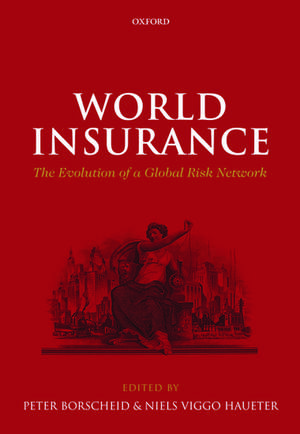
World Insurance: The Evolution of a Global Risk Network
Editat de Peter Borscheid, Niels Viggo Haueteren Limba Engleză Hardback – 22 aug 2012
Preț: 1216.96 lei
Preț vechi: 1758.88 lei
-31%
Puncte Express: 1825
Carte tipărită la comandă
Livrare economică 04-15 decembrie
Livrare prin curier în România Termenul estimat este afișat lângă disponibilitate.
Transport gratuit pentru acest produs Plată online sau ramburs, în funcție de opțiunile comenzii.
Retur gratuit în 14 zile Comandă securizată și suport în română.
Specificații
ISBN-13: 9780199657964
ISBN-10: 0199657963
Pagini: 752
Dimensiuni: 182 x 253 x 46 mm
Greutate: 1.45 kg
Editura: Oxford University Press
Colecția OUP Oxford
Locul publicării:Oxford, United Kingdom
ISBN-10: 0199657963
Pagini: 752
Dimensiuni: 182 x 253 x 46 mm
Greutate: 1.45 kg
Editura: Oxford University Press
Colecția OUP Oxford
Locul publicării:Oxford, United Kingdom
V-ar putea interesa
-
 The Third PillarRaghuram RajanPreț: 108.24 lei
 -
 The New Geography of InnovationMehran GulPreț: 123.61 lei
 -
 Introduction to Risk Management and InsuranceMark S Dorfman-15%Preț: 1168.56 lei1374.78 lei
 -
 The Anxious TriumphDonald Sassoon-16%Preț: 92.60 lei110.79 lei
 -
 Preț: 227.38 lei
 -
 Preț: 286.97 lei
 -
 Preț: 141.49 lei
 -
 Against the GodsPeter L. BernsteinPreț: 132.57 lei
 -
 Preț: 309.50 lei
 -
 Insuring States in an Uncertain WorldLouis W. PaulyPreț: 282.10 lei
 -
 The New Nature of BusinessAndre HoffmannPreț: 116.19 lei
 -
 -39%Preț: 586.37 lei960.61 lei
 -
 -27%Preț: 1215.43 lei1658.16 lei
 -
 InevitableMike ColiasPreț: 195.49 lei
 -
 Safe DangerBen SwirePreț: 142.57 lei
 -
 The Penguin History of EconomicsRoger E. Backhouse-28%Preț: 77.86 lei108.44 lei
 -
 Risk Management & Introduction to InsuranceJoel WagnerPreț: 354.17 lei
 -
 Handbook of InsuranceGeorges Dionne-18%Preț: 1462.27 lei1783.26 lei
 -
 -15%Preț: 667.52 lei785.31 lei
 -
 Empire of AIKaren HaoPreț: 163.45 lei
Recenzii
For the first time, historians working across a range of subjects from finance and economic modernization to social welfare and even religion have access to a systematic account of how the insurance industry has transformed the risk environment faced by billions around the world and how that process has knit together the economies and fortunes of far flung societies and cultures ... Whether the post-2008 financial debacle will induce a return to a more stringent regulatory environment and a new generation of statist approaches to insurance is a question that must await a sequel to Borscheid and Haueters imposing and standard-setting World Insurance.
Notă biografică
Edited by Peter Borscheid, Professor Emeritus of Economic and Social History at the Philipps-University of Marburg, and Niels Viggo Haueter, Corporate History, Swiss Re
Peter Borscheid is Professor Emeritus of Economic and Social History at the University of Marburg. He has published numerous monographs on the history of science and technology, the history of the textile industry, the standard of living, the history of old age, and old-age pension, the cultural history of acceleration. He led several projects and international working groups on insurance history. He also served as a member of the German government commission "The situation of the older generation in the Federal Republic of Germany".
Niels Viggo Haueter is Head of Swiss Reinsurance Company's Corporate History team and the company's historical archives. He serves as an academic advisor on insurance and reinsurance history to the European Association for Banking and Financial History in Frankfurt.
Contributors:
Gustavo A. Del Angel, Professor of Financial History at CIDE (Center for Economics Research and Teaching), Mexico City.
G. Balachandran, the Graduate Institute of International and Development Studies, Geneva.
Yolanda Blasco Martel, Professor, the University of Barcelona.
Peter Borscheid, Professor Emeritus of Economic and Social History, the University of Marburg.
James Darroch, Associate Professor of Strategic Management and Director of the Financial Services Program at the Schulich School of Business, York University.
David Faure, Wei Lun Professor of History, the Chinese University of Hong Kong.
Niels Viggo Haueter, Head of Corporate History, Swiss Re
Frauke Heard-Bey, Historian and Political Scientist
Myung Hwi Lee, Associate Professor at the Department of Economics, the Ewha Womans University.
Dr Monica Keneley, Associate Professor in Finance, the School of Accounting Economics and Finance, Deakin University Victoria, Australia.
Duol Kim, Fellow, Korea Development Institute, and Adjunct Professor, KDI School of Public Policy and Management.
Matthias Kipping, Professor of Policy and Chair in Business History, the Schulich School of Business, York University, Toronto, Canada.
Christopher Kobrak, Professor of Finance, ESCP Europe, and an International Fellow at the Centre for Corporate Reputation, Oxford University.
Elisabeth Köll, Associate Professor, the Harvard Business School.
Martin Lengwiler, Professor for Modern History, the University of Basle.
Marcelo de Paiva Abreu, Professor of Economics, Pontifical Catholic University of Rio de Janeiro.
Robin Pearson, Professor of Economic History, the University of Hull, UK.
Yuri A. Petrov, Director of the Institute of Russian History, RAN, Moscow.
Giandomenico Piluso, Lecturer of Economic History, the University of Siena and Adjunct Professor of Business History, Bocconi University, Milan.
Jerònia Pons, Senior Lecturer in Economic History, the University of Seville, Spain.
Rodrigo Rabetino, Assistant Professor, the Department of Management, the University of Vaasa, Finland.
Samir Saul, Professor of History, the Université de Montréal.
André Straus, Directeur de recherches, the Centre National de la Recherche Scientifique, Paris.
Felipe Tâmega Fernandes, Chief-Economist, Banco Modal, and at the Pontifical Catholic University of Rio de Janeiro.
Grietjie Verhoef, Professor in Accounting and Economic History, the Department of Accountancy, the University of Johannesburg.
Takau Yoneyama, Professor at Hitotsubashi University, Tokyo.
Cuprins
1: Peter Borscheid: Introduction
Part I. Europe
2: Peter Borscheid: Europe: Overview
3: Robin Pearson: United Kingdom: Pioneering insurance internationally
4: Peter Borscheid: Germany: Insurance, expansion and setbacks
5: André Straus: France: Insurance and the French financial networks
6: Martin Lengwiler: Switzerland: Insurance and the need to export
7: Giandomenico Piluso: Italy: Building on a long insurance heritage
8: Jerònia Pons Pons: Spain: International influence on the domestic insurance market
9: Yuri A. Petrov: Russia: Early expansion, state involvement, and re-emergence of the insurance industry
Part II. North America
10: Peter Borscheid: North America: Overview
11: Matthias Kipping & James Darroch: Canada: Taking life insurance abroad
12: Christopher Kobrak: USA: The international attraction of the US insurance market
Part III. Sub-Saharan Africa
13: Peter Borscheid: Sub-Saharan Africa: Overview
14: Grietjie Verhoef: South Africa: Leading African insurance
Part IV. Middle East & Northern Africa
15: Peter Borscheid: Middle East & Northern Africa: Overview
16: Samir Saul: Maghreb: Naturalising insurance in Algeria, Morocco and Tunisia
17: Frauke Heard-Bey: United Arab Emirates: Economic boom and insurance
Part V. Far East and Pacific
18: Peter Borscheid: Far East and Pacific: Overview
19: G. Balachandran: India: From a colonial outpost to a leading market
20: David Faure & Elisabeth Köll: China: The indigenisation of insurance
21: Takau Yoneyama,: Japan: The role of insurance in the rapid modernisation of Japan
22: Myung Hwi Lee & Duol Kim: Korea: Insurance in a tiger market
23: Monica J. Keneley: Australia and New Zealand: A tradition continued creating a domestic insurance market
Part VI. Latin America and Caribbean
24: Peter Borscheid: Latin America and Caribbean: Overview
25: Marcelo de Paiva Abreu & Felipe Tâmega Fernandes: Brazil: The resilience of the Brazilian insurance market
26: Gustavo del Angel: Mexico: A history of the insurance industry in Mexico
27: Yolanda Blasco & Rodrigo Rabetino: Argentina: The changing fortunes of the Argentinean insurance market