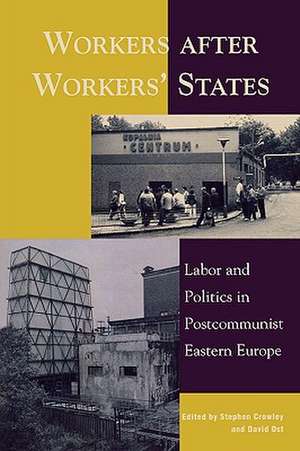
Workers after Workers' States: Labor and Politics in Postcommunist Eastern Europe
Editat de Stephen Crowley, David Ost Contribuţii de Mihail Arandarenko, Grigor Gradev, David Kideckel, Marina Kokanovic, Evgienii Kopatko, Wlodzimierz Panków, Anna Pollert, Jonathan Stein, András Tóthen Limba Engleză Paperback – 19 sep 2001
This book, through the use of comparative case studies, explores the causes, extent, significance, and implications of this weakness. The ten cases-Bulgaria, Croatia, the Czech Republic, Hungary, Poland, Romania, Russia, Serbia, Slovakia, and Ukraine-focus on the status of trade unions and the relationship between labor and politics in each country. Comprising a full array of postcommunist societies, these countries represent a wide variation in labor institutions, political experiences, and economic outcomes. In their introduction and conclusion the editors consider structural, sociological, and ideational explanations for labor decline in the postcommunist era and assess the impact of that weakness on the consolidation of democracy in the region.
Preț: 335.49 lei
Preț vechi: 412.49 lei
-19%
Puncte Express: 503
Preț estimativ în valută:
59.37€ • 69.39$ • 51.55£
59.37€ • 69.39$ • 51.55£
Carte tipărită la comandă
Livrare economică 19 februarie-05 martie
Preluare comenzi: 021 569.72.76
Specificații
ISBN-13: 9780742509993
ISBN-10: 0742509990
Pagini: 256
Dimensiuni: 148 x 230 x 19 mm
Greutate: 0.38 kg
Ediția:0252
Editura: Bloomsbury Publishing
Colecția Rowman & Littlefield Publishers
Locul publicării:New York, United States
ISBN-10: 0742509990
Pagini: 256
Dimensiuni: 148 x 230 x 19 mm
Greutate: 0.38 kg
Ediția:0252
Editura: Bloomsbury Publishing
Colecția Rowman & Littlefield Publishers
Locul publicării:New York, United States
V-ar putea interesa
-
 Small Is BeautifulE F Schumacher-21%Preț: 54.42 lei68.48 lei
 -
 -13%Preț: 341.70 lei394.54 lei
 -
 The Employment Relationship: Examining Psychological and Contextual PerspectivesJacqueline A-M. Coyle-Shapiro-24%Preț: 334.41 lei437.83 lei
 -
 Constructing Identity in and around OrganizationsMajken Schultz-13%Preț: 351.47 lei403.15 lei
 -
 The Oxford Handbook of Management ConsultingMatthias Kipping-12%Preț: 300.77 lei342.90 lei
 -
 Education in a Post Welfare SocietySally Tomlinson-27%Preț: 194.94 lei267.25 lei
 -
 Preț: 83.67 lei
 -
 ProfessionalismEliot FreidsonPreț: 161.83 lei
 -
 Hard Work: Life in Low-Pay BritainPolly Toynbee-28%Preț: 74.13 lei102.75 lei
 -
 Work, Happiness, and UnhappinessPeter Warr-25%Preț: 426.77 lei571.94 lei
 -
 Working the SkiesDrew WhiteleggPreț: 280.59 lei
 -
 Profit from ScienceGeorge DannerPreț: 292.53 lei
 -
 The Middleman EconomyMarina KrakovskyPreț: 364.65 lei
 -
 Preț: 194.78 lei
 -
 -18%Preț: 204.72 lei249.48 lei
Cuprins
Chapter 1 Introduction: The Surprise of Labor Weakness in Post-Communist Society
Chapter 2 Labor and Trade Unions in the Czech Republic, 1989-2000
Chapter 3 The Failure of Social-Democratic Unionism in Hungary
Chapter 4 Neocorporatism in Slovakia: Formalizing Labor Weakness in a (Re)democratizing State
Chapter 5 The Weakness of Symbolic Strength: Labor and Union Identity in Poland: 1989-2000
Chapter 6 Winning the Battles, Losing the War: Contradictions of Romanian Labor in the Post-Communist Transformation
Chapter 7 Bulgarian Trade Unions in Transition: The Taming of the Hedgehog
Chapter 8 The Cost of Nationalism: Croatian Labor, 1990 - 1999
Chapter 9 Waiting for the Workers: Explaining Labor Quiescence in Serbia
Chapter 10 Workers and Unions in Postcommunist Ukraine
Chapter 11 The Social Explosion That Wasn't: Labor Quiescence in Post-Communist Russia
Chapter 12 Conclusion: Making Sense of Labor's Weakness in Poscommunism
Chapter 2 Labor and Trade Unions in the Czech Republic, 1989-2000
Chapter 3 The Failure of Social-Democratic Unionism in Hungary
Chapter 4 Neocorporatism in Slovakia: Formalizing Labor Weakness in a (Re)democratizing State
Chapter 5 The Weakness of Symbolic Strength: Labor and Union Identity in Poland: 1989-2000
Chapter 6 Winning the Battles, Losing the War: Contradictions of Romanian Labor in the Post-Communist Transformation
Chapter 7 Bulgarian Trade Unions in Transition: The Taming of the Hedgehog
Chapter 8 The Cost of Nationalism: Croatian Labor, 1990 - 1999
Chapter 9 Waiting for the Workers: Explaining Labor Quiescence in Serbia
Chapter 10 Workers and Unions in Postcommunist Ukraine
Chapter 11 The Social Explosion That Wasn't: Labor Quiescence in Post-Communist Russia
Chapter 12 Conclusion: Making Sense of Labor's Weakness in Poscommunism
Recenzii
The individual country chapters provide invaluable detail on the development and progress of trade unions in each context. The book will obviously be read by specialists in the field, should be dipped into by country specialists who perhaps know little about this aspect of transition, and could usefully be recommended to those academics and students concerned more generally with trade unions and the collective organization of labor in the twenty-first century.
This book is a valuable contribution to discussions of the future of labor.
The volume as a whole is a helpful guide for understanding trends in labor power in post-communist Europe, as well as broader economic and political change both there and in other transitional societies. Recommended to academic scholars and students of post-communist Europe. Practitioners and policy-makers from the region who are interested in political aspects of union restructuring may also find the book valuable.
This informative volume provides a valuable snapshot of the last 10 years of union politics in Eastern Europe. It offers a sound basis for further debates on union weakness and very suitable material for graduate courses in economic sociology, labor studies, and comparative politics, union or otherwise.
A valuable collection of studies of labour and the Eastern European transition that has much to offer a wider audience.
Crowley and Ost have put together a valuable contribution to the comparative study of labor in postcommunist Eastern Europe including most of the Balkans, the Ukraine, and Russia.
This book is a valuable contribution to discussions of the future of labor.
The volume as a whole is a helpful guide for understanding trends in labor power in post-communist Europe, as well as broader economic and political change both there and in other transitional societies. Recommended to academic scholars and students of post-communist Europe. Practitioners and policy-makers from the region who are interested in political aspects of union restructuring may also find the book valuable.
This informative volume provides a valuable snapshot of the last 10 years of union politics in Eastern Europe. It offers a sound basis for further debates on union weakness and very suitable material for graduate courses in economic sociology, labor studies, and comparative politics, union or otherwise.
A valuable collection of studies of labour and the Eastern European transition that has much to offer a wider audience.
Crowley and Ost have put together a valuable contribution to the comparative study of labor in postcommunist Eastern Europe including most of the Balkans, the Ukraine, and Russia.