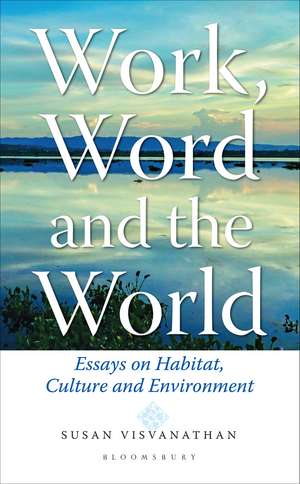
Work, Word and the World: Essays on Habitat, Culture and Environment
Autor Susan Visvanathanen Limba Engleză Hardback – 30 iul 2022
This book tries to bring to the reader the pleasures of many cultures in conversation with one another, where dissonances may be accommodated.
Preț: 524.11 lei
Preț vechi: 790.91 lei
-34%
Puncte Express: 786
Preț estimativ în valută:
92.82€ • 108.40$ • 80.63£
92.82€ • 108.40$ • 80.63£
Carte disponibilă
Livrare economică 31 ianuarie-14 februarie
Preluare comenzi: 021 569.72.76
Specificații
ISBN-13: 9789354356841
ISBN-10: 9354356842
Pagini: 330
Dimensiuni: 142 x 220 x 24 mm
Greutate: 0.52 kg
Editura: Bloomsbury Publishing
Colecția Bloomsbury Academic India
Locul publicării:New Delhi, India
ISBN-10: 9354356842
Pagini: 330
Dimensiuni: 142 x 220 x 24 mm
Greutate: 0.52 kg
Editura: Bloomsbury Publishing
Colecția Bloomsbury Academic India
Locul publicării:New Delhi, India
Cuprins
Introduction
Environmental Concerns
1. Sacred Rivers: Energy Resources and People's Power
2. Ladakh and the Creative Greening of the Desert: The Life Work of Sonam Wangchuk and Rebecca Norman through Alternative Practices in Education and Farming
3. The Territorialisation of Water
Literary Encounters
4. A Time Known to All: Stephanos Stephanides and Ari Sitas
5. Detachment and Faith
6. Songs of Solomon and Adi Shankara's Soundarya Lahari: A Comparison
Habitat and Culture
7. Kalpathy Heritage Village: Sacred and Modern
8. Alternative School Education and the Standardisation of Right to Education Debate
9. The Abyss: Covid-19 and Its Implications
10. Diaspora and Memory
Environmental Concerns
1. Sacred Rivers: Energy Resources and People's Power
2. Ladakh and the Creative Greening of the Desert: The Life Work of Sonam Wangchuk and Rebecca Norman through Alternative Practices in Education and Farming
3. The Territorialisation of Water
Literary Encounters
4. A Time Known to All: Stephanos Stephanides and Ari Sitas
5. Detachment and Faith
6. Songs of Solomon and Adi Shankara's Soundarya Lahari: A Comparison
Habitat and Culture
7. Kalpathy Heritage Village: Sacred and Modern
8. Alternative School Education and the Standardisation of Right to Education Debate
9. The Abyss: Covid-19 and Its Implications
10. Diaspora and Memory
Recenzii
Susan Visvanathan's book of essays ranges widely between activist projects blossoming in stark environments, ancient sacred texts, contemporary world literature, alternative education, Covid-19 and more. Her generous gaze, erudition and her insights delight and enlighten. I thoroughly enjoyed reading Word, Work and the World. This is a remarkable example of transdisciplinary scholarship by a social scientist and a novelist who knows how to re-energise the fertility of modernity and the tradition framework. It is also innovative in utilizing her personal history as data, refreshingly-as well as deeply informatively-breaking with the long-held convention of bracketing the scientist's own life from the research topic. A greatly rewarding read.
I find these essays in the collection, Work, Word and the World extremely profound. Susan Visvanathan and I were both in Cyprus in 2018, reading our papers at a conference organised to honour Stephanos Stephinides, the well-known Cypriot poet. Susan Visvanathan paired Stephanos with Ari Sitas, another poet from Cyprus and I paired Stephanos with our Nissim Ezekiel. Reading her essays now, I realise what a profound scholar with varied intellectual interests I had the good fortune to come across. From the initial unforgettable essays on foregrounding water debates, dams, and forest produce to later essays on King Solomon's Song of Songs, this volume is a treat.
The book is a most worthwhile read for those who have an interest in connecting the larger historical shifts with an analysis of social and cultural aspects. It is a highly valuable addition to the relevant sociological literature and as an educator, I will be searching for opportunities to discuss it with masters and PhD students as an example of ways of researching transformative processes in a global framework.
What an exciting collection of writings and subjects. Among other important subjects, Susan Visvanathan also offers insight into exciting questions related to education. She writes about education not just as an important social issue, but also reflects on its personal aspects, writing about the subject as one of the pillars of our everyday lives. Placing human encounters and everyday events at the centre of her writings and reflecting on them with great wisdom allows us, readers, to engage with the topics raised in this exciting book on a personal level as well.
Alternative visions of education exist and are kept alive in unsuspected corners of the earth. Susan Visvanathan describes the fascinating work being done in the hills of Tiruvannamalai in South India and Leh, Ladakh on the North-West Frontier of India. Her gift lies in her trusting the vivid detail of observation to allow the story to tell itself-while her rumination on education accompanies and enlightens ours. All those who work with young children will relate to the educators whose creative efforts she describes, and all those interested in anthropological narratives of childhood will delight in the vignettes she offers us. She reminds us through the particular to see what is universal in childhood, and that is a precious thing.
I enjoyed reading Word, Work and the World. A lot of it resonates with the background against which interventions from INTACH are made. Preservation of the past for the future requires a strong interdisciplinary understanding and approach. We often deal with disasters arising from 'working in silos' mindset. Susan Visvanathan's new book is seminal to understand the coalescing of histories, traditions, culture and nature in the continued evolution of communities. A must-read for those at the policy level of modernisation and development to appreciate and adopt an interdisciplinary and inclusive approach for preventing inimical development to societal and human interests.
The seemingly effortless prose of the novelist Susan Visvanathan shows us how she can move from the particulars of energy, water and village life to the major issues of work, faith and memory-while always seeing the general in the former and the specific in the latter. These rare talents are the route to, as she herself puts it: an understanding of reality as the people experience it. This is the work of a scholar at the very top of her game.
I find these essays in the collection, Work, Word and the World extremely profound. Susan Visvanathan and I were both in Cyprus in 2018, reading our papers at a conference organised to honour Stephanos Stephinides, the well-known Cypriot poet. Susan Visvanathan paired Stephanos with Ari Sitas, another poet from Cyprus and I paired Stephanos with our Nissim Ezekiel. Reading her essays now, I realise what a profound scholar with varied intellectual interests I had the good fortune to come across. From the initial unforgettable essays on foregrounding water debates, dams, and forest produce to later essays on King Solomon's Song of Songs, this volume is a treat.
The book is a most worthwhile read for those who have an interest in connecting the larger historical shifts with an analysis of social and cultural aspects. It is a highly valuable addition to the relevant sociological literature and as an educator, I will be searching for opportunities to discuss it with masters and PhD students as an example of ways of researching transformative processes in a global framework.
What an exciting collection of writings and subjects. Among other important subjects, Susan Visvanathan also offers insight into exciting questions related to education. She writes about education not just as an important social issue, but also reflects on its personal aspects, writing about the subject as one of the pillars of our everyday lives. Placing human encounters and everyday events at the centre of her writings and reflecting on them with great wisdom allows us, readers, to engage with the topics raised in this exciting book on a personal level as well.
Alternative visions of education exist and are kept alive in unsuspected corners of the earth. Susan Visvanathan describes the fascinating work being done in the hills of Tiruvannamalai in South India and Leh, Ladakh on the North-West Frontier of India. Her gift lies in her trusting the vivid detail of observation to allow the story to tell itself-while her rumination on education accompanies and enlightens ours. All those who work with young children will relate to the educators whose creative efforts she describes, and all those interested in anthropological narratives of childhood will delight in the vignettes she offers us. She reminds us through the particular to see what is universal in childhood, and that is a precious thing.
I enjoyed reading Word, Work and the World. A lot of it resonates with the background against which interventions from INTACH are made. Preservation of the past for the future requires a strong interdisciplinary understanding and approach. We often deal with disasters arising from 'working in silos' mindset. Susan Visvanathan's new book is seminal to understand the coalescing of histories, traditions, culture and nature in the continued evolution of communities. A must-read for those at the policy level of modernisation and development to appreciate and adopt an interdisciplinary and inclusive approach for preventing inimical development to societal and human interests.
The seemingly effortless prose of the novelist Susan Visvanathan shows us how she can move from the particulars of energy, water and village life to the major issues of work, faith and memory-while always seeing the general in the former and the specific in the latter. These rare talents are the route to, as she herself puts it: an understanding of reality as the people experience it. This is the work of a scholar at the very top of her game.