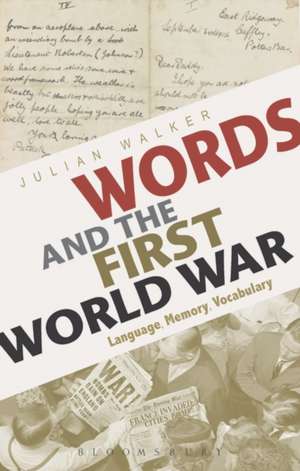
Words and the First World War: Language, Memory, Vocabulary
Autor Julian Walkeren Limba Engleză Hardback – 28 dec 2017
First World War expert Julian Walker looks at how the conflict shaped English and its relationship with other languages. He considers language in relation to mediation and authenticity, as well as the limitations and potential of different kinds of verbal communication. Walker also examines:
- How language changed, and why changed language was used in communications
- Language used at the Front and how the 'language of the war' was commercially exploited on the Home Front
- The relationship between language, soldiers and class
- The idea of the 'indescribability' of the war and the linguistic codes used to convey the experience
'Languages of the front' became linguistic souvenirs of the war, abandoned by soldiers but taken up by academics, memoir writers and commentators, leaving an indelible mark on the words we use even today.
| Toate formatele și edițiile | Preț | Express |
|---|---|---|
| Paperback (1) | 141.46 lei 6-8 săpt. | |
| Bloomsbury Publishing – 28 dec 2017 | 141.46 lei 6-8 săpt. | |
| Hardback (1) | 421.31 lei 6-8 săpt. | |
| Bloomsbury Publishing – 28 dec 2017 | 421.31 lei 6-8 săpt. |
Preț: 421.31 lei
Preț vechi: 542.61 lei
-22%
Puncte Express: 632
Preț estimativ în valută:
74.48€ • 87.19$ • 65.04£
74.48€ • 87.19$ • 65.04£
Carte tipărită la comandă
Livrare economică 06-20 martie
Preluare comenzi: 021 569.72.76
Specificații
ISBN-13: 9781350001930
ISBN-10: 1350001937
Pagini: 418
Ilustrații: 50 bw images
Dimensiuni: 138 x 216 x 24 mm
Greutate: 0.63 kg
Ediția:HPOD
Editura: Bloomsbury Publishing
Colecția Bloomsbury Academic
Locul publicării:London, United Kingdom
ISBN-10: 1350001937
Pagini: 418
Ilustrații: 50 bw images
Dimensiuni: 138 x 216 x 24 mm
Greutate: 0.63 kg
Ediția:HPOD
Editura: Bloomsbury Publishing
Colecția Bloomsbury Academic
Locul publicării:London, United Kingdom
V-ar putea interesa
-
 Preț: 392.70 lei
 -
 The History of Tense/Aspect/Mood/Voice in the Mayan Verbal ComplexJohn S. RobertsonPreț: 193.13 lei
 -
 A History of the Spanish Language through TextsChristopher PountainPreț: 473.03 lei
 -
 First Exposure to a Second LanguageZhaohong Han-14%Preț: 693.56 lei806.47 lei
 -
 A Short Account of the Hebrew TensesR. H. KennettPreț: 227.06 lei
 -
 Linguistics and Evolution: A Developmental ApproachJulie Tetel AndresenPreț: 316.06 lei
 -
 The Recovery of the Ancient Hebrew Language: An Inaugural LectureDavid Winton ThomasPreț: 116.69 lei
 -
 Preț: 235.56 lei
 -
 GreekGeoffrey HorrocksPreț: 348.70 lei
 -
 Speaking Our MindsThom Scott-Phillips-21%Preț: 257.32 lei326.45 lei
 -
 Our World American English Starter StudentbookDiane PinkleyPreț: 224.75 lei
 -
 A Brief History of Ancient GreekStephen Colvin-8%Preț: 543.21 lei590.45 lei
 -
 Preț: 111.82 lei
 -
 -23%Preț: 1493.85 lei1940.06 lei
 -
 Expletive and Referential Subject Pronouns in Medieval FrenchMichael Zimmermann-23%Preț: 1110.21 lei1441.83 lei
 -
 Esquisse de phonologie et de morphologie historique du tangouteGuillaume Jacques-23%Preț: 1054.52 lei1369.51 lei
Cuprins
Part I: Language, Dialect and the Need to Communicate
1. Slang, dialect and status
2. The need to communicate
3. Understanding 'the other'
Part II: Language at the Front
4. Our language
5. Etymologies
6. How lingua franca developed
7. Glossaries
8. Language as weapon and trophy
9. Control, and self-control
10. Avoidance
11. Wordplay
12. The sound of war
13. Language in combat
14. The destruction of the body
15. Failure
16. Unacceptable weapons
Part III: 'Us' and 'Them'
17. Race
18. Naming the enemy
19. How others spoke
20. Naming 'our' side
21. The female
Part IV: The Home Front
22. Commerce and war language
23. DORA and the control of words
24. Outrage
25. Women and children
Part V: Owning the Language
26. Class war
27. 'Not us'
28. Our language
Part VI: Letting Go
29. Losing the language of war
30. The language of commemoration
31. Silence
32. Post-war war talk
33. War porn
34. Then and now
Bibliography
Index
1. Slang, dialect and status
2. The need to communicate
3. Understanding 'the other'
Part II: Language at the Front
4. Our language
5. Etymologies
6. How lingua franca developed
7. Glossaries
8. Language as weapon and trophy
9. Control, and self-control
10. Avoidance
11. Wordplay
12. The sound of war
13. Language in combat
14. The destruction of the body
15. Failure
16. Unacceptable weapons
Part III: 'Us' and 'Them'
17. Race
18. Naming the enemy
19. How others spoke
20. Naming 'our' side
21. The female
Part IV: The Home Front
22. Commerce and war language
23. DORA and the control of words
24. Outrage
25. Women and children
Part V: Owning the Language
26. Class war
27. 'Not us'
28. Our language
Part VI: Letting Go
29. Losing the language of war
30. The language of commemoration
31. Silence
32. Post-war war talk
33. War porn
34. Then and now
Bibliography
Index
Recenzii
Edifying and readable . [An] indispensable reference [tool] for anyone researching twentieth-century history and literature, not only the documents of war.
This is a substantial book, dense but always accessible, covering both time and space. Gratifyingly, it sidesteps an all too common error that entraps books on words, of becoming no more than a padded dictionary.
An illustrated analytical study, [Words and the First World War] considers the situation at home, at war, and under categories such as race, gender and class to give a many-sided picture of language used during the conflict.
The most striking aspect of this work is its extraordinary scope of research and consequent breadth of material . [This is] an invaluable resource for researchers in all aspects of the First World War, as well as for any reader interested in the relationship between the experience of war and the language which informs it and which it creates . A comprehensive, important and useful contribution to scholarly work.
Julian Walker's Words and the First World War provides a rich account of the linguistic world that emerged from the western front during the First World War. The book convincingly demonstrates that for British and Dominion troops, language functioned as a mechanism for coping with the traumatic experiences of war, a means of dealing with separation from home, and a way of mastering and knowing new, unfamiliar environments . Words and the First World War provides a highly detailed discussion of its topic, based on extensive research of soldiers' diaries, letters, postcards, published memoirs, and trench newspapers, as well as newspapers and other materials produced on the home front. It constitutes one of the most authoritative discussions of trench talk and wartime slang, and forms part of a longer tradition of lexicography . A comprehensive, colorful, and highly engaging exploration of how the First World War transformed the English language.
Words and the First World War is the first comprehensive scholarly examination of how the First World War shaped the English language. Drawing from an impressive range of sources, Julian Walker studies how the language of the front lines became adopted, adapted, and popularised in everything from private letters to newspapers to advertising. This book is destined to be the definitive study of trench talk, propaganda, and words that endured long after the Armistice.
Julian Walker's Words and the First World War is a fine study of the myriad ways soldiers used language as a tool of play and survival. At once moving and amusing, his book should be required reading for that broad section of the public still fascinated by the catastrophe we call the Great War.
Walker's wide-ranging and engaging study of the 'linguistic phenomena' that marked the First World War and shaped its cultural memory makes an important contribution to our understanding of 1914-1918. Through media ranging from letters and postcards to advertisements and books Walker highlights an astonishing range of soldier slang, multilingual exchange, censorship of the written and spoken word (and the ways it was circumvented), home front and family colloquialisms, and the language of sacrifice and remembrance, all accompanied by striking illustrations. Words and the First World War masterfully highlights 'the huge and diverse culture of verbal and written communication' that marked the war years and its aftermath-a culture of words that continues to have resonance one hundred years on.
This is a substantial book, dense but always accessible, covering both time and space. Gratifyingly, it sidesteps an all too common error that entraps books on words, of becoming no more than a padded dictionary.
An illustrated analytical study, [Words and the First World War] considers the situation at home, at war, and under categories such as race, gender and class to give a many-sided picture of language used during the conflict.
The most striking aspect of this work is its extraordinary scope of research and consequent breadth of material . [This is] an invaluable resource for researchers in all aspects of the First World War, as well as for any reader interested in the relationship between the experience of war and the language which informs it and which it creates . A comprehensive, important and useful contribution to scholarly work.
Julian Walker's Words and the First World War provides a rich account of the linguistic world that emerged from the western front during the First World War. The book convincingly demonstrates that for British and Dominion troops, language functioned as a mechanism for coping with the traumatic experiences of war, a means of dealing with separation from home, and a way of mastering and knowing new, unfamiliar environments . Words and the First World War provides a highly detailed discussion of its topic, based on extensive research of soldiers' diaries, letters, postcards, published memoirs, and trench newspapers, as well as newspapers and other materials produced on the home front. It constitutes one of the most authoritative discussions of trench talk and wartime slang, and forms part of a longer tradition of lexicography . A comprehensive, colorful, and highly engaging exploration of how the First World War transformed the English language.
Words and the First World War is the first comprehensive scholarly examination of how the First World War shaped the English language. Drawing from an impressive range of sources, Julian Walker studies how the language of the front lines became adopted, adapted, and popularised in everything from private letters to newspapers to advertising. This book is destined to be the definitive study of trench talk, propaganda, and words that endured long after the Armistice.
Julian Walker's Words and the First World War is a fine study of the myriad ways soldiers used language as a tool of play and survival. At once moving and amusing, his book should be required reading for that broad section of the public still fascinated by the catastrophe we call the Great War.
Walker's wide-ranging and engaging study of the 'linguistic phenomena' that marked the First World War and shaped its cultural memory makes an important contribution to our understanding of 1914-1918. Through media ranging from letters and postcards to advertisements and books Walker highlights an astonishing range of soldier slang, multilingual exchange, censorship of the written and spoken word (and the ways it was circumvented), home front and family colloquialisms, and the language of sacrifice and remembrance, all accompanied by striking illustrations. Words and the First World War masterfully highlights 'the huge and diverse culture of verbal and written communication' that marked the war years and its aftermath-a culture of words that continues to have resonance one hundred years on.