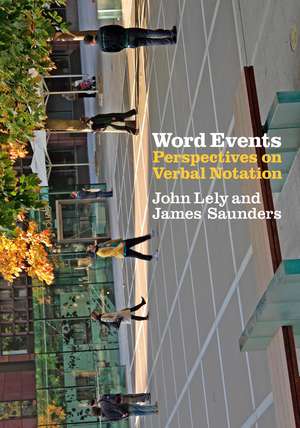
Word Events: Perspectives on Verbal Notation
Autor Dr. John Lely, James Saundersen Limba Engleză Paperback – 19 iul 2012
Considerăm că experiența parcurgerii volumului Word Events este echivalentă cu pătrunderea într-un laborator al avangardei, unde sunetul se eliberează de constrângerile portativului tradițional. Încă de la primele pagini, suntem invitați să privim cuvântul nu doar ca pe un vehicul semantic, ci ca pe un instrument de precizie compozițională. Calitatea ediției publicate de Bloomsbury Publishing permite o imersiune vizuală în estetica minimalistă a partiturilor-eveniment, oferind cititorului șansa de a vedea cum instrucțiuni simple pot genera universuri sonore complexe.
Structura volumului este riguros organizată pentru a ghida cititorul prin acest teritoriu hibrid. Prima parte, dedicată „Gramaticii”, analizează mecanismele lingvistice — timp, mod, voce — care fac notația verbală funcțională. A doua parte reprezintă inima cărții, reunind peste 170 de partituri semnate de figuri iconice precum John Cage sau Yoko Ono. Ca și The Ashgate Research Companion to Experimental Music, această lucrare pune în valoare diversitatea practicii experimentale, dar cu un accent distinct pe rolul textului ca partitură autonomă, oferind comentarii care contextualizează fiecare strategie compozițională. Ritmul lecturii alternează între rigoarea analitică a eseurilor și libertatea interpretativă a partiturilor de tip „prose score”.
Reținem acest volum ca pe o resursă fundamentală care documentează momentul în care muzica, artele vizuale și performance-ul au fuzionat prin intermediul limbajului. Este o cartografiere a indeterminării, unde autorii Dr. John Lely și James Saunders reușesc să transforme un material scholarly într-o experiență senzorială despre potențialul infinit al instrucțiunilor scrise.
Preț: 222.23 lei
Preț vechi: 405.68 lei
-45%
Carte tipărită la comandă
Livrare economică 08-22 decembrie
Specificații
ISBN-10: 1441173102
Pagini: 488
Ilustrații: 80
Dimensiuni: 174 x 252 x 34 mm
Greutate: 0.84 kg
Ediția:New.
Editura: Bloomsbury Publishing
Colecția Continuum
Locul publicării:New York, United States
V-ar putea interesa
-
 I'm Your ManSylvie Simmons-16%Preț: 93.55 lei110.76 lei
 -
 Music in Ireland: Experiencing Music, Expressing CultureDorothea E. Hast-23%Preț: 600.77 lei780.22 lei
 -
 Bollywood Sounds: The Cosmopolitan Mediations of Hindi Film SongJayson Beaster-Jones-21%Preț: 302.35 lei380.40 lei
 -
 Shakespeare and the American MusicalIrene G. DashPreț: 157.08 lei
 -
 The Words and Music of PrinceJames E. Perone-40%Preț: 483.95 lei803.97 lei
 -
 Popular Music StudiesDavid Hesmondhalgh-24%Preț: 244.41 lei323.23 lei
 -
 Cut `n' Mix: Culture, Identity and Caribbean MusicDick HebdigePreț: 368.05 lei
 -
 PlayformsRobin CookPreț: 139.58 lei
 -
 Sugar ManCraig Bartholomew Strydom-18%Preț: 76.77 lei93.94 lei
 -
 The Italian GirlJames SaundersPreț: 99.93 lei
 -
 Making It BetterJames SaundersPreț: 102.24 lei
 -
 Double, DoubleJames SaundersPreț: 87.48 lei
 -
 Call Me the Seeker: Listening to Religion in Popular MusicMichael J. Gilmour-31%Preț: 467.22 lei674.90 lei
 -
 -39%Preț: 2053.79 lei3351.66 lei
 -
 -39%Preț: 2048.87 lei3349.09 lei
 -
 -38%Preț: 189.67 lei306.27 lei
 -
 The Road Beneath My FeetFrank Turner-26%Preț: 69.60 lei93.44 lei
 -
 You Don't Own MeTrevor TolliverPreț: 151.14 lei
 -
 DJ Culture in the Mix: Power, Technology, and Social Change in Electronic Dance MusicProfessor and Department Chair Bernardo Attias-15%Preț: 258.84 lei306.22 lei
 -
 Popkiss: The Life and Afterlife of Sarah RecordsMichael White-38%Preț: 131.58 lei212.83 lei
 -
 Preț: 283.69 lei
De ce să citești această carte
Recomandăm această carte muzicienilor și artiștilor care doresc să exploreze granițele dintre text și sunet. Veți câștiga acces la o arhivă impresionantă de peste 170 de partituri experimentale, multe inaccesibile până acum. Este un instrument esențial pentru înțelegerea mișcării Fluxus și a muzicii experimentale postbelice, oferind atât baza teoretică, cât și exemple practice pentru noi forme de creativitate interdisciplinară.
Despre autor
Dr. John Lely este un compozitor și interpret preocupat de limitele notației și ale sunetului, fiind un practician activ în sfera muzicii experimentale. James Saunders este compozitor și profesor în cadrul Centrului de Cercetare Muzicală de la Bath Spa University. Expertiza sa în domeniu este recunoscută la nivel internațional, fiind și editorul volumului The Ashgate Research Companion to Experimental Music. Împreună, cei doi autori aduc o perspectivă dublă — academică și practică — asupra modului în care instrucțiunile verbale pot defini actul artistic contemporan.
Descriere
Word Events features over 170 scores, many printed here for the first time, representing the works of more than 50 practitioners including George Brecht, John Cage, Cornelius Cardew, Pauline Oliveros, Yoko Ono, Michael Pisaro, Karlheinz Stockhausen, Jennifer Walshe and La Monte Young.
The commentaries in the book explore the compositional strategies and performance practice of particular works, contextualised by key essays, including previously hard-to-find texts by Lawrence Halprin and Kenneth Maue, together with many new statements and interviews from composers, artists and performers. This unique and wide-ranging collection of scores and writings will be indispensable to musicians, artists, those involved with community arts, and anyone with an interest in exploring the rich potential of the written word.
Cuprins
Introduction
Acknowledgements
Part 1: Grammar
On the use of grammar in verbal notation
Introduction
Grammars
Context
Register
Processes
Tense
Modality
Mood
Voice
Circumstances
Postscript
Part 2: Scores, Writings and Commentaries
Eric Andersen
Opus 18 (1961)
In Mezzo a Quattro Tempi
Robert Ashley
The Entrance (1965-6)
Some notes on a performance of The Entrance
Commentary: The Entrance
G. Douglas Barrett
A Few Silence (location, date, time of performance) (2008)
A Text Score Manifesto
Commentary
Antoine Beuger
one tone. rather short. very quiet (1998)
Commentary
George Brecht
Time-Table Music (1959) and Time-Table Event (1961)
The Origin of 'Events'
Commentary
Gavin Bryars
Far Away and Dimly Pealing (1970)
On Verbal Notation
Commentary
Arthur Bull
From 25 Scores (1994)
Statement on text scores
John Cage
Solo for Voice 6 (1970)
Commentary
Cornelius Cardew
On the Role of the Instructions in the Interpretation of
Indeterminate Music
The Great Learning, Paragraph 6 (1968-71)
Commentary
Tony Conrad
Selected pieces from 1961 compositions
Word Scoring
Philip Corner
Music notation is about specifics*; Words are generalisations.
GAMELAOONY (2004)
Commentary
Bill Drummond
SHOW (2007)
MY SCORES & ME
Ken Friedman
Zen Vaudeville (1966)
Events, Scores, Notations
Malcolm Goldstein
wood stone metal skin, with voice (1983)
Statement on verbal notation
Daniel Goode
Relaxing at the Piano (1977)
Conceptual, Verbal, and Graphic Scores
Lawrence Halprin
A Summary of the Characteristics of Scores, from The RSVP Cycles:
Creative Processes in the Human Environment (1969)
Tom Johnson
The Big Rumble and the Tiny Blip, from Private Pieces (1976)
On Private Pieces: Piano Music for Self-Entertainment
Seth Kim-Cohen
Forever Got Shorter (from a t-shirt of the same name) (2010)
How To Write A Text About How To Write A Text Score (And Why)
Some thoughts on Forever Got Shorter
Realising Forever Got Shorter
Bengt af Klintberg
From Twenty Five Orange Events (1963-6)
Peel an orange carefully ...
Alison Knowles
Shoes of Your Choice (1963)
Commentary
Takehisa Kosugi
South No. 3 (Malika) (1965)
Commentary
Joseph Kudirka
superstition's willing victim (2007)
Commentary
Sol LeWitt 270
Wall Drawing #960 (2001)
Wall Drawings
Doing Wall Drawings
Annea Lockwood
From the River Archive (1973)
Statement
Alvin Lucier
Notes on Verbal Notation
Music on a Long Thin Wire (1977)
Realising Music on a Long Thin Wire
George Maciunas
In Memoriam to Adriano Olivetti (1962)
Commentary
Benedict Mason
telling (2002)
outside sight unseen and opened (2002)
Kenneth Maue
From 'Ideas Around the Experiences', in Water in the Lake:
Real Events for the Imagination
Max Neuhaus
LISTEN (1966)
LISTEN
Pauline Oliveros
Ear Piece (1998)
Commentary
Michael Parsons
Walk (1969)
Commentary
Ben Patterson
Solo for Dancer (1962)
On Solo for Dancer
Michael Pisaro
Only (2005-6)
Ten Encounters (A Personal Text Score History)
Commentary
Erik Satie
Performance Indications
Craig Shepard
Lines (1) and Lines (2) (1999)
Use of text notation
Kunsu Shim
PLACES with Airhorn (1999)
Statement: Verbal Notation
Mieko (Chieko) Shiomi
Event scores (1963-4)
Text Notation
Hugh Shrapnel
Houdini Rite (1970)
Verbal Music
Howard Skempton
for Strings (1969)
On for Strings
Mark So
Some forgotten day (sparse winter) (2009)
Text | composition - scores and structure after 4'33"
Karlheinz Stockhausen
RIGHT DURATIONS (1968)
Commentary
Jennifer Walshe
dirty white fields (2002)
Commentary
Manfred Werder
20051
Text Scores - Statement (1)
Statement on Indeterminacy
Commentary
John White
Newspaper-Reading Machine (c. 1971)
Statement on Verbal Notation
Commentary
Michael Winter
for Sol LeWitt (2009)
Relativity and Scalability in Respect to Sound and Silence
Daniel Wolf
The Long March (2009)
Notes with or without Notes
Christian Wolff
Stones (1968)
On verbal notations
Commentary
Amnon Wolman
February 26, 2000
Statement
La Monte Young
Compositions 1960
11 II 07 Corrected Numbering System for 1960 Works
Commentary
Why I Withdrew from Fluxus
Sources
Bibliography
Recenzii
"The 1960s and 1970s were, in the words of composer David Behrman, a time in which 'established techniques were thrown away and the nature of sound was dealt with from scratch.' The five-line staff collapsed under the weight of innovations like indeterminacy, Fluxus, live electronic music, performance art, and sound installations. The verbal score emerged as a pragmatic, egalitarian alternative. Today, with Sound Art ascendant, these scores have a newfound significance for all those concerned with performance outside the continuum of traditionally notated Western music. Sadly, the majority of these self-published documents remain exceedingly difficult to find, despite widespread webification of historical flotsam. In this volume Lely and Saunders have assembled an extraordinary collection of important scores, ranging from the exalted to the ephemeral. The inclusion of commentary by the artists themselves, as well as the first systematic analysis of the various forms of prose score, makes Word Events an invaluable resource for scholars and practicing artists alike." - Nicolas Collins, Professor, Department of Sound, The School of the Art Institute of Chicago, and Editor-in-Chief, Leonardo Music Journal