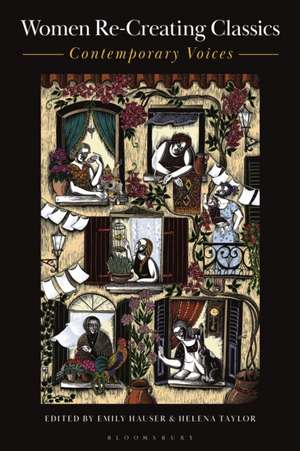
Women Re-Creating Classics: Contemporary Voices
Editat de Dr Emily Hauser, Helena Tayloren Limba Engleză Paperback – 10 iul 2025
Ne-a atras atenția în mod deosebit capitolul semnat de Madeline Miller, „Classics and Craft”, care stabilește tonul pentru această explorare interdisciplinară a modului în care vocea feminină contemporană reînvie antichitatea. Volumul Women Re-Creating Classics, editat de Dr Emily Hauser și Helena Taylor, reprezintă a doua parte a unui proiect ambițios ce analizează explozia recentă de re-interpretări ale miturilor grecești, punând față în față rigoarea academică și libertatea creativă. Subliniem faptul că structura cărții este una hibridă: cititorul va găsi aici nu doar analize critice, ci și texte originale — de la poezia lui Jennifer Saint despre Euridice, până la fragmente din lucrările lui Roz Kaveney sau Fiona Benson.
Această ediție publicată de Bloomsbury Academic funcționează ca o alternativă practică la Women Versed in Myth pentru cursurile de literatură comparată și studii de gen, având avantajul includerii unor interviuri și mese rotunde între practicieni și cercetători, ceea ce facilitează o înțelegere directă a procesului de scriere. Merită menționat că lucrarea se integrează organic în opera lui Dr Emily Hauser, continuând direcția începută în Women Creating Classics și Reading Poetry, Writing Genre, unde autoarea investighează modul în care genurile literare și perspectivele de gen modelează recepția textelor homerice.
Progresia volumului, de la „Creative Voices” la discuții despre pedagogia incluzivă, indică o dorință clară de a democratiza accesul la cultura clasică. Este o resursă esențială pentru mediul universitar, oferind instrumente teoretice și exemple practice despre cum antichitatea poate fi folosită pentru a aborda teme contemporane legate de identitate, rasă și clasă socială, eliminând barierele dintre critica literară și actul creației propriu-zise.
Preț: 188.06 lei
Preț vechi: 221.58 lei
-15%
Carte disponibilă
Livrare economică 11-25 noiembrie
Livrare express 27-31 octombrie pentru 70.66 lei
Specificații
ISBN-10: 1350445088
Pagini: 344
Ilustrații: 4 bw illus.
Dimensiuni: 156 x 234 x 22 mm
Greutate: 0.54 kg
Editura: Bloomsbury Publishing
Colecția Bloomsbury Academic
Locul publicării:London, United Kingdom
De ce să citești această carte
Recomandăm această carte cercetătorilor și studenților la litere care doresc să înțeleagă fenomenul actual al re-povestirilor mitologice. Cititorul câștigă o perspectivă unică asupra procesului creativ din spatele unor bestselleruri internaționale, descoperind cum figuri precum Madeline Miller sau Anne Carson transformă studiile clasice dintr-o disciplină elitistă într-un spațiu de dialog incluziv și vibrant, adaptat provocărilor secolului XXI.
Descriere
This second volume in a two-volume set brings together original creative work by some of the many women writers who are pushing forward changes in the landscape of re-creating Classics, from Madeline Miller to Jennifer Saint, Emily Hauser, Caroline Lawrence, Roz Kaveney, Nikita Gill, Fiona Benson, Anne Carson and many more. These are set alongside discussions and interviews between writers and academics, roundtable conversations among poets and critics, and reflections on creative and inclusive pedagogy-thus offering a cutting-edge collaboration between practitioners and researchers, and underlining the centrality of women's re-creations of Classics to the contemporary shaping of the field.
Cuprins
List of Contributors
Acknowledgments
Introduction (Emily Hauser and Helena Taylor, Exeter University, UK)
Creative Voices
1. Rewriting Greek Myth as a Woman (Emily Hauser, Exeter University, UK)
2. Classics and Craft (Madeline Miller, Independent Scholar, USA)
3. Return to the Labyrinth: Retelling the Stories of Mythical Women in Contemporary Poetry (Fiona Benson, Independent Scholar, UK)
4. Eurydice (Jennifer Saint, King's College London, UK)
5. Only Hope Remained (Rani Selvarajah, Independent Scholar, UK)
6. In the Bad Times (Cait Kremenstein, Independent Scholar, UK)
7. The Homeric Hymn to Dionysus (Roz Kaveney, Independent Scholar, UK)
8. Stage Manager's Notes (Gwyneth Lewis, Independent Scholar, UK)
9. Excerpt from Exit Kassandra (Carrie Etter, University of Bristol, UK)
10. a vespere nomen: An extract from patient zero (Kit Byford, Independent Scholar, UK)
11. The Real Sappho: Writing the Tenth Muse for the Contemporary Stage (Aimee Suzara, San Francisco State University and College of San Mateo, USA)
12. Suspended Animation: How the Fetish World Gave Life to Catullus and Callimachus (Isobel Williams, Independent Scholar, UK)
13. Transforming Voices: Ovid's Metamorphoses in Translation (Victoria Punch, Exeter University, UK)
14. Self-portrait in Egg (excerpt) (Jane Alison, University of Virginia, USA)
15. Declassifying Myself (Donna Zuckerberg, Independent Scholar, USA)
Collaborations and Conversations
16. The Genesis and Creation of Dido/Elissa, a New Play by Magdalena Zira (Magdalena Zira, Independent Scholar, Cyprus; Edith Hall, Durham University, UK)
17. On Not Turning to Stone: Unstaging Women's Sexual Trauma in an Adaptation of the Myth of Medusa (Wendy Haines, Independent Scholar, UK; Christine Plastow, Open University, UK)
18. The Music of Homer: Anne Carson's TROYJAM (Yopie Prins, University of Michigan, USA; Anne Carson, Independent Scholar, Canada)
19. Contemporary Women Writers: On Creativity in Recreating the Classics (Clare Pollard and Carrie Etter, Independent Scholars, UK)
20. Interview with Gwyneth Lewis, by Polly Stoker (University of Winchester, UK)
21. Interview with Selby Wynn Schwartz, by Helena Taylor (University of Exeter, UK)
22. Interview with Ronni Kern, by Ruby Blondell (University of Washington, USA)
23. Interview with Roz Kaveney, by Jennifer Ingleheart (Durham University, UK)
24. Interview with Nikita Gill, by Emily Hauser (University of Exeter, UK)
Creativity for the Future and Inclusive Classics
25. Students Shaping Classics: Non-traditional, Open Assessment, Creativity, Inclusivity and Shifting Disciplinary Boundaries (Helen Lovatt, University of Nottingham, UK)
26. Creative Teaching: Facing the Fear and Doing it Anyway (Sharon Marshall, University of Exeter, UK)
27. Imagining a World of Gods and Spirits Using Smells, Bells and More: A Creative Writing Workshop (Caroline Lawrence)
28. Breaking the Form: Women Writers across Creative and Critical Practice (Tom Geue, University of St. Andrews, UK; Emily Hauser, University of Exeter, UK; Daisy Dunn, Independent Scholar, UK)
29. Epilogue: No Going Back (Emily Greenwood, Harvard University, USA)
Notes
Bibliography
Index
Recenzii
Women Re-Creating Classics: Contemporary Voices offers audiences an opportunity to flip the mirror of classical mythology and reflect it against our own experiences and visions. The most unique contributions of this volume come from the creative works by women novelists, poets and playwrights who have thoughtfully and beautifully engaged with classical tales of violence, oppression and heroism. Alongside well-known figures like M. Miller and J. Saint, the second half of this volume brings these creative voices into direct dialogue with more conventional scholars, allowing us to see the creative process and choices in action. For those considering this feminist neoclassical moment in the 21st century-its inspirations and implications-this is a key volume that places a wide range of diverse voices in context and conversation, rather than lionising only a few well-known bestsellers and pop hits.