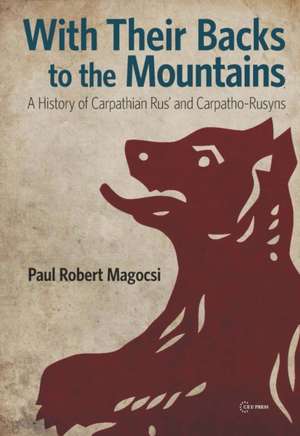
With Their Backs to the Mountains: A History of Carpathian Rus' and Carpatho-Rusyns
Autor Paul Robert Magocsien Limba Engleză Paperback – dec 2015
Adresat cu precădere studenților la istorie, cercetătorilor specializați în Europa Centrală și practicienilor din domeniul geopoliticii, With Their Backs to the Mountains oferă o sinteză exhaustivă asupra unui popor fără stat, dar cu o identitate rezilientă. Observăm cum Paul Robert Magocsi depășește simpla cronică istorică, oferind un instrument de lucru esențial pentru înțelegerea mecanismelor prin care o comunitate este „construită” și menținută în ciuda granițelor fluctuante. Cartea reprezintă o alternativă academică solidă la Into the Carpathians pentru cursurile de istorie regională, având avantajul unei rigori științifice superioare și al unei documentări cartografice de excepție.
Remarcăm structura metodică a lucrării, care debutează cu o analiză a geografiei fizice și umane, stabilind cadrul pentru o incursiune cronologică ce pornește de la așezările preistorice și interacțiunea cu Imperiul Roman și dacii. Această ediție extinsă analizează complexitatea spațiului de graniță, unde identitatea ruteană a fost supusă presiunilor imperiale și comuniste, pentru a renaște spectaculos după colapsul regimurilor totalitare în 1989. Spre deosebire de Ruthenians (the Rus') in the Kingdom of Hungary (11th to Mid- 14th Century), care se concentrează pe o perioadă medievală specifică, volumul de față acoperă întregul arc temporal până în contemporaneitate.
Apreciem modul în care autorul integrează datele demografice și disputele istoriografice despre originea slavilor în contextul mai larg al operei sale. Dacă în Jews and Ukrainians sau Babyn Yar Magocsi explora tensiunile și tragediile interetnice, aici se concentrează pe procesul de formare națională a rutenilor, oferind o perspectivă clară asupra modului în care o „comunitate imaginată” devine realitate politică și culturală.
Preț: 540.98 lei
Preț vechi: 588.02 lei
-8%
Carte disponibilă
Livrare economică 13-27 noiembrie
Specificații
ISBN-10: 6155053391
Pagini: 564
Ilustrații: 102 illustrations, 34 maps
Dimensiuni: 156 x 234 x 31 mm
Greutate: 0.84 kg
Ediția:1
Editura: Amsterdam University Press
Colecția Central European University Press
Locul publicării:Oxford, United Kingdom
V-ar putea interesa
-
 ComradesPaul PrestonPreț: 122.19 lei
 -
 1812 NAPOLEONS FATAL MARCH PBAdam ZamoyskiPreț: 142.67 lei
 -
 The Basque History Of The WorldMark Kurlansky-18%Preț: 77.76 lei94.74 lei
 -
 Hitlers ScientistsJohn CornwellPreț: 129.86 lei
 -
 The Oxford History of Modern EuropeT. C. W. Blanning-19%Preț: 98.87 lei121.96 lei
 -
 France: The Dark Years, 1940-1944Julian Jackson-20%Preț: 164.28 lei206.59 lei
 -
 Mastering Twentieth-Century Russian HistoryNorman Lowe-23%Preț: 259.36 lei336.93 lei
 -
 Heinemann Advanced History: Lenin and the Russian RevolutionSteve PhillipsPreț: 272.73 lei
 -
 Heinemann Advanced History: Stalinist RussiaSteve PhillipsPreț: 272.29 lei
 -
 Preț: 338.28 lei
 -
 Romania: An Illustrated HistoryNicolae KlepperPreț: 101.17 lei
 -
 A History of UkrainePaul Robert Magocsi-15%Preț: 482.62 lei567.79 lei
Public țintă
AcademicDe ce să citești această carte
Recomandăm această lucrare oricărui cititor interesat de istoria Europei Centrale și de mecanismele identității naționale. Cititorul câștigă o înțelegere profundă a regiunii rutene prin intermediul celor 34 de hărți detaliate și al analizei critice a surselor. Este o resursă fundamentală pentru a înțelege cum un popor dispersat între Ucraina, Slovacia și diaspora americană își păstrează unitatea culturală în absența unui stat propriu.
Despre autor
Paul Robert Magocsi este profesor de istorie și științe politice la Universitatea din Toronto, unde deține catedra de studii ucrainene. Membru al Societății Regale din Canada, Magocsi este recunoscut internațional ca unul dintre cei mai importanți specialiști în istoria rutenilor și a naționalismului în Europa Centrală și de Est. Opera sa vastă explorează complexitatea relațiilor etnice și evoluția statalității în regiunea carpatică, fiind un punct de referință pentru istoriografia modernă a spațiului slav.
Descriere scurtă
At the present, when it is fashionable to speak of nationalities as “imagined communities” created by intellectuals or elites who may live in the historic homeland, Carpatho-Rusyns provide an ideal example of a people made—or some would say still being made—before our very eyes. The book traces the evolution of Carpathian Rus’ from earliest prehistoric times to the present, and the complex manner in which a distinct Carpatho-Rusyn people, since the mid-nineteenth century, came into being, disappeared, and then re-appeared in the wake of the revolutions of 1989 and the collapse of communist rule in central and eastern Europe.
To help guide the reader further there are 34 detailed maps plus an annotated discussion of relevant books, chapters, and journal articles.