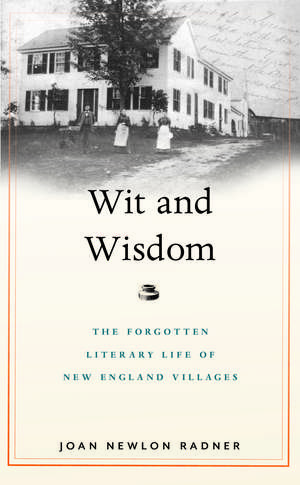
Wit and Wisdom
Autor Joan Newlon Radneren Limba Engleză Paperback – 30 iun 2023
Wit and Wisdom takes readers inside this long-forgotten tradition, providing new access to the vibrant voices, surprising talents, and understated humor on display on many a cold winter’s night. Having uncovered dozens of handwritten newspapers produced by village lyceums across Maine, New Hampshire, Vermont, and Massachusetts, Joan Newlon Radner proves that these close-knit groups offered a vital expression of the beliefs, ambitions, and resilience of rural New Englanders.
Preț: 131.01 lei
Puncte Express: 197
Preț estimativ în valută:
23.17€ • 27.37$ • 19.96£
23.17€ • 27.37$ • 19.96£
Carte disponibilă
Livrare economică 27 februarie-13 martie
Specificații
ISBN-13: 9781625347381
ISBN-10: 1625347383
Pagini: 272
Ilustrații: 15 illus.
Dimensiuni: 132 x 214 x 21 mm
Greutate: 0.29 kg
Editura: Bright Leaf
ISBN-10: 1625347383
Pagini: 272
Ilustrații: 15 illus.
Dimensiuni: 132 x 214 x 21 mm
Greutate: 0.29 kg
Editura: Bright Leaf
Notă biografică
JOAN NEWLON RADNER is professor emerita of literature at American University. She is past president of both the National Storytelling Network and the American Folklore Society.
Cuprins
Author's Note
Prologue. The Treasure in the Attic
Introduction
1. “Report of last Lyceum”: Discovering a Forgotten Institution
2. “A crown of wisdom weave”: The Rural Lyceum Tradition
3. “The great work of self-culture”: Learning through Debate
4. “The ladies have nobly responded”: Women in the Lyceum
5. “Who will sustain the paper?”: The Work of Editing
6. “Effulgent in wisdom and sparkling with wit”: Exploring the Papers
7. “Read by so many eager subscribers”: The Press as Model
8. “The speaking eye and the listening ear”: Performing the Papers
9. “How shall we win back lost ground?”: The End of an Era
Epilogue. “Coming here among strangers”
Acknowledgments
Appendices
A. Lyceum Papers Consulted
B. 1870 Constitution: The Literary Association of West Plymouth, New Hampshire
C. Emblem (Landaff, NH) 1, no. 8, February 25, 1860
D. “The Three Centuries”
Notes
Index
Prologue. The Treasure in the Attic
Introduction
1. “Report of last Lyceum”: Discovering a Forgotten Institution
2. “A crown of wisdom weave”: The Rural Lyceum Tradition
3. “The great work of self-culture”: Learning through Debate
4. “The ladies have nobly responded”: Women in the Lyceum
5. “Who will sustain the paper?”: The Work of Editing
6. “Effulgent in wisdom and sparkling with wit”: Exploring the Papers
7. “Read by so many eager subscribers”: The Press as Model
8. “The speaking eye and the listening ear”: Performing the Papers
9. “How shall we win back lost ground?”: The End of an Era
Epilogue. “Coming here among strangers”
Acknowledgments
Appendices
A. Lyceum Papers Consulted
B. 1870 Constitution: The Literary Association of West Plymouth, New Hampshire
C. Emblem (Landaff, NH) 1, no. 8, February 25, 1860
D. “The Three Centuries”
Notes
Index
Recenzii
“In Radner’s hands, the newspapers bring these villages to life, revealing their inhabitants’ values, literacy, humor, hopes, fears, and much more. Radner skillfully draws on her extensive research and her informed historical imagination to bring the reader into the lyceum, where the audience clapped, whistled, and stomped its feet.”—Joseph A. Conforti, author of Imagining New England: Explorations of Regional Identity from the Pilgrims to the Mid-Twentieth Century
“Radner contributes new information about how rural lyceums worked, and who participated in them, with a real attention to detail. She is also attuned to the gender roles and ideology within the lyceum communities in an important way. I particularly enjoyed Radner’s depiction of her forensic investigations into her great-grandmother’s papers.”—Susan Branson, author of Scientific Americans: Invention, Technology, and National Identity
“Radner contributes new information about how rural lyceums worked, and who participated in them, with a real attention to detail. She is also attuned to the gender roles and ideology within the lyceum communities in an important way. I particularly enjoyed Radner’s depiction of her forensic investigations into her great-grandmother’s papers.”—Susan Branson, author of Scientific Americans: Invention, Technology, and National Identity