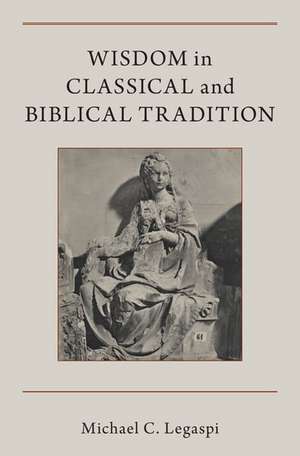
Wisdom in Classical and Biblical Tradition
Autor Michael Legaspien Limba Engleză Hardback – 27 sep 2018
În lucrarea Wisdom in Classical and Biblical Tradition, Michael Legaspi propune o analiză riguroasă a fundamentelor intelectuale ale Occidentului, pornind de la premisa că modernitatea este rezultatul unei sinteze între moștenirea greacă și teologia biblică. Observăm în acest volum o deschidere interdisciplinară necesară, unde filologia clasică, teologia exegetică și filozofia morală converg pentru a explica conceptul de „înțelepciune”. Autorul nu tratează înțelepciunea doar ca pe un cumul de informații, ci ca pe o aspirație spre întregire, în care cunoașterea este inseparabilă de virtute, iar ordinea cosmică (cosmos) este oglindită în organizarea socială (polis).
Reținem structura binară a volumului: o primă parte dedicată definirii formale a înțelepciunii ca mecanism ce guvernează eforturile intelectuale și etice, urmată de o analiză aplicată pe texte ce pornesc de la Homer și ajung până la perioada celui de-al Doilea Templu. Cititorii familiarizați cu Wisdom in the Ancient World de Trevor Curnow vor aprecia modul în care Legaspi trece dincolo de inventarierea perspectivelor istorice, încercând să recupereze relevanța acestui model de gândire unitar pentru contextul problematic al lumii contemporane. Dacă The Oxford Handbook of Wisdom and the Bible oferă o perspectivă enciclopedică, volumul de față se concentrează pe mecanismul intern al sintezei dintre rațiunea clasică și revelația biblică.
Această lucrare continuă preocupările autorului din The Death of Scripture and the Rise of Biblical Studies, unde analiza transformările interpretării biblice în modernitate. Aici, Michael Legaspi revine la rădăcinile pre-moderne pentru a demonstra cum, istoric, autoritatea divină și responsabilitatea umană au fost văzute ca elemente complementare ale aceleiași realități, oferind o perspectivă critică asupra fragmentării actuale a cunoașterii.
Preț: 556.21 lei
Preț vechi: 646.75 lei
-14%
Carte tipărită la comandă
Livrare economică 11-17 iunie
Specificații
ISBN-10: 0190885122
Pagini: 328
Dimensiuni: 236 x 160 x 28 mm
Greutate: 0.57 kg
Editura: Oxford University Press
Colecția OUP USA
Locul publicării:New York, United States
V-ar putea interesa
-
 Job the Silent: A Study in Historical CounterpointBruce Zuckerman-39%Preț: 405.90 lei663.06 lei
 -
 The Bible in History: How the Texts Have Shaped the TimesDavid W. KlingPreț: 281.76 lei
 -
 David, Saul, and God: Rediscovering an Ancient StoryPaul BorgmanPreț: 354.61 lei
 -
 Preț: 367.50 lei
 -
 The Death of Scripture and the Rise of Biblical StudiesMichael Legaspi-14%Preț: 660.13 lei767.59 lei
 -
 Diakonia Re-Interpreting the Ancient SourcesJohn N. CollinsPreț: 366.54 lei
 -
 Wisdom-Laws: A Study of the Mishpatim of Exodus 21:1-22:16Bernard S Jackson-34%Preț: 1586.15 lei2414.47 lei
 -
 The Bible and Literature: The BasicsNorman W. JonesPreț: 193.63 lei
 -
 Poetic Ethics in ProverbsAnne W Stewart-29%Preț: 571.86 lei810.94 lei
 -
 The Revelation of St John the DivineG. H. S. WalpolePreț: 219.96 lei
 -
 -18%Preț: 699.47 lei853.00 lei
 -
 Intersex, Theology, and the BibleSusannah Cornwall-18%Preț: 859.62 lei1048.32 lei
 -
 Religious Representation in PlaceM. GeorgePreț: 374.46 lei
 -
 An Aural-Performance Analysis of Revelation 1 and 11Kayle B. de Waal-23%Preț: 590.35 lei766.69 lei
 -
 Exodus in the Jewish Experience: Echoes and ReverberationsPamela Barmash-31%Preț: 629.08 lei909.36 lei
 -
 -35%Preț: 544.28 lei835.99 lei
 -
 -33%Preț: 497.01 lei743.56 lei
 -
 -35%Preț: 364.05 lei562.33 lei
 -
 Preț: 138.24 lei
 -
 -25%Preț: 498.92 lei663.13 lei
 -
 The Orthodox HereticPeter RollinsPreț: 101.66 lei
 -
 The Handbook of Biblical ChronologyJack FineganPreț: 169.47 lei
 -
 The Jesus PhenomenonGreg RigbyPreț: 87.17 lei
 -
 Preț: 78.22 lei
De ce să citești această carte
Această carte este esențială pentru cei care doresc să înțeleagă rădăcinile comune ale filozofiei europene și ale teologiei creștine. Cititorul va câștiga o perspectivă clară asupra modului în care gândirea antică unea etica de cunoaștere, oferind un argument solid pentru recuperarea unei viziuni integrate asupra lumii. Este o resursă academică de prim rang pentru studenții la teologie, istoria ideilor și studii clasice.
Despre autor
Michael Legaspi este un cercetător recunoscut în domeniul studiilor biblice și al istoriei intelectuale, publicând lucrări de referință sub egida Oxford University Press. Expertiza sa se concentrează pe transformările pe care Biblia și textele clasice le-au suferit în tranziția către modernitate. Prin lucrări precum The Death of Scripture and the Rise of Biblical Studies, Legaspi s-a impus ca o voce critică în analiza modului în care critica academică a reformat moștenirea scripturală a Occidentului, menținând un dialog constant între rigoarea istorică și semnificația teologică.
Descriere
Wisdom in Classical and Biblical Tradition begins with the recognition that modern culture emerged from a synthesis of the legacies of ancient Greek civilization and the theological perspectives of Jewish and Christian scriptures. Part of what made this synthesis possible was a shared outlook: a common aspiration toward wholeness of understanding that refused to separate knowledge from goodness, virtue from happiness, cosmos from polis, and divine authorityfrom human responsibility. This wholeness of understanding, or wisdom, features prominently in both classical and biblical literatures as an ultimate good. Wisdom in Classical and Biblical Tradition has two central aims. The first is to explain in formal terms what wisdom is. Though wisdom involves matters of practical judgment affecting the life of the individual and the social sphere, it has also been identified with an understanding of the world and of the ultimate realities that give meaning to human thought and action. Michael Legaspi explains how, in its traditional form, wisdom was understood to govern intellectual, social, andethical endeavors. Legaspi's second aim is to analyze figures and texts that have yielded and shaped the traditional understanding of wisdom. This book examines accounts of wisdom from foundational texts that range from the period of Homer to the destruction of the Second Temple, and explains why the search forwisdom remains an important but problematic endeavor today.
Recenzii
In Wisdom in Classical and Biblical Tradition, Legaspi provides an expansive view of the roots of wisdom and its development in biblical and classical cultures... His work is a valuable resource for those seeking to bridge that gap.
Overall, this is a rich and indeed wise portrait of wisdom, with real insight for philosophers, theologians, and biblical scholars.
The idea of 'metaphysical vulnerability' (see especially pp. 105-7) that Legaspi employs to interpret Job and the Hebrew bible is particularly striking. Placing Socrates in the midst of Jewish and Christian religious writings, and foregrounding the religious nature of Socrates' teaching (111) may well be unfamiliar to many classicists but allow us to look at some of Plato's dialogues in a new light.
This superb monograph is an important contribution to our understanding of wisdom in the ancient world.
Wisdom in Classical and Biblical Tradition succeeds in illustrating several facets of wisdom, a concept that is notoriously difficult to define. Legaspi's definition of wisdom as "a program for life" is refreshing and opens new avenues for research, instead of being mired with the perennial-and non-productive-question of defining wisdom as a genre or category of literature.
Summing up: Recommended
Notă biografică
William Legaspi is Associate Professor of Classics and Ancient Mediterranean Studies at Penn State University, and the author of The Death of Scripture and the Rise of Biblical Studies.