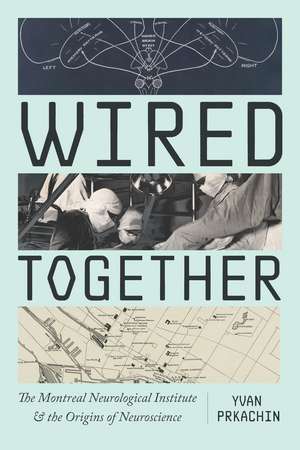
Wired Together: The Montreal Neurological Institute and the Origins of Neuroscience
Autor Yvan Prkachinen Limba Engleză Paperback – 12 ian 2026
Wired Together explains the rise of neuroscience by tracing the history of the Montreal Neurological Institute (MNI) and the men and women who transformed it into neuroscience’s most innovative and productive research site. Opened by neurosurgeon Wilder Penfield in 1934, the MNI pioneered the surgical treatment of epilepsy and transformed the operating theater into a new kind of scientific laboratory for investigating the functions of the brain. But more than that, the MNI became a crucial site for forming new interdisciplinary practices. These involved, as Yvan Prkachin puts it, wiring together new assemblies of physicians, surgeons, and scientists into a growing network that made possible the emergence of an interdisciplinary science of the brain.
Wired Together also traces how the MNI and its network of scientists spread this new interdisciplinary neuroscience to the rest of the world. Prkachin uncovers the surprising history of some of the most important neuroscientific organizations, discoveries, theories, and instruments from their beginnings in Montreal through the complex international networks of the post-war sciences. In doing so, he tells the stories of the most crucial and least understood characters from early neuroscience—such as Brenda Milner, Donald Hebb, Herbert Jasper, Molly Harrower, and David Hubel—as well as the surprising origins of scientific practices and ideas like sensory deprivation, multiple forms of memory, and artificial neural networks.
Preț: 228.24 lei
Preț vechi: 240.25 lei
-5%
Puncte Express: 342
Carte disponibilă
Livrare economică 29 octombrie-12 noiembrie
Livrare express 15-21 octombrie pentru 25.73 lei
Livrare prin curier în România Termenul estimat este afișat lângă disponibilitate.
Transport gratuit de la 400.00 lei Plată online sau ramburs, în funcție de opțiunile comenzii.
Retur gratuit în 14 zile Comandă securizată și suport în română.
Specificații
ISBN-13: 9780226845463
ISBN-10: 022684546X
Pagini: 304
Ilustrații: 34 halftones
Dimensiuni: 152 x 229 x 20 mm
Greutate: 0.39 kg
Ediția:First Edition
Editura: University of Chicago Press
Colecția University of Chicago Press
ISBN-10: 022684546X
Pagini: 304
Ilustrații: 34 halftones
Dimensiuni: 152 x 229 x 20 mm
Greutate: 0.39 kg
Ediția:First Edition
Editura: University of Chicago Press
Colecția University of Chicago Press
V-ar putea interesa
-
 Essentials of Modern NeuroscienceFranklin Amthor-32%Preț: 625.71 lei919.16 lei
 -
 Brain and BehaviorDavid Eagleman-23%Preț: 1053.30 lei1370.73 lei
 -
 The Brain: A Very Short IntroductionMichael O'Shea-32%Preț: 48.55 lei71.12 lei
 -
 The Organisation of MindTim Shallice-24%Preț: 532.26 lei704.37 lei
 -
 Natural NeuroscienceNachum Ulanovsky-14%Preț: 447.91 lei520.82 lei
 -
 Preț: 92.12 lei
 -
 Netter's Neuroscience Coloring BookDavid L. Felten-5%Preț: 166.39 lei175.15 lei
 -
 Proust Was a NeuroscientistJonah LehrerPreț: 77.57 lei
 -
 Principles of Cognitive NeuroscienceDale Purves-27%Preț: 1350.46 lei1849.95 lei
 -
 Preț: 399.14 lei
 -
 The Wiley-Blackwell Handbook of PsychoneuroimmunologyAlexander W Kusnecov-9%Preț: 1341.16 lei1473.80 lei
 -
 The Neuroscience of PsychotherapyLouis CozolinoPreț: 396.23 lei
 -
 The Beautiful BrainLarry Swanson-18%Preț: 243.13 lei296.99 lei
 -
 Introducing Mind and BrainAngus GellatlyPreț: 63.34 lei
 -
 One Hand ClappingNikolay KukushkinPreț: 156.39 lei
 -
 Crick: A Mind in Motion – from DNA to the BrainProfessor Matthew Cobb-18%Preț: 189.62 lei231.05 lei
 -
 Brain (Edition, Revised)Ammar Al-ChalabiPreț: 87.47 lei
 -
 The Divided Mind: Uncovering psychiatry's dark past and reimagining its futureProfessor Edward Bullmore-29%Preț: 103.03 lei144.79 lei
 -
 The NeuronomiconGrayson W. Hooper-5%Preț: 434.27 lei457.12 lei
Notă biografică
Yvan Prkachin is a senior research associate at the Institute of Biomedical Ethics and History of Medicine at the University of Zurich.
Cuprins
Archival Abbreviations
Introduction
Part I: A Genealogy of Neuroscience
1. At the Crossroads of Scientific Medicine: Wilder Penfield, the Rockefeller Foundation, and the Genesis of the Montreal Neurological Institute
2. The Montreal Method: Molly Harrower, Brenda Milner, and the Neuroscience of Memory
3. A Tale of Two Sciences: Herbert Jasper, Francis Schmitt, and the Origins of Neuroscience
Part II: Weak Ties and Afterlives
4. From Natural Intelligence to Artificial Intelligence: D. O. Hebb, K.M., and the Cognitive Revolution
5. Two Solitudes: Psychosurgery and the Troubled Relationship between Wilder Penfield and Ewen Cameron
6. Eye, Brain, Vision: David Hubel, Microelectrodes, and the Science of Seeing
Conclusion: Reassembling the Origins of Neuroscience
Acknowledgments
Notes
Bibliography
Index
Introduction
Part I: A Genealogy of Neuroscience
1. At the Crossroads of Scientific Medicine: Wilder Penfield, the Rockefeller Foundation, and the Genesis of the Montreal Neurological Institute
2. The Montreal Method: Molly Harrower, Brenda Milner, and the Neuroscience of Memory
3. A Tale of Two Sciences: Herbert Jasper, Francis Schmitt, and the Origins of Neuroscience
Part II: Weak Ties and Afterlives
4. From Natural Intelligence to Artificial Intelligence: D. O. Hebb, K.M., and the Cognitive Revolution
5. Two Solitudes: Psychosurgery and the Troubled Relationship between Wilder Penfield and Ewen Cameron
6. Eye, Brain, Vision: David Hubel, Microelectrodes, and the Science of Seeing
Conclusion: Reassembling the Origins of Neuroscience
Acknowledgments
Notes
Bibliography
Index
Recenzii
“Prkachin’s book rests on a solid evidentiary foundation, is written with verve, and well conveys the substantive content of the science it discusses. It is a valuable contribution to our understanding of the prehistory of modern neuroscience.”
“The excellent Wired Together shows that the Montreal Neurological Institute was at the heart of the development of neuroscience. Prkachin explores the MNI’s fascinating and ambiguous global legacies, ranging from novel experimental tools to CIA-funded attempts at brainwashing. The combination of deft analysis, theoretical sophistication, and fascinating stories makes the book a must-read not only for those interested in the history of neuroscience, but for those who care about scientific institutions, interdisciplinarity, and Cold War-era scientific ties.”
“Wired Together represents a magnificent accomplishment. In writing what will surely stand as the definitive history of the Montreal Neurological Institute (MNI), Prkachin has also rewritten the history of the origins of neuroscience. In contrast to accounts that stress the importance of developments at MIT in this history, the author offers a new origin story that highlights developments at McGill University’s MNI. A remarkable group of figures—neurosurgeon Wilder Penfield, neurophysiologist Herbert Jasper, and psychologists Molly Harrower, Brenda Milner, Donald Hebb, and David Hubel—came together there during the period from 1930–1960 to usher in a new era in brain science. Prodigiously researched, beautifully written, theoretically incisive, this book tells the story of how these figures were—to borrow from Hebb’s famous postulate that nerves that wire together, fire together—‘wired together’ through a series of momentous interdisciplinary collaborations to produce foundational work in the treatment of epilepsy, in cognitive and memory science, and in the science of vision. It was these collaborations, Prkachin persuasively argues, that laid the foundations for much of today’s neuroscience.”