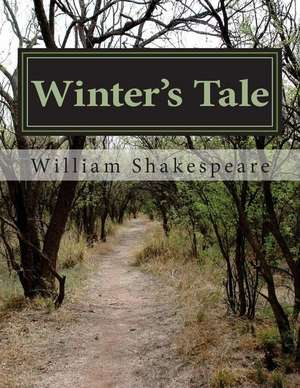
Winter's Tale
Autor William Shakespeare Note de Vincent Verreten Paperback
Preț: 46.74 lei
Puncte Express: 70
Carte indisponibilă temporar
Doresc să fiu notificat când acest titlu va fi disponibil:
Se trimite...
Specificații
ISBN-13: 9781537323060
ISBN-10: 1537323067
Pagini: 118
Dimensiuni: 216 x 279 x 6 mm
Greutate: 0.29 kg
ISBN-10: 1537323067
Pagini: 118
Dimensiuni: 216 x 279 x 6 mm
Greutate: 0.29 kg
V-ar putea interesa
-
 HamletCollins GcsePreț: 28.01 lei
 -
 A Midsummer Night's DreamWilliam ShakespearePreț: 28.01 lei
 -
 Twelfth NightWilliam ShakespearePreț: 28.01 lei
 -
 The TempestWilliam ShakespearePreț: 28.01 lei
 -
 The Republic and The LawsCicero-19%Preț: 52.78 lei64.95 lei
 -
 OthelloWilliam ShakespearePreț: 24.92 lei
 -
 Measure for MeasureWilliam ShakespearePreț: 27.29 lei
 -
 The Comedy of ErrorsWilliam ShakespearePreț: 28.68 lei
 -
 The PoemsWilliam ShakespearePreț: 57.99 lei
 -
 Satyricon. ApocolocyntosisLucius Annaeus SenecaPreț: 230.54 lei
 -
 Love in the Big CitySang Young ParkPreț: 93.76 lei
 -
 Essential Shakespeare: The Arden Guide to Text and InterpretationDr. Pamela Bickley-10%Preț: 162.39 lei180.12 lei
 -
 MacbethWilliam ShakespearePreț: 38.67 lei
 -
 All's Well That Ends WellWilliam ShakespearePreț: 38.47 lei
 -
 King JohnWilliam ShakespearePreț: 37.70 lei
 -
 Roma Aeterna: Second Edition, with Full Color IllustrationsHans H. Ørberg-21%Preț: 275.29 lei348.42 lei
 -
 Pericles: Discover Primary & Early YearsWilliam Shakespeare-25%Preț: 39.78 lei53.29 lei
 -
 Antony and CleopatraWilliam ShakespearePreț: 28.01 lei
 -
 Taming of the ShrewWilliam ShakespearePreț: 30.05 lei
 -
 Much Ado About NothingWilliam ShakespearePreț: 28.01 lei
Descriere
Descriere de la o altă ediție sau format:
George Lyman Kittredge’s insightful editions of Shakespeare have endured in part because of his eclecticism, his diversity of interests, and his wide-ranging accomplishments, all of which are reflected in the valuable notes in each volume.
These new editions have specific emphasis on the performance histories of the plays (on stage and screen).
Features of each edition include:
These new editions have specific emphasis on the performance histories of the plays (on stage and screen).
Features of each edition include:
- The original introduction to the Kittredge Edition
- Editor’s Introduction to the Focus Edition. An overview on major themes of the plays, and sections on the play’s performance history on stage and screen.
- Explanatory Notes. The explanatory notes either expand on Kittredge’s superb glosses, or, in the case of plays for which he did not write notes, give the needed explanations for Shakespeare’s sometimes demanding language.
- Performance notes. These appear separately and immediately below the textual footnotes and include discussions of noteworthy stagings of the plays, issues of interpretation, and film and stage choices.
- How to read the play as Performance Section. A discussion of the written play vs. the play as performed and the various ways in which Shakespeare’s words allow the reader to envision the work "off the page."
- Comprehensive Timeline. Covering major historical events (with brief annotations) as well as relevant details from Shakespeare’s life. Some of the Chronologies include time chronologies within the plays.
- Topics for Discussion and Further Study Section. Critical Issues: Dealing with the text in a larger context and considerations of character, genre, language, and interpretative problems. Performance Issues: Problems and intricacies of staging the play connected to chief issues discussed in the Focus Editions’ Introduction.
- Select Bibliography & Filmography
Notă biografică
JONATHAN BATE is Professor of Shakespeare and Renaissance Literature, University of Warwick, UK, and the editor of The RSC Shakespeare: The Complete Works. He has held visiting posts at Harvard, Yale and UCLA and is a Fellow of the Royal Society of Literature, a Fellow of the British Academy, an Honorary Fellow of St Catherine's College, Cambridge, and a Governor and Board member of the Royal Shakespeare Company. A prominent critic, award-winning biographer and broadcaster, he is the author of several books on Shakespeare, including The Genius of Shakespeare (Picador), which was praised by Sir Peter Hall, founder of the RSC, as 'the best modern book on Shakespeare.' In June 2006 he was awarded a CBE by HM The Queen 'for services to Higher Education'.
ERIC RASMUSSEN is Professor of English at the University of Nevada, USA, and the Textual Editor of The RSC Shakespeare: The Complete Works. He is co-editor of the Norton Anthology of English Renaissance Drama and has edited volumes in both the Arden Shakespeare and Oxford World's Classics series. He is the General Textual Editor of the Internet Shakespeare Editions project - one of the most visited Shakespeare websites in the world. For over nine years he has written the annual review of editions and textual studies for the Shakespeare Survey.
ERIC RASMUSSEN is Professor of English at the University of Nevada, USA, and the Textual Editor of The RSC Shakespeare: The Complete Works. He is co-editor of the Norton Anthology of English Renaissance Drama and has edited volumes in both the Arden Shakespeare and Oxford World's Classics series. He is the General Textual Editor of the Internet Shakespeare Editions project - one of the most visited Shakespeare websites in the world. For over nine years he has written the annual review of editions and textual studies for the Shakespeare Survey.
Cuprins
FOREWARD
ACKNOWLEDGEMENTS
INTRODUCTION
SHAKESPEARE’S LIFE
SHAKESPEARE’S THEATER
WILLIAM SHAKESPEARE: A BRIEF CHRONOLOGY
A NOTE ON THE TEXT
ABBREVIATIONS
THE WINTER’S TALE
APPENDIX A: SOURCES
ACKNOWLEDGEMENTS
INTRODUCTION
SHAKESPEARE’S LIFE
SHAKESPEARE’S THEATER
WILLIAM SHAKESPEARE: A BRIEF CHRONOLOGY
A NOTE ON THE TEXT
ABBREVIATIONS
THE WINTER’S TALE
APPENDIX A: SOURCES
- Robert Greene, Pandosto (1588)
- From Ovid, Metamorphoses
- Pygmalion
- Ceres and Proserpina
- Callisto
- From James VI of Scotland, Basilikon Doron (1599)
- From Robert Greene, The Second and Last Part of Coney-Catching and the Third and Last Part of Coney-Catching (1592)
- From God’s Handi-Work in Wonders (1615)
Recenzii
The Winter’s Tale is a kind of miracle play in which performance is of the essence of an exciting, imaginative, and inspiring plot embodied in visionary dialogue. In creating a course in Shakespeare Performed (2010) with his students staging an abridged Winter’s Tale, Mark Muggli was in an ideal position to edit the play especially from the perspective of performance, as he did. This is a twenty-first-century edition up-to-date enough to include the Guthrie Theater’s production of 2011 together with the solid twentieth-century scholarship of G. L. Kittredge. Kittredge’s introduction, lightly edited, begins with Muggli’s “Spoiler Alert” about plot revelations the reader might prefer to experience first in the play itself. His notes are designed less to interpret than “to facilitate the reader’s interpretation,” and the reader and the play are primary in this presentation of The Winter’s Tale.
—Tom Clayton, Regents Profesor, University of Minnesota
—Tom Clayton, Regents Profesor, University of Minnesota
"No edition gives such equal balance to the play as it appears on the page, the stage, and the screen as does the New Kittredge Shakespeare. This edition of Winter’s Tale begins that balancing act with Mark Muggli’s engaging introduction and continues it throughout the text of the play per se with considerations of stage choices, abundant photographs, and a concluding essay on the play as performance. The result is that the reader is always in touch with the work in its multiple dimensions as a literary, theatrical, and cultural phenomenon. That approach makes Muggli's edition an excellent introduction to the play and equally an ally of the teacher and the director."
— Ralph Alan Cohen, Mary Baldwin College
— Ralph Alan Cohen, Mary Baldwin College
Even as the New Kittredge Shakespeare series glances back to George Lyman Kittredge's student editions of the plays, it is very much of our current moment: the slim editions are targeted largely at high school and first-year college students who are more versed in visual than in print culture. Not only are the texts of the plays accompanied by photographs or stills from various stage and cinema performances: the editorial contributions are performance-oriented, offering surveys of contemporary film interpretations, essays on the plays as performance pieces, and an annotated filmography. Traditional editorial issues (competing versions of the text, cruxes, editorial emendation history) are for the most part excluded; the editions focus instead on clarifying the text with an eye to performing it. There is no disputing the pedagogic usefulness of the New Kittredge Shakespeare's performance-oriented approach. At times, however, it can run the risk of treating textual issues as impediments, rather than partners, to issues of performance. This is particularly the case with a textually vexed play such as Pericles: Prince of Tyre. In the introduction to the latter, Jeffrey Kahan notes the frequent unintelligibility of the play as originally published: "the chances of a reconstructed text matching what Shakespeare actually wrote are about 'nil'" (p. xiii) But his solution — to use a "traditional text" rather than one corrected as are the Oxford and Norton Pericles — obscures how this "traditional text," including its act and scene division, is itself a palimpsest produced through three centuries of editorial intervention. Nevertheless, the series does a service to its target audience with its emphasis on performance and dramaturgy. Kahan's own essay about his experiences as dramaturge for a college production of Pericles is very good indeed, particularly on the play's inability to purge the trace of incestuous desire that Pericles first encounters in Antioch. Other plays' cinematic histories: Annalisa Castaldo's edition of Henry V contrasts Laurence Oliver's and Branagh's film productions; Samuel Crowl's and James Wells's edition of (respectively) I and 2 Henry IV concentrate on Welle's Chimes at Midnight and Gus Van Sant's My Own Private Idaho; Patricia Lennox's edition of As You Like It offers an overview of four Hollywood and British film adaptations; and John R. Ford's edition of A Midsummer Night's Dream provides a spirited survey of the play's rich film history.
The differences between, and comparative merits of, various editorial series are suggested by the three editions of The Taming of the Shrew published this year. Laury Magnus's New Kittredge Shakespeare edition is, like the other New Kittredge volumes, a workable text for high school and first year college students interested in film and theater. The introduction elaborates on one theme — Elizabethan constructions of gender — and offers a very broad performance history, focusing on Sam Taylor's and Zeffirelli's film versions as well as adaptations such as Kiss Me Kate and Ten Things I Hate About You (accompanied by a still of ten hearthtrobs Heath Ledger and Julia Stiles). The volume is determined to eradicate any confusion that a first time reader of the play might experience: the dramatis personae page explains that "Bianca Minola" is "younger daughter to Baptista, wooed by Lucentio-in-disguise (as Cambio) and then wife to him, also wooed by the elderly Gremio and Hortensio-in-disguise (as Licio)" (p.1). Other editorial notes, based on Kittredge's own, are confined mostly to explaining individual words and phrases: additional footnotes discuss interpretive choices made by film and stage productions. Throughout, the editorial emphasis is on the play less as text than as performance piece, culminating in fifteen largely performance-oriented "study questions" on topics such as disguise, misogyny, and violence.
Studies in English Literature, Tudor and Stuart Drama, Volume 51, Spring 2011, Number 2, pages 497-499.
The differences between, and comparative merits of, various editorial series are suggested by the three editions of The Taming of the Shrew published this year. Laury Magnus's New Kittredge Shakespeare edition is, like the other New Kittredge volumes, a workable text for high school and first year college students interested in film and theater. The introduction elaborates on one theme — Elizabethan constructions of gender — and offers a very broad performance history, focusing on Sam Taylor's and Zeffirelli's film versions as well as adaptations such as Kiss Me Kate and Ten Things I Hate About You (accompanied by a still of ten hearthtrobs Heath Ledger and Julia Stiles). The volume is determined to eradicate any confusion that a first time reader of the play might experience: the dramatis personae page explains that "Bianca Minola" is "younger daughter to Baptista, wooed by Lucentio-in-disguise (as Cambio) and then wife to him, also wooed by the elderly Gremio and Hortensio-in-disguise (as Licio)" (p.1). Other editorial notes, based on Kittredge's own, are confined mostly to explaining individual words and phrases: additional footnotes discuss interpretive choices made by film and stage productions. Throughout, the editorial emphasis is on the play less as text than as performance piece, culminating in fifteen largely performance-oriented "study questions" on topics such as disguise, misogyny, and violence.
Studies in English Literature, Tudor and Stuart Drama, Volume 51, Spring 2011, Number 2, pages 497-499.
“The Winter’s Tale is a kind of miracle play in which performance is of the essence of an exciting, imaginative, and inspiring plot embodied in visionary dialogue. This is a twenty-first-century edition with the solid twentieth-century scholarship of G. L. Kittredge. Muggli's contributions are designed less to interpret than ‘to facilitate the reader’s interpretation,’ and the reader and the play are primary in this presentation of The Winter’s Tale.”
—Tom Clayton, University of Minnesota
“No edition gives such equal balance to the play as it appears on the page, the stage, and the screen as does the New Kittredge Shakespeare. [In] this edition of Winter’s Tale . . . the reader is always in touch with the work in its multiple dimensions as a literary, theatrical, and cultural phenomenon. That approach makes Muggli's edition an excellent introduction to the play and equally an ally of the teacher and the director.”
—Ralph Alan Cohen, Mary Baldwin College
George Lyman Kittredge’s insightful editions of Shakespeare have endured in part because of this eclecticism, his diversity of interests, and his wide-ranging accomplishments—all of which are reflected in the valuable notes in each volume. The plays in the New Kittredge Shakespeare series retain the original Kittredge notes and introductions, changed or augmented only when some modernization seems necessary. These new editions also include introductory essays by contemporary editors, notes on the plays as they have been performed on stage and film, and additional student materials. These plays are being made available by Focus Publishing with the permission of the Kittredge heirs.
Mark Z. Muggli is Professor and Department Head of English at Luther College, where he developed the “Our Shakespeare” project (www.luther.edu/english/ourshakespeare).
—Tom Clayton, University of Minnesota
“No edition gives such equal balance to the play as it appears on the page, the stage, and the screen as does the New Kittredge Shakespeare. [In] this edition of Winter’s Tale . . . the reader is always in touch with the work in its multiple dimensions as a literary, theatrical, and cultural phenomenon. That approach makes Muggli's edition an excellent introduction to the play and equally an ally of the teacher and the director.”
—Ralph Alan Cohen, Mary Baldwin College
George Lyman Kittredge’s insightful editions of Shakespeare have endured in part because of this eclecticism, his diversity of interests, and his wide-ranging accomplishments—all of which are reflected in the valuable notes in each volume. The plays in the New Kittredge Shakespeare series retain the original Kittredge notes and introductions, changed or augmented only when some modernization seems necessary. These new editions also include introductory essays by contemporary editors, notes on the plays as they have been performed on stage and film, and additional student materials. These plays are being made available by Focus Publishing with the permission of the Kittredge heirs.
Mark Z. Muggli is Professor and Department Head of English at Luther College, where he developed the “Our Shakespeare” project (www.luther.edu/english/ourshakespeare).
Textul de pe ultima copertă
Neither comedy nor tragedy, The Winter's Tale contains elements of each genre, and defies easy classification. It experiments, like many of Shakespeare's late plays, with different styles and tones, and draws on a wide range of sources and inspirations. Full of mysteries and miracles, grief and dark humour, this strange play has fascinated critics and theatregoers for centuries. Theatrical and cinematic productions have tried to capture the range of interpretations and staging possibilities presented by The Winter's Tale, and the introduction to this edition explores the play's long history in performance and in criticism. Illustrations and extended notes interleaved throughout the text discuss the echoes of religious, scientific, and mythological texts found in the play.
Caracteristici
This is the first edition of The Winter's Tale to be developed by and for the RSC, the world's leading Shakespeare theatre company and it includes unique material to help the reader understand and enjoy Shakespeare on the stage as well as on the page
Illustrated with photographs of classic and unusual performances
Outstanding on-page notes which explain words and phrases unfamiliar to a modern audience, including the slang, political references and bawdy humour often ignored or censored in competing editions
Includes scene-by-scene summary, offering an easily understandable way into the play
Completely new introduction by Jonathan Bate, exploring the text and critical debates around it
Summary of the play's performance history, at the RSC and elsewhere
Interviews with important Shakespearean directors Dominic Cooke, Adrian Noble and Gregory Doran discussing key productions at the RSC
Illustrated with photographs of classic and unusual performances
Outstanding on-page notes which explain words and phrases unfamiliar to a modern audience, including the slang, political references and bawdy humour often ignored or censored in competing editions
Includes scene-by-scene summary, offering an easily understandable way into the play
Completely new introduction by Jonathan Bate, exploring the text and critical debates around it
Summary of the play's performance history, at the RSC and elsewhere
Interviews with important Shakespearean directors Dominic Cooke, Adrian Noble and Gregory Doran discussing key productions at the RSC