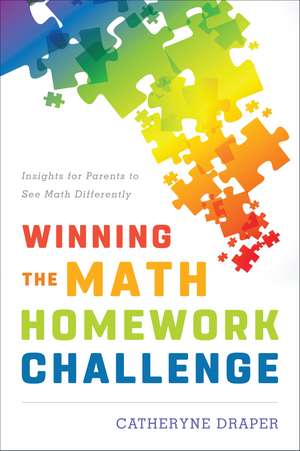
Winning the Math Homework Challenge: Insights for Parents to See Math Differently
Autor Catheryne Draperen Limba Engleză Hardback – 21 dec 2016
Preț: 280.34 lei
Preț vechi: 381.51 lei
-27%
Puncte Express: 421
Carte tipărită la comandă
Livrare economică 19 noiembrie-03 decembrie
Livrare prin curier în România Termenul estimat este afișat lângă disponibilitate.
Transport gratuit de la 400.00 lei Plată online sau ramburs, în funcție de opțiunile comenzii.
Retur gratuit în 14 zile Comandă securizată și suport în română.
Specificații
ISBN-13: 9781475829716
ISBN-10: 147582971X
Pagini: 180
Ilustrații: 101 b/w illustrations
Dimensiuni: 185 x 264 x 16 mm
Greutate: 0.46 kg
Editura: Bloomsbury Publishing
Colecția Rowman & Littlefield
Locul publicării:New York, United States
ISBN-10: 147582971X
Pagini: 180
Ilustrații: 101 b/w illustrations
Dimensiuni: 185 x 264 x 16 mm
Greutate: 0.46 kg
Editura: Bloomsbury Publishing
Colecția Rowman & Littlefield
Locul publicării:New York, United States
V-ar putea interesa
-
 EDUCATION REFORMStephen Ball-29%Preț: 209.25 lei295.28 lei
 -
 Introduction to Childhood StudiesMary Jane Kehily-28%Preț: 172.70 lei241.03 lei
 -
 Preț: 339.59 lei
 -
 Problematizing Public PedagogyJake Burdick-15%Preț: 418.85 lei492.76 lei
 -
 -15%Preț: 551.79 lei649.17 lei
 -
 Critical Dispositions: Evidence and Expertise in EducationGreg Dimitriadis-15%Preț: 417.04 lei490.63 lei
 -
 Preț: 444.19 lei
 -
 Curriculum Studies in the Lifelong Learning SectorJonathan TummonsPreț: 313.42 lei
 -
 Preț: 108.27 lei
 -
 Creating Standards-Based Integrated CurriculumSusan M. DrakePreț: 282.03 lei
 -
 Preț: 150.31 lei
 -
 Preț: 233.82 lei
 -
 Classroom in the CloudsAlex Mcgrath-20%Preț: 96.17 lei119.59 lei
 -
 -16%Preț: 79.54 lei94.73 lei
Descriere
If you've ever been stumped by your child's math homework, this is the book for you. Winning the Math Homework Challenge shares students' reasoning, thinking, and even misunderstandings about mathematics to provide you with the opportunity to see math through their eyes, including both the clarity and the confusion. Armed with this new sight, and therefore insight, parents will be able to effectively communicate with their child about math experiences.
This book focuses more on the "why" behind math relationships, explained in plain English and through images that show mathematical relationships. The ability to recognize connections among math topics significantly reduces the confusion and frustration that can accompany math homework. By including more images and fewer formulas, readers - especially the visual-spatial learners - are better equipped to understand how math concepts connect to each other. Finding and understanding these connections will allow parents to find their own "math mojo" and to pass on that legacy to their child.
This book focuses more on the "why" behind math relationships, explained in plain English and through images that show mathematical relationships. The ability to recognize connections among math topics significantly reduces the confusion and frustration that can accompany math homework. By including more images and fewer formulas, readers - especially the visual-spatial learners - are better equipped to understand how math concepts connect to each other. Finding and understanding these connections will allow parents to find their own "math mojo" and to pass on that legacy to their child.
Cuprins
ForewordPrefaceIntroductionDefinition SectionA Rose Is Still a Rose - Other Terms to See Math DifferentlySome Other Ways to "See" Math Visual-Spatial and Auditory-SequentialKeep in MindLearning Styles, Learning Networks, and Learning Intelligences Learning StylesLearning NetworksLearning IntelligencesLearning Preferences through the SensesSeeing Relationships with Your HandsSeeing Patterns with Your ImaginationKeep in MindGPS of Reading MathStraight Line Left-to-Right and Right-to-LeftAround Left-to-right Then ReversedTop-to-Bottom and Bottom-to-TopDiagonal Left-to-Right and Diagonal Right-to-LeftEye-Tracking CombinationsKeep in MindOrganization SectionAssessments and the Visual-Spatial ChildVisual-Spatial and TestingShow Your WorkKeep in MindWhat You See Is What You SayEyesight That a Good Pair of Eyeglasses Will HelpEyesight That May Need More Than a Good Pair of EyeglassesMental Sight That a Good Imagination Can HelpHow to Capitalize on What Your Child Does SeeA Different Way to See Math "Facts"Seeing Fractions with Pictures - Or NotKeep in MindFinding Your Math Jigsaw Strengths Multiply with Base Ten Blocks JigsawEarly Stages for Smaller PuzzlesFinal Assembly of the Two-Digit Jigsaw PuzzleDifferent Multiplication Table JigsawsWord Problem JigsawsKeep in Mind. Relationships with Mathematics Section
Math Avoiders Are Still HereStress of SuccessPremature PrecisionShame ShacklesOnly-One-Right-Answer-or-Method Myth Six Things the Math Aficionado Knows That the Math Avoider Doesn't KnowKeep in MindMath Aficionados at WorkSpelunking for PatternsPredictable Changes Create PatternsDoubling Sides - Doubling Areas? Not So FastVolume Follows SuitKeep in MindInsight Is an Inside JobHands-On InsightMath Abstractions Too SoonThe Squares Have It Statistics and SquaresWhat's In a Square Root?Squares To Cubes And.Keep in MindConnectionsMathematics of LookingMath Relationships as Seen Through a Photographer's EyesBalanceAngle and ShapeVanishing Point ProportionPatterns of RepetitionBen's Engaging ViewKeep in MindMathematics of MovingFeeling the Math in Dance MovementsThe Beat of ProportionSports Angles and BasketsSports Fields and Angles Keep in MindMathematics of Building Building Blocks for Shape FormRatios for StairsRoof Pitch, Ratios, and AnglesA Pythagorean TunnelKeep in MindConclusion: What Parents Can Do
Color-CodingBrainstorming Webs and Other OrganizersUse the Tools of MathTop Five Do ListKeep in MindGlossary
References
Math Avoiders Are Still HereStress of SuccessPremature PrecisionShame ShacklesOnly-One-Right-Answer-or-Method Myth Six Things the Math Aficionado Knows That the Math Avoider Doesn't KnowKeep in MindMath Aficionados at WorkSpelunking for PatternsPredictable Changes Create PatternsDoubling Sides - Doubling Areas? Not So FastVolume Follows SuitKeep in MindInsight Is an Inside JobHands-On InsightMath Abstractions Too SoonThe Squares Have It Statistics and SquaresWhat's In a Square Root?Squares To Cubes And.Keep in MindConnectionsMathematics of LookingMath Relationships as Seen Through a Photographer's EyesBalanceAngle and ShapeVanishing Point ProportionPatterns of RepetitionBen's Engaging ViewKeep in MindMathematics of MovingFeeling the Math in Dance MovementsThe Beat of ProportionSports Angles and BasketsSports Fields and Angles Keep in MindMathematics of Building Building Blocks for Shape FormRatios for StairsRoof Pitch, Ratios, and AnglesA Pythagorean TunnelKeep in MindConclusion: What Parents Can Do
Color-CodingBrainstorming Webs and Other OrganizersUse the Tools of MathTop Five Do ListKeep in MindGlossary
References
Recenzii
Mathematics is so much about relationships and seeing how objects and numbers fit together. This book affirms the value of visualization as a valid way of looking at mathematics.
Mathematics Educator Catheryne Draper's Winning the Math Challenge is a gift to math students and their parents. Draper, a talented and wise math teacher, shares wisdom gained in decades of teaching. She reveals different ways of 'seeing' math, and she shows how learning styles and preferences influence students' ability to understand. Her goal is to help parents help their children to become math aficionados instead of math avoiders. She makes this goal achievable by dispelling the only-one-right-answer-or-method myth, honoring the place of imagination in math thinking, and dropping the shame shackles often attached to those having trouble with math. This book shows an exciting, even liberating view of how to learn and enjoy math. Don't miss this chance to become your child's math mentor and to have a deepened understanding of math yourself.
Winning the Math Challenge explores and explains how we all approach learning differently. Mathematics has a rich set of rules and conventions to convey meaning and allow solution to problems. However, to a young student it is also a new language, with new concepts, new 'grammar' and new 'spelling.' Catheryne Draper does a wonderful job of showing how we can employ different ways to explain the meaning of those 'basic' concepts we are asked to learn in our early years. Just because we learned through one method in our school years, doesn't mean that our children should or best learn the same way. We can benefit our children by going back to school, to learn about learning. Winning the Math Challenge is an excellent place to start.
Mathematics Educator Catheryne Draper's Winning the Math Challenge is a gift to math students and their parents. Draper, a talented and wise math teacher, shares wisdom gained in decades of teaching. She reveals different ways of 'seeing' math, and she shows how learning styles and preferences influence students' ability to understand. Her goal is to help parents help their children to become math aficionados instead of math avoiders. She makes this goal achievable by dispelling the only-one-right-answer-or-method myth, honoring the place of imagination in math thinking, and dropping the shame shackles often attached to those having trouble with math. This book shows an exciting, even liberating view of how to learn and enjoy math. Don't miss this chance to become your child's math mentor and to have a deepened understanding of math yourself.
Winning the Math Challenge explores and explains how we all approach learning differently. Mathematics has a rich set of rules and conventions to convey meaning and allow solution to problems. However, to a young student it is also a new language, with new concepts, new 'grammar' and new 'spelling.' Catheryne Draper does a wonderful job of showing how we can employ different ways to explain the meaning of those 'basic' concepts we are asked to learn in our early years. Just because we learned through one method in our school years, doesn't mean that our children should or best learn the same way. We can benefit our children by going back to school, to learn about learning. Winning the Math Challenge is an excellent place to start.
Notă biografică
Catheryne Draper has been learning from her students for over half a century of teaching, supervising the math program in a school district, advising math education at the state level, coaching math in schools, and presenting math workshops for teachers. She is the author of The Algebra Game, a hands-on multi-deck algebra program in four topics covering Linear Graphs, Quadratic Equations, Conic Sections, and Trig Functions that allows students to work together in cooperative groups, or individually, to identify the algebra relationships and patterns in the each topic. In addition to contributing many published articles, Draper is also the author of Winning the Math Homework Challenge: Insights for Parents To See Math Differently,User-Friendly Math for Parents: Learning and Understanding the Language of Numbers is Key, and How the Math Gets Done: Why Parents Don't Need to Worry About New vs. Old Math.