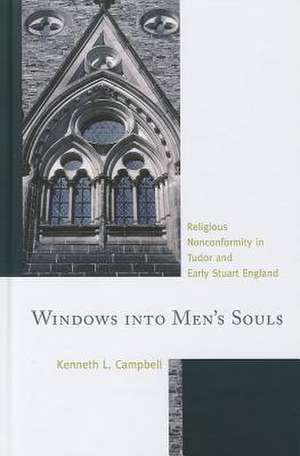
Windows into Men's Souls: Religious Nonconformity in Tudor and Early Stuart England
Autor Kenneth L. Campbellen Limba Engleză Hardback – 17 aug 2012
Preț: 633.67 lei
Preț vechi: 958.66 lei
-34%
Puncte Express: 951
Carte tipărită la comandă
Livrare economică 21 noiembrie-05 decembrie
Livrare prin curier în România Termenul estimat este afișat lângă disponibilitate.
Transport gratuit pentru acest produs Plată online sau ramburs, în funcție de opțiunile comenzii.
Retur gratuit în 14 zile Comandă securizată și suport în română.
Specificații
ISBN-13: 9780739168196
ISBN-10: 0739168193
Pagini: 236
Dimensiuni: 160 x 235 x 24 mm
Greutate: 0.52 kg
Ediția:New.
Editura: Bloomsbury Publishing
Colecția Lexington Books
Locul publicării:New York, United States
ISBN-10: 0739168193
Pagini: 236
Dimensiuni: 160 x 235 x 24 mm
Greutate: 0.52 kg
Ediția:New.
Editura: Bloomsbury Publishing
Colecția Lexington Books
Locul publicării:New York, United States
Descriere
Windows into Men's Souls uses the works of John Robinson, Thomas Helwys, and John Smyth to examine the concept of religious nonconformity that was inherent in the English Reformation. Kenneth Campbell frames the primary works and historical development of various groups and individuals as examples of a general impulse toward religious nonconformity during the sixteenth and early seventeenth centuries. During this time, religious nonconformity became an integral part of English culture and society, shaped by a historical experience that led to rebellion and civil war. The issues that English thinkers wrestled with during this period led to profound insights on both Christianity and on religious toleration that continue to shape Anglo-American and Western religious culture to the present day. This is the story of courageous people-Catholics and Protestants, Separatists and non-Separatists-who ignored, defied, or challenged their government to pursue their own version of religious truth in an age of religious intolerance that valued conformity at all costs.
Cuprins
Chapter 1: The Problem of Religious Identity
Chapter 2: The Origins of Religious Nonconformity in England
Chapter 3: The Concept of Religious Truth
Chapter 4: Separatism in Elizabethan and Early Stuart England
Chapter 5: Religious Dissent in the Reign of James I
Chapter 6: Internationalism and English Religion
Chapter 7: Arminianism and the English Separatists
Chapter 2: The Origins of Religious Nonconformity in England
Chapter 3: The Concept of Religious Truth
Chapter 4: Separatism in Elizabethan and Early Stuart England
Chapter 5: Religious Dissent in the Reign of James I
Chapter 6: Internationalism and English Religion
Chapter 7: Arminianism and the English Separatists
Recenzii
Campbell's examination of early modern English Nonconformity urges his reader to perceive ecclesiastical history as an ongoing critical and theological conversation that can offer a fuller understanding of the period and the thinkers who animate it.
This is a useful addition to the historiography. Where attention has concentrated on the common ground shared within the Church of England between the godly and the conformist and more recently on the internal tensions among the godly, the more fulsome criticisms, criticisms that were acted on, on behalf of the Separatists have sneaked under the radar of attention. This treatment, building on the work of scholars such as Stephen Brachlow, is a pertinent reminder; and the specific engagements with the Separatists' writings are insightful and thought-provoking, not least in examining the tensions within the conditional loyalty of the Puritans to the Church of England.
Campbell carefully documents the primary evidence and adeptly responds to the secondary literature, producing a text that is cultured and illuminating. This is a book for scholars focused on the history of ideas, the foundations for British and American political thought, or the history of English-speaking Christianity. It is a great resource for those interested in a profound historical instance of humanity's existential cry for religious freedom in an intolerant world.
This is an excellent exploration of early modern English religious nonconformity, scholarly yet accessible. It would make a great addition to any undergraduate or graduate course.
This is a richly textured study of religious nonconformity and separatism in sixteenth and early seventeenth century England. The monograph explores the definition and development of religious identity as well as the contests over religious truth in England and internationally. Campbell analyzes early modern religious and political thought in the context of recent scholarly interpretation and debate in an engaging and accessible manner. His study will benefit early modern specialists as well as those new to the field.
This is a useful addition to the historiography. Where attention has concentrated on the common ground shared within the Church of England between the godly and the conformist and more recently on the internal tensions among the godly, the more fulsome criticisms, criticisms that were acted on, on behalf of the Separatists have sneaked under the radar of attention. This treatment, building on the work of scholars such as Stephen Brachlow, is a pertinent reminder; and the specific engagements with the Separatists' writings are insightful and thought-provoking, not least in examining the tensions within the conditional loyalty of the Puritans to the Church of England.
Campbell carefully documents the primary evidence and adeptly responds to the secondary literature, producing a text that is cultured and illuminating. This is a book for scholars focused on the history of ideas, the foundations for British and American political thought, or the history of English-speaking Christianity. It is a great resource for those interested in a profound historical instance of humanity's existential cry for religious freedom in an intolerant world.
This is an excellent exploration of early modern English religious nonconformity, scholarly yet accessible. It would make a great addition to any undergraduate or graduate course.
This is a richly textured study of religious nonconformity and separatism in sixteenth and early seventeenth century England. The monograph explores the definition and development of religious identity as well as the contests over religious truth in England and internationally. Campbell analyzes early modern religious and political thought in the context of recent scholarly interpretation and debate in an engaging and accessible manner. His study will benefit early modern specialists as well as those new to the field.