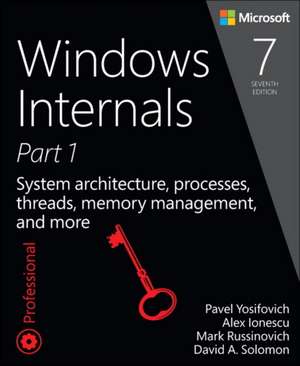
Windows Internals: System architecture, processes, threads, memory management, and more, Part 1
Autor Pavel Yosifovich, Mark E. Russinovich, Alex Ionescu, David A. Solomonen Limba Engleză Paperback – 5 mai 2017
Notăm cu interes faptul că Windows Internals: System architecture, processes, threads, memory management, and more, Part 1 se adresează profesioniștilor IT și dezvoltatorilor cu un nivel de experiență avansat, care posedă deja cunoștințe solide despre arhitectura calculatoarelor și programarea de sistem. Nu este un simplu manual de utilizare, ci o incursiune tehnică în măruntaiele sistemului de operare Microsoft, presupunând familiaritatea cu limbaje de programare precum C sau C++. Suntem de părere că această lucrare se distinge prin rigoarea tehnică și accesul la detalii care, în mod normal, sunt opace pentru utilizatorul obișnuit. Abordarea diferă de Modern Operating Systems, Global Edition de Andrew Tanenbaum prin faptul că este mai puțin abstractă și mult mai aplicabilă: în timp ce Tanenbaum discută principii teoretice universale, echipa condusă de Mark E. Russinovich și Alex Ionescu demonstrează cum sunt implementate aceste principii în codul real al Windows. Structura cărții urmărește o progresie logică, pornind de la conceptele fundamentale și arhitectura de sistem (Capitolul 2), trecând prin managementul proceselor și al firelor de execuție (Capitolele 3 și 4), până la complexitatea managementului memoriei în Capitolul 5, unde sunt explorate mecanisme precum paginarea și heap-urile kernel-mode. În contextul operei autorilor, acest titlu reprezintă piatra de temelie. Dacă Windows Kernel Programming de Pavel Yosifovich se concentrează pe scrierea de drivere, volumul de față oferă fundamentul teoretic și arhitectural necesar pentru a înțelege de ce acele drivere funcționează într-un anumit mod. Ne-a atras atenția în mod deosebit includerea noilor tehnologii de securitate bazate pe virtualizare și a proceselor de tip Trustlets, reflectând evoluția sistemului către o izolare mai strictă a componentelor critice.
Preț: 296.45 lei
Preț vechi: 370.56 lei
-20%
Carte disponibilă
Livrare economică 07-21 noiembrie
Livrare express 27-31 octombrie pentru 77.85 lei
Specificații
ISBN-10: 0735684189
Pagini: 800
Dimensiuni: 195 x 235 x 43 mm
Greutate: 1.49 kg
Ediția:7. Auflage
Editura: Microsoft Press
V-ar putea interesa
-
 -20%Preț: 374.94 lei468.68 lei
 -
 -20%Preț: 333.13 lei416.42 lei
 -
 Preț: 394.09 lei
 -
 Design and Implementation of the FreeBSD Operating System, TheGeorge Neville-Neil-20%Preț: 443.60 lei554.50 lei
 -
 Computer Architecture: A Quantitative ApproachJohn L. Hennessy-39%Preț: 534.37 lei882.55 lei
 -
 Troubleshooting with the Windows Sysinternals ToolsMark Russinovich-20%Preț: 292.26 lei365.32 lei
 -
 Microsoft Windows Operating System EssentialsT Carpenter-20%Preț: 189.88 lei237.34 lei
 -
 Comptia It Fundamentals (Itf+) Study GuideQuentin Docter-20%Preț: 277.09 lei346.36 lei
 -
 Understanding Operating SystemsAnn McIver McHoes-25%Preț: 636.06 lei849.67 lei
 -
 Operating Systems: Internals and Design Principles, Global EditionWilliam Stallings-20%Preț: 678.19 lei847.74 lei
 -
 Modern Operating Systems, Global EditionAndrew Tanenbaum-20%Preț: 669.46 lei836.83 lei
 -
 Windows 11 All-in-One For Dummies, 2nd EditionCiprian Adrian Rusen-20%Preț: 214.39 lei267.99 lei
 -
 Windows 11 for Seniors for Dummies, 2nd EditionCurt Simmons-20%Preț: 118.48 lei148.10 lei
 -
 Teach Yourself VISUALLY Windows 11Paul McFedries-20%Preț: 165.76 lei207.19 lei
 -
 CCNA Cybersecurity Operations Course BookletCisco Networking AcademyPreț: 266.28 lei
 -
 -20%Preț: 264.28 lei330.35 lei
 -
 Dive Into Systems: A Gentle Introduction to Computer SystemsSuzanne J Matthews-35%Preț: 407.65 lei625.36 lei
 -
 -35%Preț: 304.45 lei468.52 lei
 -
 Windows 11 for Seniors in Easy StepsNick Vandome-20%Preț: 100.48 lei125.60 lei
De ce să citești această carte
Recomandăm această carte inginerilor software și administratorilor de sistem care doresc să înțeleagă logica internă a Windows. Veți câștiga capacitatea de a diagnostica probleme complexe de performanță și securitate, explorând direct structurile de date și algoritmii de scheduling. Este motivul concret pentru care orice specialist care lucrează cu ecosistemul Microsoft ar trebui să aibă acest volum în bibliotecă pentru a trece de la utilizarea empirică la controlul tehnic deplin.
Despre autor
Echipa de autori reunește unii dintre cei mai respectați specialiști în arhitectura Windows. Mark E. Russinovich este CTO la Microsoft Azure și co-fondator al Winternals, fiind creatorul celebrei suite de instrumente Sysinternals. Alex Ionescu este un expert recunoscut internațional în securitatea și designul kernel-ului Windows, contribuind masiv la documentarea componentelor interne ale sistemului. Pavel Yosifovich completează echipa cu o vastă experiență în dezvoltarea de software și training tehnic, fiind autorul mai multor lucrări de referință despre programarea în mediul Windows, inclusiv Windows Kernel Programming.
Notă biografică
Alex Ionescu is Vice President of EDR Strategy at CrowdStrike and an internationally recognized expert in low-level system software, operating system research and kernel development, security training, and reverse engineering. He teaches Windows Internals courses around the world and is active in the security research community through conference talks and bug bounty programs.
Mark Russinovich is Chief Technology Officer for Microsoft Azure, Microsoft's global enterprise-grade cloud platform. Mark is a widely recognized expert in distributed systems and operating systems. He co-founded Winternals Software and joined Microsoft in 2006 when it was acquired. He is the primary author of the Sysinternals tools and website, which include dozens of popular Windows administration and diagnostic utilities.
David Solomon (retired) taught Windows kernel internals for 20 years to developers and IT professionals worldwide, including at Microsoft. His first book was Windows NT for OpenVMS Professionals. He then authored Inside Windows NT, 2nd edition, and later, with Mark Russinovich, coauthored the 3rd, 4th, 5th, and 6th editions of the Windows Internals series. David has spoken at many Microsoft conferences and was a recipient of the 1993 and 2005 Microsoft Support Most Valuable Professional (MVP) award.
Descriere scurtă
Cuprins
Windows operating system versions
Foundation concepts and terms
Digging into Windows internals
Conclusion
Chapter 2: System architecture
Requirements and design goals
Operating system model
Architecture overview
Virtualization-based security architecture overview
Key system components
Conclusion
Chapter 3: Processes and jobs
Creating a process
Process internals
Protected processes
Minimal and Pico processes
Trustlets (secure processes)
Flow of CreateProcess
Terminating a process
Image loader
Jobs
Conclusion
Chapter 4: Threads
Creating threads
Thread internals
Examining thread activity
Thread scheduling
Group-based scheduling
Worker factories (thread pools)
Conclusion
Chapter 5: Memory management
Introduction to the memory manager
Services provided by the memory manager
Kernel-mode heaps (system memory pools)
Heap manager
Virtual address space layouts
Address translation
Page fault handling
Stacks
Virtual address descriptors
NUMA
Section objects
Working sets
Page frame number database
Physical memory limits
Memory compression
Memory partitions
Memory combining
Memory enclaves
Proactive memory management (SuperFetch)
Conclusion
Chapter 6: I/O system
I/O system components
Interrupt Request Levels and Deferred Procedure Calls
Device drivers
I/O processing
Driver Verifier
The Plug and Play manager
General driver loading and installation
The Windows Driver Foundation
The power manager
Conclusion
Chapter 7: Security
Security ratings
Security system components
Virtualization-based security
Protecting objects
The AuthZ API
Account rights and privileges
Access tokens of processes and threads
Security auditing
AppContainers
Logon
User Account Control and virtualization
Exploit mitigations
Application Identification
AppLocker
Software Restriction Policies
Kernel Patch Protection
PatchGuard
HyperGuard
Conclusion