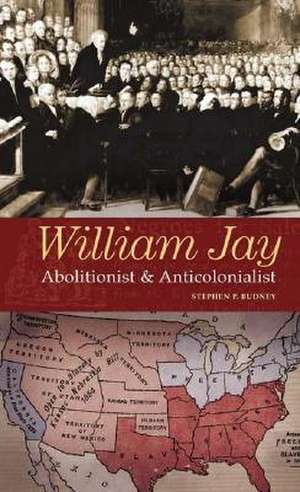
William Jay: Abolitionist and Anticolonialist
Autor Stephen Budneyen Limba Engleză Hardback – 28 feb 2005
The son of founding father John Jay, William Jay felt an obligation to help purify America so that it could continue to adhere to the republican principles that had helped create it. Not only does Budney examine the motivation for multifaceted reform, he also probes how advocates of abolition, peace activists, and temperance attempted to craft their appeals to influence the greatest number of people. Many scholars have attributed the vitality of the reform movement-particularly the abolitionists-to the more radical elements such as the Garrisons; however, most reformers would have preferred a more gentle approach to persuading Americans of the veracity of their efforts.
Preț: 374.07 lei
Preț vechi: 542.60 lei
-31%
Puncte Express: 561
Carte tipărită la comandă
Livrare economică 21 noiembrie-05 decembrie
Livrare prin curier în România Termenul estimat este afișat lângă disponibilitate.
Transport gratuit de la 400.00 lei Plată online sau ramburs, în funcție de opțiunile comenzii.
Retur gratuit în 14 zile Comandă securizată și suport în română.
Specificații
ISBN-13: 9780275985554
ISBN-10: 0275985555
Pagini: 200
Dimensiuni: 156 x 235 x 19 mm
Greutate: 0.42 kg
Ediția:New.
Editura: Bloomsbury Publishing
Colecția Praeger
Locul publicării:New York, United States
ISBN-10: 0275985555
Pagini: 200
Dimensiuni: 156 x 235 x 19 mm
Greutate: 0.42 kg
Ediția:New.
Editura: Bloomsbury Publishing
Colecția Praeger
Locul publicării:New York, United States
V-ar putea interesa
-
 Command and ControlEric Schlosser-27%Preț: 90.39 lei123.58 lei
 -
 The Last Caribbean Frontier, 1795-1815K. Candlin-15%Preț: 637.00 lei749.41 lei
 -
 Slavery in FloridaLarry Eugene RiversPreț: 161.80 lei
 -
 "My Brave Mechanics"Mark HoffmanPreț: 390.21 lei
 -
 Stand Up!: The Story of Minnesota's Protest TraditionRhoda R. GilmanPreț: 97.47 lei
 -
 Canada's Constitutional RevolutionBarry L. Strayer-23%Preț: 201.15 lei260.18 lei
 -
 Waterfront: The Illustrated Maritime History of Greater VancouverJames P. Delgado-5%Preț: 139.13 lei146.03 lei
 -
 Preț: 175.70 lei
 -
 A Population History of the United StatesHerbert S. KleinPreț: 233.89 lei
 -
 Liberty and American Anti-ImperialismM. CullinanePreț: 390.09 lei
 -
 Preț: 403.27 lei
 -
 The Right Side of the SixtiesLaura Jane GiffordPreț: 391.06 lei
 -
 America ImaginedAxel KörnerPreț: 391.06 lei
Cuprins
Preface
Introduction
Influences
A Wonderful Apathy Prevails
I Am an Abolitionist, and I Thank God I Am
On the Altar of Moloch
The Time Has Come for Christians and Churches to Act
Bibliography
Introduction
Influences
A Wonderful Apathy Prevails
I Am an Abolitionist, and I Thank God I Am
On the Altar of Moloch
The Time Has Come for Christians and Churches to Act
Bibliography
Recenzii
William Jay, the son of America's first chief justice, John Jay, is a significant but overlooked figure in the annals of antebellum reform. In this short but important book, Budney maintains that Jay was led to reform by his religious convictions, his republican principles, and his father's humanitarian example. Early in his career, he was active in religious benevolence and in the peace movement. He was sympathetic to, but remained aloof from, abolitionism. Budney asserts that it was the antiabolitionist riots and racial violence of the 1830s that galvanized Jay to activism. He endorsed the newly formed American Antislavery Society and denounced the American Colonization Society's efforts to colonize freed African Americans in Africa. Although never as radical in his speeches and writings as William Lloyd Garrison and his followers, Jay condemned the annexation of Texas and the war with Mexico as examples of a conspiracy to spread slavery in the West. Jay remained active in both the antislavery and peace movements until his death in 1857. Budney's book restores Jay to his rightful place in the abolitionist movement and helps the reader understand the complexity of antislavery. The bibliography enhances the book's worth..Recommended. All levels/libraries.
Stephen P. Budney's insightful biography of William Jay (1789-1857) extends the historiography of abolitionism beyond well-worn tales of Garrisonian reformers in antebellum New England..Jay is fortunate to have found a sympathetic and probing biographer whose compact book brings both conservative abolitionists and the American nation-state back into the story of antislavery activism.
Stephen P. Budney's insightful biography of William Jay (1789-1857) extends the historiography of abolitionism beyond well-worn tales of Garrisonian reformers in antebellum New England..Jay is fortunate to have found a sympathetic and probing biographer whose compact book brings both conservative abolitionists and the American nation-state back into the story of antislavery activism.