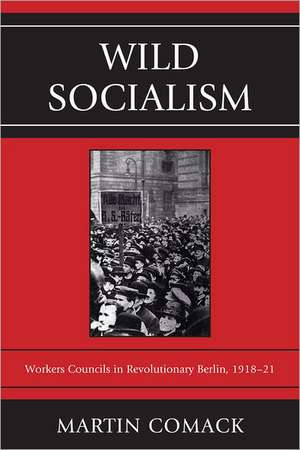
Wild Socialism: Workers Councils in Revolutionary Berlin, 1918-21
Autor Martin Comacken Limba Engleză Paperback – 11 sep 2012
These workers councils were most highly developed in Berlin, within its particular industrial, political, and cultural milieu. The Berlin Shop Stewards group provided a hard core of militant revolutionaries within the movement, many of whose adherents were more moderate or ambiguous in their views. Externally, the councilists faced a hostile Social Democratic-trade union bureaucracy who characterized council rule as "wilde Sozialismus," a reconstituted and repressive state power, and a revolutionary rival in the rise of German Bolshevism. This work considers the experience of the Berlin councils as alternative institutions outside of traditional union, party, and governmental structures.
Preț: 252.91 lei
Preț vechi: 348.53 lei
-27%
Puncte Express: 379
Carte tipărită la comandă
Livrare economică 14-28 noiembrie
Livrare prin curier în România Termenul estimat este afișat lângă disponibilitate.
Transport gratuit de la 400.00 lei Plată online sau ramburs, în funcție de opțiunile comenzii.
Retur gratuit în 14 zile Comandă securizată și suport în română.
Specificații
ISBN-13: 9780761859031
ISBN-10: 0761859039
Pagini: 97
Dimensiuni: 151 x 231 x 11 mm
Greutate: 0.18 kg
Editura: Bloomsbury Publishing
Colecția University Press of America
Locul publicării:New York, United States
ISBN-10: 0761859039
Pagini: 97
Dimensiuni: 151 x 231 x 11 mm
Greutate: 0.18 kg
Editura: Bloomsbury Publishing
Colecția University Press of America
Locul publicării:New York, United States
V-ar putea interesa
-
 A History of the British IslesJeremy Black-24%Preț: 188.53 lei249.56 lei
 -
 Lady Lucy Houston DBEMiles MacnairPreț: 193.31 lei
 -
 -26%Preț: 67.83 lei92.14 lei
 -
 Canals in BritainTony Conder-26%Preț: 47.18 lei64.14 lei
 -
 Visitors to Verona: Lovers, Gentlemen and AdventurersCaroline Webb-19%Preț: 349.08 lei429.02 lei
 -
 Preț: 431.91 lei
 -
 MicrocosmsClaudio Magris-32%Preț: 62.54 lei91.54 lei
 -
 I Never Knew That About the EnglishChristopher WinnPreț: 119.11 lei
 -
 Sacred Trees of IrelandChristine ZucchelliPreț: 130.52 lei
Cuprins
Preface
Chapter 1: Introduction
Chapter 2: Berlin
Chapter 3: The Urban Proletariat
Chapter 4: German Social Democracy
Chapter 5: The Trade Unions
Chapter 6: Wartime
Chapter 7: The Workers Councils
Chapter 8: Revolution
Chapter 9: 1919
Chapter 10: 1920
Chapter 11: Council Communism
Chapter 12: Conclusion
Appendices
A. Chronology
B. Abbreviations
Bibliography
About the Author
Chapter 1: Introduction
Chapter 2: Berlin
Chapter 3: The Urban Proletariat
Chapter 4: German Social Democracy
Chapter 5: The Trade Unions
Chapter 6: Wartime
Chapter 7: The Workers Councils
Chapter 8: Revolution
Chapter 9: 1919
Chapter 10: 1920
Chapter 11: Council Communism
Chapter 12: Conclusion
Appendices
A. Chronology
B. Abbreviations
Bibliography
About the Author
Recenzii
[This book is] a valuable contribution to the understanding of Germany social history that carries important implications for the situation of labor until today.
.How relevant is Wild Socialism for today? One only needs to think of the Arab Spring, anti-austerity debt riots in Greece, spontaneous mass strikes of workers in China, or mass labor protests in Wisconsin - to appreciate Comack's history of a revolutionary moment in troubling times.
...Scrupulously researched with prose as clear as a bell, he takes us through the twists and turns of German social democracy and trade unions before, during, and after World War I with great clarity in this very readable volume. Wild Socialism is must-read for not only historians of the period, but for those interested in the working class and labor activism.
.A welcome addition to the literature on post-World War I Germany..He skillfully delineates the bureaucratic degeneration of the German Social Democratic Party and trade unions during the previous thirty years which led them to become complicity with the Imperial regime and its war..Comack writes with remarkable clarity and is able to describe the complex situations in an accessible manner..Comack is to be commended.
.How relevant is Wild Socialism for today? One only needs to think of the Arab Spring, anti-austerity debt riots in Greece, spontaneous mass strikes of workers in China, or mass labor protests in Wisconsin - to appreciate Comack's history of a revolutionary moment in troubling times.
...Scrupulously researched with prose as clear as a bell, he takes us through the twists and turns of German social democracy and trade unions before, during, and after World War I with great clarity in this very readable volume. Wild Socialism is must-read for not only historians of the period, but for those interested in the working class and labor activism.
.A welcome addition to the literature on post-World War I Germany..He skillfully delineates the bureaucratic degeneration of the German Social Democratic Party and trade unions during the previous thirty years which led them to become complicity with the Imperial regime and its war..Comack writes with remarkable clarity and is able to describe the complex situations in an accessible manner..Comack is to be commended.