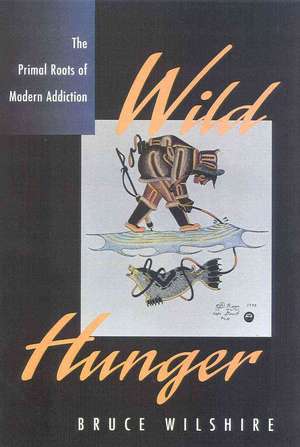
Wild Hunger: The Primal Roots of Modern Addiction
Autor Bruce Wilshireen Limba Engleză Paperback – 27 oct 1999
Preț: 111.93 lei
Preț vechi: 131.97 lei
-15%
Puncte Express: 168
Carte tipărită la comandă
Livrare economică 09-23 noiembrie
Livrare prin curier în România Termenul estimat este afișat lângă disponibilitate.
Transport gratuit de la 400.00 lei Plată online sau ramburs, în funcție de opțiunile comenzii.
Retur gratuit în 14 zile Comandă securizată și suport în română.
Specificații
ISBN-13: 9780847689682
ISBN-10: 0847689689
Pagini: 304
Dimensiuni: 150 x 229 x 17 mm
Greutate: 0.38 kg
Ediția:0303
Editura: Bloomsbury Publishing
Colecția Rowman & Littlefield
Locul publicării:New York, United States
ISBN-10: 0847689689
Pagini: 304
Dimensiuni: 150 x 229 x 17 mm
Greutate: 0.38 kg
Ediția:0303
Editura: Bloomsbury Publishing
Colecția Rowman & Littlefield
Locul publicării:New York, United States
V-ar putea interesa
-
 -30%Preț: 1100.64 lei1564.41 lei
 -
 Substance Use DisordersAddiction Medicine Services Department of Psychiatry University of Pittsburgh School of Medicine Antoine Douaihy, M.D. Associate Professor of Psychiatry Medical Director-22%Preț: 626.31 lei805.47 lei
 -
 -26%Preț: 623.75 lei843.52 lei
 -
 I Shop Therefore I Am: Compulsive Buying and the Search for SelfApril Lane Benson-33%Preț: 849.02 lei1267.93 lei
 -
 Managing Addictions: Cognitive, Emotive, and Behavioral TechniquesMichler F. Bishop-34%Preț: 791.27 lei1191.88 lei
 -
 -33%Preț: 368.48 lei549.38 lei
 -
 Neuroimaging and Psychosocial Addiction TreatmentSarah W Feldstein Ewing-5%Preț: 729.40 lei767.79 lei
 -
 -23%Preț: 1389.56 lei1813.27 lei
 -
 The Biology of DesireMarc LewisPreț: 77.77 lei
 -
 Eating Disorders, Addictions and Substance Use DisordersTimothy D. Brewerton-5%Preț: 1641.95 lei1728.36 lei
Cuprins
Chapter 1 Prologue: Hunger for Ecstatic Connectedness
Part 2 I NATURE'S REGENERATIVE CYCLES
Chapter 3 1 Ecstasy Deprivation and Addictive "Remedies"
Chapter 4 2 Rediscovering Space, Time, Body, Self
Chapter 5 3 Circular Power Returning into Itself
Chapter 6 4 The Intimate Otherness of Body-Self's World: Addiction as Frightened Response
Part 7 II ADDICTION: CIRCULAR POWER SHORT-CIRCUITED
Chapter 8 5 The More Than Merely Human: Hunger to Belong
Chapter 9 6 Medical Materialism and the Fragmented Grasp of Addiction
Chapter 10 7 Possession, Addiction, Fragmentation: Is a Healing Community Possible?
Chapter 11 8 Smoking As Ritual, Smoking As Addiction
Chapter 12 9 Body, Nose, Viscera, Earth
Chapter 13 10 Art and Truth
Chapter 14 III HARMONY WITH NATURE
Chapter 15 11 Mother Nature: Circular Power Returning into Itself
Chapter 16 12 Technology As Ecstasy: How to Deal with It?
Chapter 17 Conclusion: The Awesome World
Chapter 18 Sources
Chapter 19 Acknowledgments
Chapter 20 Index
Chapter 21 About the Author
Part 2 I NATURE'S REGENERATIVE CYCLES
Chapter 3 1 Ecstasy Deprivation and Addictive "Remedies"
Chapter 4 2 Rediscovering Space, Time, Body, Self
Chapter 5 3 Circular Power Returning into Itself
Chapter 6 4 The Intimate Otherness of Body-Self's World: Addiction as Frightened Response
Part 7 II ADDICTION: CIRCULAR POWER SHORT-CIRCUITED
Chapter 8 5 The More Than Merely Human: Hunger to Belong
Chapter 9 6 Medical Materialism and the Fragmented Grasp of Addiction
Chapter 10 7 Possession, Addiction, Fragmentation: Is a Healing Community Possible?
Chapter 11 8 Smoking As Ritual, Smoking As Addiction
Chapter 12 9 Body, Nose, Viscera, Earth
Chapter 13 10 Art and Truth
Chapter 14 III HARMONY WITH NATURE
Chapter 15 11 Mother Nature: Circular Power Returning into Itself
Chapter 16 12 Technology As Ecstasy: How to Deal with It?
Chapter 17 Conclusion: The Awesome World
Chapter 18 Sources
Chapter 19 Acknowledgments
Chapter 20 Index
Chapter 21 About the Author
Recenzii
This book is absolutely on the cutting edge-even ahead of its time. It brings us an entirely new way of understanding addiction, one of the major curses of industrial society in the late twentieth century. After Wild Hunger, it will be very difficult to think of addiction as a purely medical-neurological problem.
Footnotes provide interesting information and lead the reader to the other source.
Literate and spiritually refreshing.
The book is an interesting indicator of current trends in fin-de-siecle America.
An impassioned plea for rediscovering our primal need for ecstatic involvement in the world. . . will speak to a wide audience.
Wilshire gives insight into the nature of the pseudo-ecstasy of addiction...and how a new awakening can come about.
Carries the analysis of addiction to new heights and depths. We are immersed in the ultimate question of what we once called 'salvation.'
Quite unlike any other work I know on addiction, culture, or spirit, this text becomes a living site of recognition and regeneration, an eco-textual therapeutic you immediately begin to practice and share.
Startling! Writing with passion and honesty, Wilshire shows that in addiction we participate in degenerative vicious circles that substitute for the regenerative cycles of nature.
[Wilshire]'s approac is intuitive and imaginative, mixing medical and scientific research with the insights of Thoreau, James, Dewey, Muir, ad St. Paul, and he is most persuasive when describing the alienating disaffections of dualism, patriarchy, and a scientism whhich places inordinate faith in technology.
A worthwhile contribution to the study of addiction, which rarely receives such sustained, serious reflection by professional philosophers. . . . Wilshire makes a significant contribution not only to the study of addiction but also to the remedying of the ever-widening cultural-societal situation in which modern addictions proliferate.
Wild Hunger is an incredibly rich book. . . . This is a book that is sure to interest philosophers, especially American philosophers and phenomenologists, but also medical doctors, anthropologists, feminists, psychologists, addiction counselors, addicts, relatives of addicts, and, more generally, anyone who is concerned with the ominous signs that our present way of inhabiting the world is interfering with our opportunity to realize our most primal needs.
Footnotes provide interesting information and lead the reader to the other source.
Literate and spiritually refreshing.
The book is an interesting indicator of current trends in fin-de-siecle America.
An impassioned plea for rediscovering our primal need for ecstatic involvement in the world. . . will speak to a wide audience.
Wilshire gives insight into the nature of the pseudo-ecstasy of addiction...and how a new awakening can come about.
Carries the analysis of addiction to new heights and depths. We are immersed in the ultimate question of what we once called 'salvation.'
Quite unlike any other work I know on addiction, culture, or spirit, this text becomes a living site of recognition and regeneration, an eco-textual therapeutic you immediately begin to practice and share.
Startling! Writing with passion and honesty, Wilshire shows that in addiction we participate in degenerative vicious circles that substitute for the regenerative cycles of nature.
[Wilshire]'s approac is intuitive and imaginative, mixing medical and scientific research with the insights of Thoreau, James, Dewey, Muir, ad St. Paul, and he is most persuasive when describing the alienating disaffections of dualism, patriarchy, and a scientism whhich places inordinate faith in technology.
A worthwhile contribution to the study of addiction, which rarely receives such sustained, serious reflection by professional philosophers. . . . Wilshire makes a significant contribution not only to the study of addiction but also to the remedying of the ever-widening cultural-societal situation in which modern addictions proliferate.
Wild Hunger is an incredibly rich book. . . . This is a book that is sure to interest philosophers, especially American philosophers and phenomenologists, but also medical doctors, anthropologists, feminists, psychologists, addiction counselors, addicts, relatives of addicts, and, more generally, anyone who is concerned with the ominous signs that our present way of inhabiting the world is interfering with our opportunity to realize our most primal needs.