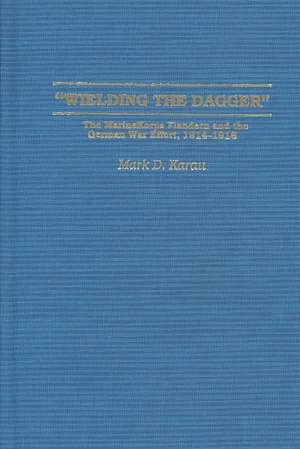
Wielding the Dagger
en Limba Engleză Hardback – 30 sep 2003
The British had traditionally seen Belgium as a dagger pointed at the throat of England, and the Royal Navy feared what use the Germans might make of the position. The result was an active naval campaign in the English Channel. Karau brings to light the contributions of the MarineKorps Flandern, a force often neglected by historians. He examines the role of the MarineKorps in both land and naval wars and reaffirms the increasingly important role played by aircraft in the Flanders theater. If Belgium was a weapon pointed at the British throat, were the Germans properly equipped to wield the dagger?
Preț: 526.15 lei
Preț vechi: 611.81 lei
-14%
Puncte Express: 789
Carte disponibilă
Livrare economică 07-21 octombrie
Livrare prin curier în România Termenul estimat este afișat lângă disponibilitate.
Transport gratuit pentru acest produs Plată online sau ramburs, în funcție de opțiunile comenzii.
Retur gratuit în 14 zile Comandă securizată și suport în română.
Specificații
ISBN-13: 9780313324758
ISBN-10: 0313324751
Pagini: 280
Dimensiuni: 158 x 247 x 25 mm
Greutate: 0.57 kg
Ediția:New.
ISBN-10: 0313324751
Pagini: 280
Dimensiuni: 158 x 247 x 25 mm
Greutate: 0.57 kg
Ediția:New.
V-ar putea interesa
-
 The World Crisis 1911-1918Winston Churchill-18%Preț: 118.49 lei143.90 lei
 -
 The Guns of AugustBarbara W. TuchmanPreț: 141.66 lei
 -
 The Guns of AugustBarbara W. TuchmanPreț: 66.31 lei
 -
 British Battle Insignia (1)Mike Chappell-34%Preț: 64.80 lei97.61 lei
 -
 Preț: 122.61 lei
 -
 Passchendaele: The Fight for the VillageNigel CavePreț: 111.92 lei
 -
 The Great War: 1914-1918Ian F. W. BeckettPreț: 289.23 lei
 -
 Cheerful Sacrifice: The Battle of Arras 1917Jonathan NichollsPreț: 115.04 lei
 -
 PasschendaelePeter Barton-24%Preț: 360.48 lei472.69 lei
Descriere
In August 1914, Admiral Alfred von Tirpitz convinced the German armed forces to create a new unit, called the MarineDivision Flandern, to garrison the Belgian coastline and prepare naval bases in for the implementation of a naval guerrilla war against Great Britain. The Germans called their strategy Kleinkrieg, or little war, and they intended to whittle away at British naval superiority by using their submarines and destroyers. Later expanded into the MarineKorps, the unit soon found itself in the middle of a land war as well. What had been intended as a garrison unit found itself on the frontlines when the war stalemated.
The British had traditionally seen Belgium as a dagger pointed at the throat of England, and the Royal Navy feared what use the Germans might make of the position. The result was an active naval campaign in the English Channel. Karau brings to light the contributions of the MarineKorps Flandern, a force often neglected by historians. He examines the role of the MarineKorps in both land and naval wars and reaffirms the increasingly important role played by aircraft in the Flanders theater. If Belgium was a weapon pointed at the British throat, were the Germans properly equipped to wield the dagger?
The British had traditionally seen Belgium as a dagger pointed at the throat of England, and the Royal Navy feared what use the Germans might make of the position. The result was an active naval campaign in the English Channel. Karau brings to light the contributions of the MarineKorps Flandern, a force often neglected by historians. He examines the role of the MarineKorps in both land and naval wars and reaffirms the increasingly important role played by aircraft in the Flanders theater. If Belgium was a weapon pointed at the British throat, were the Germans properly equipped to wield the dagger?