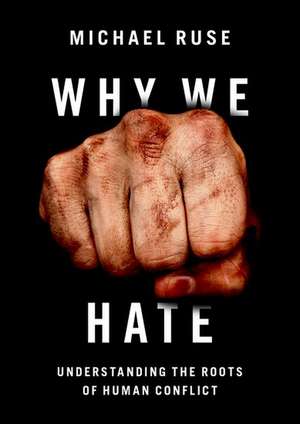
Why We Hate: Understanding the Roots of Human Conflict
Autor Michael Ruseen Limba Engleză Hardback – 14 noi 2022
Preț: 170.17 lei
Preț vechi: 201.68 lei
-16%
Puncte Express: 255
Carte disponibilă
Livrare economică 30 octombrie-10 noiembrie
Livrare express 20-24 octombrie pentru 59.69 lei
Livrare prin curier în România Termenul estimat este afișat lângă disponibilitate.
Transport gratuit de la 400.00 lei Plată online sau ramburs, în funcție de opțiunile comenzii.
Retur gratuit în 14 zile Comandă securizată și suport în română.
Specificații
ISBN-13: 9780197621288
ISBN-10: 0197621287
Pagini: 320
Dimensiuni: 184 x 134 x 29 mm
Greutate: 0.42 kg
Editura: Oxford University Press
Colecția OUP USA
Locul publicării:New York, United States
ISBN-10: 0197621287
Pagini: 320
Dimensiuni: 184 x 134 x 29 mm
Greutate: 0.42 kg
Editura: Oxford University Press
Colecția OUP USA
Locul publicării:New York, United States
Recenzii
This book is a must read for anyone hoping to address instances of human hatred, because it also offers a hope of reducing hate-based conflicts.
Ruse has written one of the most powerful books this reader has encountered in quite a while... [he] does a masterful job of uncovering those roots in a text that addresses the fundamentals of human conflict in a more comprehensive way than any other work on this reader's current course list. The work is both personal and professional, incorporating a blend of historical fact and firsthand observation that effectively reveals manifestations of the roots of human conflict. The text is both humbling and uplifting, offering a clear look at the past with an eye toward promoting resolution or avoidance of hate-based conflicts in the future. Ruse achieves this effect through a blended approach encompassing aspects of religion, sociology, social work, history, anthropology-and even a bit of psychology. This book is a must read for anyone hoping to address instances of human hatred, because it also offers a hope of reducing hate-based conflicts.
An illuminating interdisciplinary rumination on the causes of war and prejudice. Considering both nature and nurture, Ruse argues that hate is not an irradicably given aspect of human life. Squarely facing present day cultural conflicts over immigration, race, sex, and more, this heartfelt book provides hope that we may yet overcome ingroup/outgroup divisions and find a way forward together.
This is a lively, personal, and often provocative natural history of human hate, its origins in ingroup-outgroup discriminations, and all it brings: wars, individual aggression, prejudice, racism, class conflict, anti-Semitism, misogyny and more. In his unique and conversational style, Michael Ruse draws upon an impressive range of scholarship from evolutionary biology, philosophy, history, political science, anthropology, and literature, to understand human hate and its sources, in part to debunk the 'killer ape' hypothesis that humans are irremediably violent and hateful. We may be able to do something about human hate if we understand more about it; if so, then Why We Hate starts an essential conversation on a matter of crucial importance.
Ruse has written one of the most powerful books this reader has encountered in quite a while... [he] does a masterful job of uncovering those roots in a text that addresses the fundamentals of human conflict in a more comprehensive way than any other work on this reader's current course list. The work is both personal and professional, incorporating a blend of historical fact and firsthand observation that effectively reveals manifestations of the roots of human conflict. The text is both humbling and uplifting, offering a clear look at the past with an eye toward promoting resolution or avoidance of hate-based conflicts in the future. Ruse achieves this effect through a blended approach encompassing aspects of religion, sociology, social work, history, anthropology-and even a bit of psychology. This book is a must read for anyone hoping to address instances of human hatred, because it also offers a hope of reducing hate-based conflicts.
An illuminating interdisciplinary rumination on the causes of war and prejudice. Considering both nature and nurture, Ruse argues that hate is not an irradicably given aspect of human life. Squarely facing present day cultural conflicts over immigration, race, sex, and more, this heartfelt book provides hope that we may yet overcome ingroup/outgroup divisions and find a way forward together.
This is a lively, personal, and often provocative natural history of human hate, its origins in ingroup-outgroup discriminations, and all it brings: wars, individual aggression, prejudice, racism, class conflict, anti-Semitism, misogyny and more. In his unique and conversational style, Michael Ruse draws upon an impressive range of scholarship from evolutionary biology, philosophy, history, political science, anthropology, and literature, to understand human hate and its sources, in part to debunk the 'killer ape' hypothesis that humans are irremediably violent and hateful. We may be able to do something about human hate if we understand more about it; if so, then Why We Hate starts an essential conversation on a matter of crucial importance.
Notă biografică
Michael Ruse, born (in 1940) in England, taught philosophy for 35 years at the University of Guelph, in Ontario, Canada, and then for 20 years at Florida State University. He is an expert on the history and philosophy of evolutionary biology and has written or edited over sixty books. He is particularly interested in the relationship between science and religion, and was a witness for the ACLU in 1981 in its successful attempt to overturn a law mandating the compulsory teaching of Creationism in Arkansas. He has been awarded a Guggenheim fellowship (USA) and a Killam fellowship (Canada). A Fellow of the Royal Society of Canada, he has been a Gifford Lecturer and is the recipient of four honorary degrees. He was the founding editor of Biology and Philosophy and editor of several series of books, most recently and continuing the Cambridge University Press Elements series in the Philosophy of Biology.