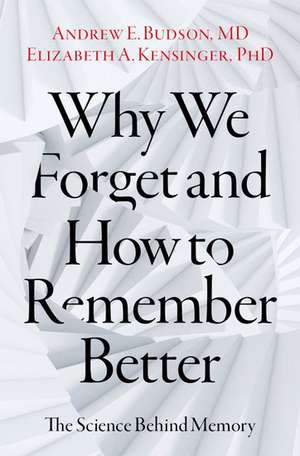
Why We Forget and How To Remember Better: The Science Behind Memory
Autor Andrew E. Budson, Elizabeth A. Kensinger Cuvânt înainte de Daniel L. Schacteren Limba Engleză Hardback – 25 mai 2023
Preț: 223.12 lei
Preț vechi: 276.09 lei
-19%
Puncte Express: 335
Carte disponibilă
Livrare economică 30 octombrie-04 noiembrie
Livrare express 16-22 octombrie pentru 84.99 lei
Livrare prin curier în România Termenul estimat este afișat lângă disponibilitate.
Transport gratuit de la 400.00 lei Plată online sau ramburs, în funcție de opțiunile comenzii.
Retur gratuit în 14 zile Comandă securizată și suport în română.
Specificații
ISBN-13: 9780197607732
ISBN-10: 019760773X
Pagini: 448
Dimensiuni: 168 x 235 x 33 mm
Greutate: 0.81 kg
Editura: Oxford University Press
Colecția OUP USA
Locul publicării:New York, United States
ISBN-10: 019760773X
Pagini: 448
Dimensiuni: 168 x 235 x 33 mm
Greutate: 0.81 kg
Editura: Oxford University Press
Colecția OUP USA
Locul publicării:New York, United States
V-ar putea interesa
-
 -24%Preț: 173.22 lei229.26 lei
 -
 Antibiotic ResistanceBoard On Global Health-5%Preț: 721.02 lei758.97 lei
 -
 Sex Differences and Implications for Translational Neuroscience ResearchBoard On Health Sciences Policy-5%Preț: 225.61 lei237.48 lei
 -
 -5%Preț: 140.47 lei147.86 lei
 -
 Memory, Brain & BeliefDaniel L. Schacter-5%Preț: 294.12 lei309.60 lei
 -
 Preț: 396.94 lei
 -
 The Laws of EmotionNico H. Frijda-5%Preț: 498.12 lei524.34 lei
 -
 -26%Preț: 425.03 lei573.19 lei
 -
 -23%Preț: 639.22 lei830.15 lei
Recenzii
This book is an essential read for all those concerned with memory loss and should be a part of all collections in the behavioral and social sciences.
In "Why we Forget", memory experts Andrew Budson and Elizabeth Kensinger provide readers with a practical and clearly explained masterclass in how memory works and how to keep it working well as we age. This is a must-read for anyone who wants to understand and maximize their memory functions.
In this highly readable book, two authorities on the science of memory and the brain unpack everything you could want to know about memory and memory disorders. You will find surprising answers here to fascinating puzzles - for example, why we form false memories, why someone with Alzheimer's disease remembers how to play the piano but forgets the names of family members, how to distinguish between memory decline due to normal aging and disorders of memory, and why sleep is so important for memory. In addition, the authors describe evidence-based ways to remember better and to defend against false memories.
Budson and Kensinger have done a marvelous job creating an accessible summary of the wide-ranging field of memory research. A perfect place to start for anyone interested in understanding this fundamental human capacity.
This book delivers on all fronts. Written by two of the most eminent memory scientists in the world, the book draws in the reader immediately - engaging both the practitioners of the science of memory as well as those who are new to memory research. The reader is presented with many relatable, everyday examples and practical tips, and with concrete steps that unfold and explain complex theories of memory and forgetting. The authors cover a wide range of representative phenomena about when memory works and when it fails. The book delves into the neuroscience of memory and effects of aging at one end, strategies for improving memory at the other, and many key topics in between. I want this book for my memory course, and for my family and friends who are curious about how memory works.
Everyone knows how memory works, we have our own experiences of remembering and forgetting to go on. But the science of memory, as Budson and Kensinger engagingly recount, teaches us so much more—how it really works and how it doesn't. And how this scientifically grounded knowledge enriches our understanding of our own minds.
the book is worth the time for anyone wanting a better understanding of how memory works. Recommended. All readers.
In "Why we Forget", memory experts Andrew Budson and Elizabeth Kensinger provide readers with a practical and clearly explained masterclass in how memory works and how to keep it working well as we age. This is a must-read for anyone who wants to understand and maximize their memory functions.
In this highly readable book, two authorities on the science of memory and the brain unpack everything you could want to know about memory and memory disorders. You will find surprising answers here to fascinating puzzles - for example, why we form false memories, why someone with Alzheimer's disease remembers how to play the piano but forgets the names of family members, how to distinguish between memory decline due to normal aging and disorders of memory, and why sleep is so important for memory. In addition, the authors describe evidence-based ways to remember better and to defend against false memories.
Budson and Kensinger have done a marvelous job creating an accessible summary of the wide-ranging field of memory research. A perfect place to start for anyone interested in understanding this fundamental human capacity.
This book delivers on all fronts. Written by two of the most eminent memory scientists in the world, the book draws in the reader immediately - engaging both the practitioners of the science of memory as well as those who are new to memory research. The reader is presented with many relatable, everyday examples and practical tips, and with concrete steps that unfold and explain complex theories of memory and forgetting. The authors cover a wide range of representative phenomena about when memory works and when it fails. The book delves into the neuroscience of memory and effects of aging at one end, strategies for improving memory at the other, and many key topics in between. I want this book for my memory course, and for my family and friends who are curious about how memory works.
Everyone knows how memory works, we have our own experiences of remembering and forgetting to go on. But the science of memory, as Budson and Kensinger engagingly recount, teaches us so much more—how it really works and how it doesn't. And how this scientifically grounded knowledge enriches our understanding of our own minds.
the book is worth the time for anyone wanting a better understanding of how memory works. Recommended. All readers.
Notă biografică
Andrew E. Budson, Chief, Cognitive & Behavioral Neurology and Associate Chief of Staff for Education, VA Boston Healthcare System, Associate Director & Education Core Leader, Boston University Alzheimer's Disease Center, Professor of Neurology, Boston University School of Medicine, Lecturer in Neurology, Harvard Medical SchoolAndrew Budson majored in chemistry and philosophy at Haverford College, graduated cum laude from Harvard Medical School, interned at Brigham and Women's Hospital, attended the Harvard-Longwood Neurology Residency Program, and then pursued a clinical fellowship in behavioral neurology and dementia at Brigham and Women's Hospital and a research post-doctoral fellowship in experimental psychology and cognitive neuroscience at Harvard University. He has given over 700 talks and published over 150 papers in peer-reviewed journals. From the American Academy of Neurology he received the Norman Geschwind Prize in Behavioral Neurology in 2008 and the Research Award in Geriatric Neurology in 2009.Elizabeth Kensinger, PhD,Professor and Chair of the Department of Psychology and Neuroscience, Boston CollegeElizabeth Kensinger majored in psychology and biology at Harvard University and received her Ph.D. in neuroscience at the Massachusetts Institute of Technology. After a postdoctoral fellowship at Harvard University and the Massachusetts General Hospital, she joined the faculty of Boston College, where she is now a Full Professor and Chairperson of the Department of Psychology and Neuroscience. She directs a research laboratory that investigates many aspects of human memory, including how emotion, stress, and sleep affect memory, and how memory strengths shift as adults age, and she teaches courses on these topics.
Cuprins
- Foreword, Daniel Schacter
- Preface
- Part 1: All the ways to remember
- Chapter 1: Memory is not one thing
- Chapter 2: Travel back in time
- Chapter 3: Keep it in mind
- Chapter 4: Muscle memory
- Chapter 5: Our store of knowledge
- Chapter 6: What we remember together
- Part 2: Remembering the days of our lives
- Chapter 7: Do you need to try to remember?
- Chapter 8: Get it into your memory - and keep it there
- Chapter 9: Retrieve that memory
- Chapter 10: Associate information
- Chapter 11: Control what you forget and remember
- Chapter 12: Are you sure that's not a false memory?
- Part 3: When there is too little memory - or too much
- Chapter 13: Just normal aging - or is it Alzheimer's disease?
- Chapter 14: What else can go wrong with your memory
- Chapter 15: When you can't forget
- Chapter 16: Those who can remember everything
- Part 4: How to remember better
- Chapter 17: Exercise, exercise, exercise
- Chapter 18: Diet, alcohol, and drugs
- Chapter 19: Sleep
- Chapter 20: Do the right things
- Chapter 21: Use strategies
- Chapter 22: Use memory aids
- Chapter 23: Putting it all together
- Appendix: Twelve tips to remember better
- Acknowledgments
- References
- About the Authors
- Index