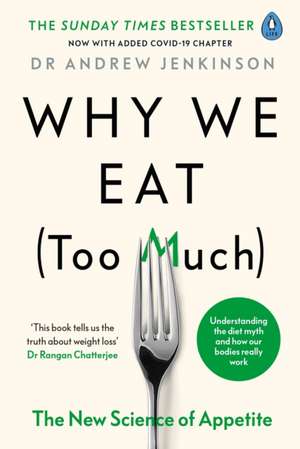
Why We Eat (Too Much)
Autor Andrew Jenkinsonen Limba Engleză Paperback – 14 ian 2021
Remarcăm, încă de la primele pagini, o rigoare clinică în prezentarea proceselor metabolice, susținută de figuri și date ce explică mecanismele hormonale ale apetitului. Why We Eat (Too Much) nu este un manual de dietă, ci o investigație asupra biologiei umane, scrisă de Andrew Jenkinson, un chirurg cu peste două decenii de experiență în tratarea obezității. Notăm cu interes modul în care autorul integrează studii de caz din practica sa chirurgicală pentru a ilustra de ce restricția calorică simplistă eșuează sistematic. Merită menționat că structura cărții prioritizează înțelegerea conceptului de „set weight point” — pragul biologic de greutate pe care corpul tinde să îl apere. Această abordare este comparabilă cu cea din Gene Eating de Dr Giles Yeo, însă Andrew Jenkinson pune un accent mai mare pe interacțiunea dintre mediu, grăsimile alimentare și răspunsul hormonal post-dietă. Această ediție actualizată aduce în discuție și contextul epidemiologic recent, printr-un capitol dedicat vulnerabilităților metabolice în fața COVID-19. În contextul operei autorului, deși acesta a publicat anterior lucrări de nișă istorică precum The Touring Caravan Story, tranziția către literatura medicală de popularizare în Why We Eat (Too Much) reprezintă o sinteză a expertizei sale profesionale. Este un manual de referință clinică pentru publicul larg, oferind o perspectivă radicală asupra nutriției, similară cu abordarea din Always Hungry? de David S. Ludwig, dar ancorată în realitățile chirurgiei bariatrice contemporane. Stilul este precis, eliminând miturile despre voință în favoarea explicațiilor despre leptină, insulină și semnalele chimice ale creierului.
Preț: 61.85 lei
Preț vechi: 79.56 lei
-22%
Carte disponibilă
Livrare economică 06-18 noiembrie
Livrare express 23-29 octombrie pentru 35.02 lei
Specificații
ISBN-10: 0241400538
Pagini: 352
Dimensiuni: 132 x 195 x 25 mm
Greutate: 0.25 kg
Editura: Penguin Books
Colecția Penguin Life
Locul publicării:London, United Kingdom
V-ar putea interesa
-
 Fat ChanceRobert H LustigPreț: 109.96 lei
 -
 Feel Great Lose WeightRangan Chatterjee-15%Preț: 108.88 lei128.06 lei
 -
 How to Eat (And Still Lose Weight)Andrew Jenkinson-5%Preț: 61.31 lei64.54 lei
 -
 Why We Get FatGary TaubesPreț: 94.99 lei
 -
 -26%Preț: 89.21 lei120.81 lei
 -
 Ultrametabolism: UltrametabolismDr. Mark HymanPreț: 104.83 lei
 -
 -29%Preț: 56.42 lei79.85 lei
 -
 -27%Preț: 57.03 lei77.76 lei
 -
 -26%Preț: 101.19 lei136.90 lei
 -
 -26%Preț: 91.06 lei122.37 lei
 -
 Always Hungry?: Beat cravings and lose weight the healthy way!David S. Ludwig-27%Preț: 67.48 lei91.93 lei
 -
 Preț: 155.31 lei
 -
 How Not to DietMichael Greger-5%Preț: 63.61 lei66.97 lei
 -
 THE FITNESS CHEFGraeme Tomlinson-15%Preț: 107.54 lei127.10 lei
 -
 WeightlessRocio Salas-Whalen-19%Preț: 110.62 lei136.66 leiRecomandat
 -
 How Diets Make Us FatShahroo IzadiPreț: 143.02 lei
 -
 Preț: 116.56 lei
 -
 Gene Eating: The Story of Human AppetiteDr Giles Yeo-26%Preț: 58.15 lei78.72 lei
 -
 Diet, Drugs and Dopamine: The new science of achieving a healthy weightDavid A. Kessler, MD-24%Preț: 122.54 lei161.73 lei
De ce să citești această carte
Recomandăm această carte oricui dorește să înțeleagă biologia din spatele kilogramelor în plus, dincolo de clișeele industriei de fitness. Cititorul câștigă o perspectivă științifică asupra modului în care metabolismul se autoreglează și învață cum să colaboreze cu propriul corp, nu să îl înfometeze. Este o resursă esențială pentru a descifra semnalele hormonale ale foamei și influența reală a geneticii.
Despre autor
Dr. Andrew Jenkinson este un renumit chirurg bariatric și general, cu o experiență clinică de peste 20 de ani în cadrul sistemului medical britanic. Specializat în intervenții laparoscopice și tratamentul obezității severe, Jenkinson a utilizat datele colectate de la mii de pacienți pentru a scrie Why We Eat (Too Much), devenind un autor de succes în topurile Sunday Times. Deși a explorat și subiecte de istorie socială în lucrări precum The Motorhome Story, contribuția sa majoră rămâne în domeniul sănătății publice și al nutriției metabolice.
Notă biografică
Recenzii
Cool, clear and highly persuasive ... a radical approach to weight loss
I would recommend [it] to anyone trying to lose weight. I would also recommend [it] to those who struggle to be kind to people with obesity
A compelling look at the science of appetite and metabolism
Debunks the myths around dieting and weight-loss
A refreshing antidote to junk public health diet advice. The current epidemic of obesity and diet-related disease is a legacy of catastrophic public health advice based on flimsy science. Dr Jenkinson takes-down this failed paradigm and replaces it with sensible, workable advice that reflects the sanity of new-wave nutrition thinking. Articulate, clear, a joy to read, this is a book that really needed written
Will engross anyone who has ever struggled with dieting, but you don't have to want to lose weight to read it ... If you do this then 2020 might be the year that you learn to understand your body
Dr Jenkinson wants solutions because he knows how recent and overwhelming the global weight problem is ... His key insight is that weight isn't chosen by our conscious mind. Our bodies are designed to keep our weight at a set point ... His message is for individuals wanting help, not industry or government, who may block their ears. It's one of enjoyment, not deprivation, summed up by "eat more, rest more" ... He promises no incredible solutions, no drastic fat loss, no scourging or short-term January misery, just a gradual improvement in metabolic health, weight and wellbeing over months and years. I hope he's listened to
Distilling what he has learned over decades of practice [...] in his book, Mr Jenkinson says a far better approach is to ditch the quick-fix solution in favour of an old-fashioned approach'
Descriere scurtă
'A compelling look at the science of appetite and metabolism' Vogue
'This book tells us the truth about weight loss' Dr Rangan Chatterjee
_______________
We've all heard the golden rule: eat less, exercise more and you'll lose weight. But what if it isn't that simple?
For over two decades, weight loss surgeon Dr Andrew Jenkinson has treated thousands of people who have become trapped in the endless cycle of dieting. Why We Eat (Too Much), combines case studies from his practice and the new science of metabolism to illuminate how our appetite really works.
Debunking myths of about body and systematically explaining why dieting is counter-productive, this unflinching book investigates every aspect of nutrition: from the 'set weight point' that is unique to all of us, to good and bad fats, and from how genes impact our weight to how our hormones are affected after a diet ends.
With a new chapter about the link between obesity and COVID-19, this incredible book will help you understand your body better than ever before.
_______________
'Articulate, clear, a joy to read, this is a book that really needed written' Joanna Blythman, author of Swallow This
'Highly persuasive . . . a radical approach to weight loss' Sunday Times
'Debunks the myths around dieting and weight-loss' Telegraph