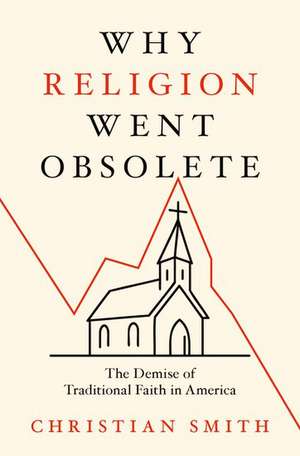
Why Religion Went Obsolete: The Demise of Traditional Faith in America
Autor Christian Smithen Limba Engleză Hardback – iul 2025
Preț: 207.10 lei
Preț vechi: 240.50 lei
-14%
Puncte Express: 311
Carte disponibilă
Livrare economică 12-18 noiembrie
Livrare express 24-30 octombrie pentru 77.08 lei
Livrare prin curier în România Termenul estimat este afișat lângă disponibilitate.
Transport gratuit de la 400.00 lei Plată online sau ramburs, în funcție de opțiunile comenzii.
Retur gratuit în 14 zile Comandă securizată și suport în română.
Specificații
ISBN-13: 9780197800737
ISBN-10: 0197800734
Pagini: 440
Dimensiuni: 165 x 236 x 38 mm
Greutate: 0.77 kg
Editura: Oxford University Press
Colecția OUP USA
Locul publicării:New York, United States
ISBN-10: 0197800734
Pagini: 440
Dimensiuni: 165 x 236 x 38 mm
Greutate: 0.77 kg
Editura: Oxford University Press
Colecția OUP USA
Locul publicării:New York, United States
Recenzii
This is an era-defining work. What Herberg's Protestant, Catholic, Jew was in the 1950s, what Lenski's The Religious Factor was in the 1960s, and what Wuthnow's Restructuring of American Religion was in the 1990s, Christian Smith's Why Religion Went Obsolete is to the early 21st century. It is a remarkable work of scholarship and essential reading for anyone keen to understand the perplexing status of religion in contemporary America.
What has driven millions of Americans, especially the younger generations, to desert church pews? Drawing upon a rich multimethod body of evidence, Christian Smith presents an updated Durkheimian argument that American churches lost their core social functions during the late twentieth century due to both major historical events and complex societal developments. This readable study will provide fresh insights into reasons for the decay of religion in America, which has contributed to a fervent cultural backlash among the remaining faithful.
In this provocative new book, one of America's most eminent social scientists marshals a wealth of data and a lifetime of study behind a stunning argument: traditional religion became obsolete starting in the year 1991. Required reading for anyone who wants to understand the precipitous decline of religion in American society.
Why Religion Went Obsolete is not a book of theological reflection, but it should be required reading for theologians, pastors, educators, and lay leaders alike.
The work is well-researched, detailed, and offers those active in the American church an experience of ecclesial blunt force trauma.
Smith's book is a new and important way of understanding the fate of institutional religion in the United States.
Why Religion Went Obsolete constitutes an important corrective to theories of secularization.
Smith's book serves as a helpful tool for understanding the challenges Christians face as they seek to live faithfully in the modern age.
This is a masterly study, of genuine originality, marshalling hard data to show how, why and when our religious landscape changed.
With its combination of plausibility, readability, and rigor, Why Religion Went Obsolete stands out in the growing corpus of scholarship asking what happened to American religion.
...offers a perspective both original and enlightening.
What has driven millions of Americans, especially the younger generations, to desert church pews? Drawing upon a rich multimethod body of evidence, Christian Smith presents an updated Durkheimian argument that American churches lost their core social functions during the late twentieth century due to both major historical events and complex societal developments. This readable study will provide fresh insights into reasons for the decay of religion in America, which has contributed to a fervent cultural backlash among the remaining faithful.
In this provocative new book, one of America's most eminent social scientists marshals a wealth of data and a lifetime of study behind a stunning argument: traditional religion became obsolete starting in the year 1991. Required reading for anyone who wants to understand the precipitous decline of religion in American society.
Why Religion Went Obsolete is not a book of theological reflection, but it should be required reading for theologians, pastors, educators, and lay leaders alike.
The work is well-researched, detailed, and offers those active in the American church an experience of ecclesial blunt force trauma.
Smith's book is a new and important way of understanding the fate of institutional religion in the United States.
Why Religion Went Obsolete constitutes an important corrective to theories of secularization.
Smith's book serves as a helpful tool for understanding the challenges Christians face as they seek to live faithfully in the modern age.
This is a masterly study, of genuine originality, marshalling hard data to show how, why and when our religious landscape changed.
With its combination of plausibility, readability, and rigor, Why Religion Went Obsolete stands out in the growing corpus of scholarship asking what happened to American religion.
...offers a perspective both original and enlightening.
Notă biografică
Christian Smith is the William R. Kenan, Jr. Professor of Sociology and Founding Director of the Center for the Study of Religion and Society at the University of Notre Dame. Smith is well known for his research focused on religion, adolescents and emerging adults, and social theory. He has written many books, including Divided by Faith: Evangelical Religion and the Problem of Race in America (with Michael O. Emerson), as well as Soul Searching: The Religious and Spiritual Lives of American Teenagers (with Melinda Lundquist Denton).
Cuprins
- 0. Introduction
- I. Setting the Stage
- 1. What Needs Explaining
- 2. Religion Is Good When...
- 3. Some Complex Ways Culture Changes
- II. Perfect Storms Converging
- 4. Long-Term Social Trends
- 5. The Developing Religious Environment
- 6. The 1990s: Beginning of the End
- 7. The 2000s: Obsolescence Assured
- 8. Religious Self-Destructions
- III. The Aftermath
- 9. Contours of the Millennial Zeitgeist
- 10. Through the Exit Door
- Conclusion
- Appendix: Social Locations of Not Religious Americans