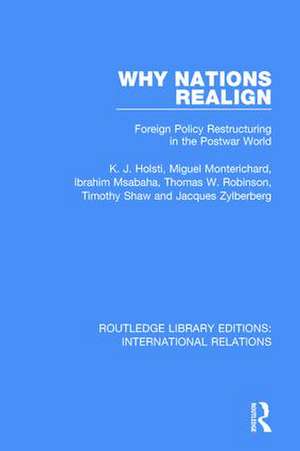
Why Nations Realign: Foreign Policy Restructuring in the Postwar World: Routledge Library Editions: International Relations
Autor Kal Holstien Limba Engleză Paperback – 29 aug 2017

Preț: 244.58 lei
Preț vechi: 310.69 lei
-21%
Puncte Express: 367
Preț estimativ în valută:
43.30€ • 50.42$ • 37.62£
43.30€ • 50.42$ • 37.62£
Carte indisponibilă temporar
Doresc să fiu notificat când acest titlu va fi disponibil:
Se trimite...
Preluare comenzi: 021 569.72.76
Specificații
ISBN-13: 9781138940086
ISBN-10: 1138940089
Pagini: 238
Dimensiuni: 156 x 234 x 19 mm
Greutate: 0.32 kg
Ediția:1
Editura: Taylor & Francis
Colecția Routledge
Seria Routledge Library Editions: International Relations
Locul publicării:Oxford, United Kingdom
ISBN-10: 1138940089
Pagini: 238
Dimensiuni: 156 x 234 x 19 mm
Greutate: 0.32 kg
Ediția:1
Editura: Taylor & Francis
Colecția Routledge
Seria Routledge Library Editions: International Relations
Locul publicării:Oxford, United Kingdom
V-ar putea interesa
-
 World OrderKissingerPreț: 89.70 lei
 -
 Preț: 420.22 lei
 -
 -18%Preț: 1067.54 lei1301.89 lei
 -
 -15%Preț: 416.84 lei490.40 lei
 -
 -15%Preț: 412.00 lei484.70 lei
 -
 Social Power in International PoliticsPeter Van Ham-15%Preț: 428.73 lei504.38 lei
 -
 Preț: 272.67 lei
 -
 Fifty Key Thinkers in International RelationsMartin GriffithsPreț: 265.46 lei
 -
 @WarShane Harris-28%Preț: 53.77 lei75.05 lei
 -
 Understanding Public Diplomacy in East AsiaJan MelissenPreț: 375.81 lei
 -
 Mission Accomplished?Simon Jenkins-18%Preț: 108.91 lei132.84 lei
 -
 China and the West: Hope and Fear in the Age of AsiaFokke Obbema-23%Preț: 156.73 lei202.79 lei
 -
 The European IdentityStephen Green-38%Preț: 41.86 lei67.03 lei
Public țintă
General, Postgraduate, Professional, and UndergraduateCuprins
Introduction. 1. Restructuring Foreign Policy: A Neglected Phenomenon in Foreign Policy Theory K. J. Holsti 2. From Isolation to Dependence: Bhutan, 1958-62 K. J. Holsti 3. From Dependence to Diversification: Tanzania, 1967-77 Timothy M. Shaw and Ibrahim S. R. Msabaha 4. From Dependence to Diversification: Canada 1972-8 5. From Diversification to Isolation: Burma, 1963-7 K. J. Holsti 6. Restructuring Chinese Foreign Policy, 1959-76: Three Episodes Thomas W. Robinson 7. An Abortive Attempt to Change Foreign Policy: Chile, 1970-3 Jacques Zylberberg and Miguel Monterichard 8. Restructuring Foreign Policy: A Comparative Analysis K. J. Holsti
Descriere
This book, originally published in 1982, analyzes the process of radical foreign policy change – how states restructure their foreign relations, and why they do so. Using a common analystical framework, the authors examine Bhutan, Burma, Canada, Child, China and Tanzania. They distinguish between piecemeal foreign policy change and adaptation, and the fundamental re-ordering of foreign policy. Their analysis underlines the extent to which non-military and sometimes imagined threats, such as dependency and external economic and cultural penetration, can constitute an important cause of radical realignment activity.