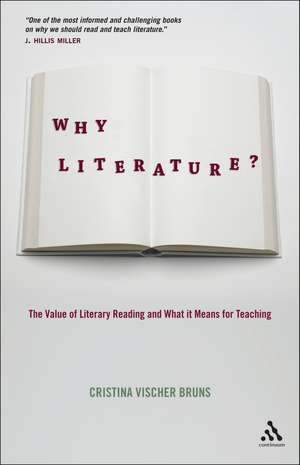
Why Literature?: The Value of Literary Reading and What It Means for Teaching
Autor Dr. Cristina Vischer Brunsen Limba Engleză Paperback – 7 iul 2011
Preț: 191.06 lei
Puncte Express: 287
Carte tipărită la comandă
Livrare economică 27 noiembrie-11 decembrie
Livrare prin curier în România Termenul estimat este afișat lângă disponibilitate.
Transport gratuit de la 400.00 lei Plată online sau ramburs, în funcție de opțiunile comenzii.
Retur gratuit în 14 zile Comandă securizată și suport în română.
Specificații
ISBN-13: 9781441124654
ISBN-10: 1441124659
Pagini: 176
Ilustrații: black & white illustrations
Dimensiuni: 136 x 214 x 16 mm
Greutate: 0.25 kg
Editura: Bloomsbury Publishing
Colecția Continuum
Locul publicării:New York, United States
ISBN-10: 1441124659
Pagini: 176
Ilustrații: black & white illustrations
Dimensiuni: 136 x 214 x 16 mm
Greutate: 0.25 kg
Editura: Bloomsbury Publishing
Colecția Continuum
Locul publicării:New York, United States
V-ar putea interesa
-
 The History of the Hobbit: One Volume EditionJ. R. R. TolkienPreț: 280.14 lei
 -
 The Art of FictionDavid Lodge-19%Preț: 63.67 lei78.72 lei
 -
 The Poisonous Pen of Agatha ChristieMichael C. GeraldPreț: 223.74 lei
 -
 The Exegesis of Philip K DickPhilip K. DickPreț: 199.63 lei
 -
 Crime FictionMartin PriestmanPreț: 246.43 lei
 -
 Jane Austen: The Complete Novels in One SittingJennifer Kasius-27%Preț: 36.14 lei49.76 lei
 -
 TransmesisThomas O BeebeePreț: 404.31 lei
 -
 The Romanticism HandbookDr Sue Chaplin-23%Preț: 244.10 lei317.92 lei
 -
 Narcissistic NarrativeLinda HutcheonPreț: 279.62 lei
 -
 The EnchanterLila Azam ZanganehPreț: 114.44 lei
Cuprins
Acknowledgments Preface - Situating the Questioner
Introduction - the Questioner and Its Importance
1. Why Read Literature?
Literary Reading as Instructive
Literary Reading as a Source of Pleasure
The Varied Effects of Literary Experience and Why They Matter
Shock Recognition Enchantment
The Mechanism of Literature's Effects and Its Importance: Literature as a
Transitional Object
Literature, Transitional Space, and Cultural Contact
2. From Words on Paper to an Object in Transitional Space: Reading for the Formative Use of Literature
Literary Reading and the Self's State in Transitional Space
Making Visible the Moves of the Reader
My own experiences as a reader . . . and a teacher
Jeffrey Wilhelm's remedial readers
Immersion and Reflection: The Two Moves of the Reading Process in Conflict
The role of immersive reading
When reflective reading undermines immersive reading
Sustaining the Tension: Immersion and Reflection as Interdependent
3. Recent Conceptions of Literary Education and Their Potential Impact on Students' Formative Use of LiteratureLiterary Education as the Instructor's Activity
Literary Education in which Students Are Actively Involved
Literary education that prioritizes the ideological critique of texts
Literary education that prioritizes students encounters with texts
The Challenge of the School Context
4. Toward a Literary Education Conducive to the Formative Use of Literature
Principles for Instruction
The priority of immersion in a text Beginning with students' experience of texts Reflection and analysis in a supporting role Attending to culture
The complication of casting students as co-inquirers
Making Space for Students
What students bring to the class A Receptive environment for students' contributions
Ideas for Practice
Works Cited
Index
Introduction - the Questioner and Its Importance
1. Why Read Literature?
Literary Reading as Instructive
Literary Reading as a Source of Pleasure
The Varied Effects of Literary Experience and Why They Matter
Shock Recognition Enchantment
The Mechanism of Literature's Effects and Its Importance: Literature as a
Transitional Object
Literature, Transitional Space, and Cultural Contact
2. From Words on Paper to an Object in Transitional Space: Reading for the Formative Use of Literature
Literary Reading and the Self's State in Transitional Space
Making Visible the Moves of the Reader
My own experiences as a reader . . . and a teacher
Jeffrey Wilhelm's remedial readers
Immersion and Reflection: The Two Moves of the Reading Process in Conflict
The role of immersive reading
When reflective reading undermines immersive reading
Sustaining the Tension: Immersion and Reflection as Interdependent
3. Recent Conceptions of Literary Education and Their Potential Impact on Students' Formative Use of LiteratureLiterary Education as the Instructor's Activity
Literary Education in which Students Are Actively Involved
Literary education that prioritizes the ideological critique of texts
Literary education that prioritizes students encounters with texts
The Challenge of the School Context
4. Toward a Literary Education Conducive to the Formative Use of Literature
Principles for Instruction
The priority of immersion in a text Beginning with students' experience of texts Reflection and analysis in a supporting role Attending to culture
The complication of casting students as co-inquirers
Making Space for Students
What students bring to the class A Receptive environment for students' contributions
Ideas for Practice
Works Cited
Index
Recenzii
"This bold, innovative, clear, and well-argued book not only gives an answer to the question 'Why Literature?' at a time when many people doubt its value. It also makes detailed recommendations, in the light of the answer given, for how literature should be taught. We need literature, Cristina Vischer Bruns argues, because a literary work is an ideal example of what D. W. Winnicott, one of the founders of object relations psychoanalysis, calls a 'transitional object'-an object, that is, halfway between the self and the external world. Such an object aids in the (primarily unconscious) discovery and transformation of the self. Bruns's teaching agenda is based not only on this theory of literature's 'why,' but also on her long face to face experience in the classroom. Rather than stressing analytical reading, she argues, teachers should encourage self-reflection in students about what happens to them in 'immersive reading.' In such reading the reader gets lost in the imaginary world the words on the page create. That can lead to a transition in selfhood. Distanced reading, analytical reading, may inhibit that transformation, though it can also serve as a way station toward a more powerful immersive reading. This is one of the most informed and challenging books on why we should read and teach literature." -- J. Hillis Miller, UCI Distinguished Research Professor, Departments of Comparative Literature and English, University of California Irvine, USA
"A very well-written, powerfully insightful, thorough and thoughtful contribution to the ongoing conversations about literary theory, critical theory, psychology of understanding, and pedagogy. I do not know of anything else written in the last ten years that I would regard as a more important contribution to ongoing professional conversations about the teaching of literature." -- Jeffrey D. Wilhelm, Professor of English Education and Director of Boise State Writing Project, Boise State University, USA
"Cristina Bruns is clearly not one of those teachers who conveys to students, 'If you don't know why you should read literature, then what are you doing in this course?' Thanks to this well informed and immensely readable study, the Why Literature? question has taken on a whole new life." -- Professor Gerald Graff, Professor of Literature and Education, University of Illinois at Chicago, USA, and author of Clueless in Academe: How Schooling Obscures the Life of the Mind (Yale University Press)
Christina Vischer Bruns' work is highly readable. She situates herself very clearly as a teacher and researcher and reveals her perspective as what it is, not assuming more claim to truth than an individual perspective allows. Following a very stringent argument, she guides the reader strongly and with a clear voice. Speaking in her own terms, her text facilitates immersive reading on all levels.
"A very well-written, powerfully insightful, thorough and thoughtful contribution to the ongoing conversations about literary theory, critical theory, psychology of understanding, and pedagogy. I do not know of anything else written in the last ten years that I would regard as a more important contribution to ongoing professional conversations about the teaching of literature." -- Jeffrey D. Wilhelm, Professor of English Education and Director of Boise State Writing Project, Boise State University, USA
"Cristina Bruns is clearly not one of those teachers who conveys to students, 'If you don't know why you should read literature, then what are you doing in this course?' Thanks to this well informed and immensely readable study, the Why Literature? question has taken on a whole new life." -- Professor Gerald Graff, Professor of Literature and Education, University of Illinois at Chicago, USA, and author of Clueless in Academe: How Schooling Obscures the Life of the Mind (Yale University Press)
Christina Vischer Bruns' work is highly readable. She situates herself very clearly as a teacher and researcher and reveals her perspective as what it is, not assuming more claim to truth than an individual perspective allows. Following a very stringent argument, she guides the reader strongly and with a clear voice. Speaking in her own terms, her text facilitates immersive reading on all levels.