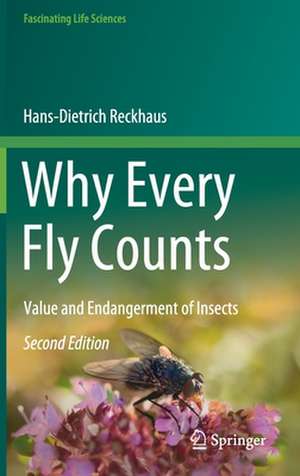
Why Every Fly Counts: Fascinating Life Sciences
Autor Hans-Dietrich Reckhausen Limba Engleză Hardback – 13 noi 2019
This second, fully reviewed and enlarged, edition provides new insights, especially about the value of specific insect species that are generally seen as pests (e.g. ants and moths), as well as an extended chapter on the development of insects and especially their decline in different regions in the world, the industrialized countries in particular. Numerous info graphics show connections between changes in the environment due to human expansion and the number of insects and species. Studies from the US, Canada, Asia, Africa, Europe and Switzerland are used to point out the dramatic reduction of biodiversity. New tables illustrate these developments. The glossary as well as the insects index is extended, the text, tables, pictures and graphs provide even more well-rounded image. Readers will find the argumentation even more clearly and detailed.
Din seria Fascinating Life Sciences
- 18%
 Preț: 788.77 lei
 - 24%
 Preț: 764.43 lei
 - 18%
 Preț: 934.22 lei
 -
 Preț: 465.45 lei
 - 24%
 Preț: 668.50 lei
 - 5%
 Preț: 887.83 lei
 - 24%
 Preț: 1041.46 lei
 - 15%
 Preț: 734.44 lei
 - 18%
 Preț: 979.65 lei
 - 15%
 Preț: 739.28 lei
 - 15%
 Preț: 740.47 lei
 -
 Preț: 521.03 lei
 - 18%
 Preț: 700.10 lei
 - 18%
 Preț: 699.73 lei
 - 20%
 Preț: 522.73 lei
 - 15%
 Preț: 700.48 lei
 - 5%
 Preț: 624.70 lei
 - 18%
 Preț: 753.87 lei
 - 20%
 Preț: 637.78 lei
 - 18%
 Preț: 760.75 lei
 -
 Preț: 434.19 lei
 - 20%
 Preț: 499.41 lei
 -
 Preț: 423.91 lei
 - 18%
 Preț: 760.65 lei
 - 24%
 Preț: 838.43 lei
 -
 Preț: 468.55 lei
 - 18%
 Preț: 764.65 lei
 - 24%
 Preț: 938.74 lei
 - 24%
 Preț: 1246.03 lei
 - 20%
 Preț: 661.47 lei
 - 15%
 Preț: 529.09 lei
 - 24%
 Preț: 639.45 lei
 - 18%
 Preț: 782.32 lei
 - 24%
 Preț: 749.16 lei
 - 24%
 Preț: 682.63 lei
 - 24%
 Preț: 802.41 lei
Preț: 662.36 lei
Preț vechi: 779.24 lei
-15%
Puncte Express: 994
Carte tipărită la comandă
Livrare economică 07-21 decembrie
Livrare prin curier în România Termenul estimat este afișat lângă disponibilitate.
Transport gratuit pentru acest produs Plată online sau ramburs, în funcție de opțiunile comenzii.
Retur gratuit în 14 zile Comandă securizată și suport în română.
Specificații
ISBN-13: 9783030312282
ISBN-10: 3030312283
Pagini: 164
Ilustrații: XV, 146 p. 44 illus., 43 illus. in color.
Dimensiuni: 160 x 241 x 15 mm
Greutate: 0.37 kg
Ediția:Second Edition 2019
Editura: Springer
Colecția Fascinating Life Sciences
Seria Fascinating Life Sciences
Locul publicării:Cham, Switzerland
ISBN-10: 3030312283
Pagini: 164
Ilustrații: XV, 146 p. 44 illus., 43 illus. in color.
Dimensiuni: 160 x 241 x 15 mm
Greutate: 0.37 kg
Ediția:Second Edition 2019
Editura: Springer
Colecția Fascinating Life Sciences
Seria Fascinating Life Sciences
Locul publicării:Cham, Switzerland
Cuprins
1. Insects as Beneficials.- 2 Insects as Pests.- 3 Insects Today and in the Future.- 4 Conclusion: Hated, Threatened and Worth Protecting.
Recenzii
Notă biografică
Dr. Hans-Dietrich Reckhaus pursued his studies in business administration at the University of St. Gallen, which he completed in 1993 by receiving his Dr. oec. He has headed Reckhaus GmbH & Co KG in Bielefeld since 1995 in the second generation as the executive manager. With the quality seal “Insect Respect” launched in 2012, Reckhaus strives for sustainable transformation in his sector. He was awarded the German Visionary Prize for this in 2014. This globally unique compensation model was triggered by a dialog with the Swiss conceptual artists Frank and Patrik Riklin. They initiated the countermovement “saving instead of killing” and in 2012, implemented the “Saving the flies” action together with Hans-Dietrich Reckhaus. The entrepreneur regularly gives lectures and publishes about issues regarding SME leadership and sustainability.
Textul de pe ultima copertă
Threatening pests or threatened beneficials? Biting midges are wonderful insects. The animals are so tiny and uniquely shaped that they are particularly good at pollinating the small and tight flowers of the cocoa tree. Without them, there would be much less chocolate. We associate other insects more with the damage that they cause. Mosquitoes and wasps bite us. Moth larvae damage textiles and contaminate foods. Ants undermine our paths and flies are just a pain.
But what exactly is our relationship with insects? Are they more beneficial or harmful? What role do they play in the world? What are the effects of climate change: Will the number of insects continue to increase? This book discusses the beneficial and harmful effects of insects and explains their development and significance for biodiversity.
This second, fully reviewed and enlarged, edition provides new insights, especially about the value of specific insect species that are generally seen as pests (e.g. ants and moths), as well as an extended chapter on the development of insects and especially their decline in different regions in the world, the industrialized countries in particular. Numerous info graphics show connections between changes in the environment due to human expansion and the number of insects and species. Studies from the US, Canada, Asia, Africa, Europe and Switzerland are used to point out the dramatic reduction of biodiversity. New tables illustrate these developments. The glossary as well as the insects index is extended, the text, tables, pictures and graphs provide even more well-rounded image. Readers will find the argumentation even more clearly and detailed.
But what exactly is our relationship with insects? Are they more beneficial or harmful? What role do they play in the world? What are the effects of climate change: Will the number of insects continue to increase? This book discusses the beneficial and harmful effects of insects and explains their development and significance for biodiversity.
This second, fully reviewed and enlarged, edition provides new insights, especially about the value of specific insect species that are generally seen as pests (e.g. ants and moths), as well as an extended chapter on the development of insects and especially their decline in different regions in the world, the industrialized countries in particular. Numerous info graphics show connections between changes in the environment due to human expansion and the number of insects and species. Studies from the US, Canada, Asia, Africa, Europe and Switzerland are used to point out the dramatic reduction of biodiversity. New tables illustrate these developments. The glossary as well as the insects index is extended, the text, tables, pictures and graphs provide even more well-rounded image. Readers will find the argumentation even more clearly and detailed.
Caracteristici
Unique current overview of the relationship between humans and insects Well-researched numbers and correlations Highlighting the value and threats of insects, while showing their growing endangerment Fascinating facts, contexts and background information