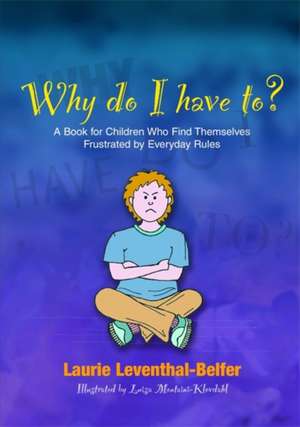
Why Do I Have To?: A Book for Children Who Find Themselves Frustrated by Everyday Rules
Ilustrat de Luisa Montaini-Klovdahl Autor Laurie Leventhal-Belferen Limba Engleză Paperback – 15 iul 2008 – vârsta până la 12 ani
Why do I have to? looks at a set of everyday situations that provide challenges for children at home, with their friends, and at school. Laurie Leventhal-Belfer empathizes with children's wish to do things their way, explains clearly why their way does not work, and provides a list of practical suggestions for how to cope with these challenges and avoid feelings of frustration. This is the ideal book for children who have difficulty coping with the expectations of daily living, as well as for their parents and the professionals who work with them.
Preț: 79.04 lei
Preț vechi: 99.50 lei
-21%
Puncte Express: 119
Carte disponibilă
Livrare economică 16-30 noiembrie
Livrare express 31 octombrie-06 noiembrie pentru 37.81 lei
Livrare prin curier în România Termenul estimat este afișat lângă disponibilitate.
Transport gratuit de la 400.00 lei Plată online sau ramburs, în funcție de opțiunile comenzii.
Retur gratuit în 14 zile Comandă securizată și suport în română.
Specificații
ISBN-13: 9781843108917
ISBN-10: 1843108917
Pagini: 80
Dimensiuni: 172 x 244 x 10 mm
Greutate: 0.16 kg
Editura: JESSICA KINGSLEY PUBLISHERS
Colecția Jessica Kingsley Publishers
Locul publicării:London, United Kingdom
ISBN-10: 1843108917
Pagini: 80
Dimensiuni: 172 x 244 x 10 mm
Greutate: 0.16 kg
Editura: JESSICA KINGSLEY PUBLISHERS
Colecția Jessica Kingsley Publishers
Locul publicării:London, United Kingdom
V-ar putea interesa
-
 When We Go to Grandma's HouseCandy BeePreț: 57.14 lei
 -
 Preț: 72.28 lei
 -
 A Kids Book About BoredomKyle Steed-16%Preț: 79.64 lei95.16 lei
 -
 A Kids Book About SchoolRachel Burger-17%Preț: 79.28 lei95.44 lei
 -
 Rules (Scholastic Gold)Cynthia LordPreț: 51.71 lei
 -
 I Can Do It By Myself!Caryl HartPreț: 56.85 lei
 -
 Tiny Tiger says Why Can't I?Smriti Halls-18%Preț: 47.73 lei58.09 lei
 -
 My Sad BookHonor HeadPreț: 58.15 lei
 -
 -36%Preț: 42.16 lei65.79 lei
 -
 -30%Preț: 91.69 lei131.36 lei
 -
 -38%Preț: 61.26 lei98.43 lei
 -
 Preț: 89.62 lei
 -
 Preț: 63.71 lei
 -
 Are You Mad At Me?Meg JosephsonPreț: 108.04 leiRecomandat
 -
 -18%Preț: 121.96 lei148.76 lei
 -
 -17%Preț: 109.10 lei131.58 lei
 -
 -19%Preț: 96.16 lei119.15 lei
 -
 Social Rules for KidsSusan DiamondPreț: 108.21 lei
 -
 The Things You Have to Do Before I Buy You a PhoneAdam FergusonPreț: 100.28 lei
Recenzii
Laurie Leventhal-Belfer's WHY DO I HAVE TO? is a thoughtfully structured guide for children who are fustrated with everyday rules and adults who are fustrated with those children. This short book is packed with a comprehensive set of questions, phrased from a child's perspective, dealing primarily with social expectations...This book will be an invaluable addition to the shelves for the children who are challenged by the expectations of daily living. The insightful questions, thoughtful answers, and clinically tested suggestions will decrease fustration for children and parents alike.
As a SENCO I would recommend this book to staff in schools supporting pupils within the autistic spectrum and/or with ADHD. Finally, this book would also be a useful read for children, young people and their families.
This book looks at everyday situations that can cause conflict for children with Asperger's syndrome at home, at school and with their friends. A useful tool to give parents and carers the confidence to tackle behaviours that are regular triggers for conflict.
Laurie Leventhal-Belfer's approach shows empathy for children's wish to do things their way, explains why their way does not work, and provides a list of practical suggestions for how to cope with these challenges and avoid feelings of frustration. Her approach encourages children to be involved in determining solutions for dealing with daily rules and expectations...This is the ideal book for children who have difficulty coping with the expectations of daily living, as well as for their parents and the professionals who work with them.
This is a useful self-help guide that tackles a wide range of issues... some of the strategies involve a lot of personal initiation... Although, this book is not explicitly aimed at children on the autism spectrum, it certainly tackles issues particular to this population. The author clearly has experience in this area.. she is founder and director of The Friends Program, the therapeutic group project for children with Asperger's in the US... it is certainly a resource that educational psychologists could use in their work with service users. It also be recommended as reading for some children, teachers and parents who are having particular issues with dealing with rules and need a logical explanation and some guidance. It is accessible and easy to read with amusing picture to add interest and most of all, there is a positive ethos underpinning this book, which helps reassure children that they are not alone in their frustrations and there are ways to help.
If you want a child with Asperger's syndrome to comply with a social or family rule, it is very important to explain the logical reason to comply. Laurie's book provides the logic for compliance that will be invaluable for parents and teachers. I know this book will become regular bed time reading and be used many times at home and at school.
Dr. Laurie clearly understands how children with limited flexibility and difficulty coping think and respond. She has used her clinical experience to teach us how to help these children succeed. Dr. Laurie has provided a format, similar to Social Stories (TM), for reducing stress in daily life and for minimizing conflict stemming from unwritten or everyday rules. While there is no one solution for every child, the stories can be easily adapted for each child. She encourages children to be participants in determining solutions to their problems by providing simple, not simplistic, methods that work.
As a SENCO I would recommend this book to staff in schools supporting pupils within the autistic spectrum and/or with ADHD. Finally, this book would also be a useful read for children, young people and their families.
This book looks at everyday situations that can cause conflict for children with Asperger's syndrome at home, at school and with their friends. A useful tool to give parents and carers the confidence to tackle behaviours that are regular triggers for conflict.
Laurie Leventhal-Belfer's approach shows empathy for children's wish to do things their way, explains why their way does not work, and provides a list of practical suggestions for how to cope with these challenges and avoid feelings of frustration. Her approach encourages children to be involved in determining solutions for dealing with daily rules and expectations...This is the ideal book for children who have difficulty coping with the expectations of daily living, as well as for their parents and the professionals who work with them.
This is a useful self-help guide that tackles a wide range of issues... some of the strategies involve a lot of personal initiation... Although, this book is not explicitly aimed at children on the autism spectrum, it certainly tackles issues particular to this population. The author clearly has experience in this area.. she is founder and director of The Friends Program, the therapeutic group project for children with Asperger's in the US... it is certainly a resource that educational psychologists could use in their work with service users. It also be recommended as reading for some children, teachers and parents who are having particular issues with dealing with rules and need a logical explanation and some guidance. It is accessible and easy to read with amusing picture to add interest and most of all, there is a positive ethos underpinning this book, which helps reassure children that they are not alone in their frustrations and there are ways to help.
If you want a child with Asperger's syndrome to comply with a social or family rule, it is very important to explain the logical reason to comply. Laurie's book provides the logic for compliance that will be invaluable for parents and teachers. I know this book will become regular bed time reading and be used many times at home and at school.
Dr. Laurie clearly understands how children with limited flexibility and difficulty coping think and respond. She has used her clinical experience to teach us how to help these children succeed. Dr. Laurie has provided a format, similar to Social Stories (TM), for reducing stress in daily life and for minimizing conflict stemming from unwritten or everyday rules. While there is no one solution for every child, the stories can be easily adapted for each child. She encourages children to be participants in determining solutions to their problems by providing simple, not simplistic, methods that work.
Cuprins
Preface. Rules that can be frustrating at home: Why do I have to: Go to school before the show that I am watching is over? Wear shoes and a jacket when I go outside? Eat when I am not hungry? Rest when I am not tired? Go to the bathroom when I do not need to go? Share toys if I am still using them? Turn off the television or computer before my show or game is over? Stop talking about things that I like? Rules that may be frustrating about friends: Why do I have to: Play with my play date when I would rather play by myself? Say thank-you for a present that I do not like? Go to a friend's house when I would rather stay home? Let other kids play a game the "wrong" way? Apologize to other children for hurting them when they hurt me first? Listen to a friend talk about something that I do not find interesting? Rules that may be frustrating at school: Why do I have to: Listen to a story that I already know? Let my hands get dirty? Say hello with words instead of giving a friend a big hug or slap on the back? Only talk about what the teacher asked about? Tell my friends that I am no longer playing the game when they can see for themselves? Ask my teacher if I can leave the room? Sit in a chair to do my work when I work better standing up? Be quiet when I am working? Explain to an adult why I got into a fight when they should know? Do homework after I have been working in school all day? Appendix: Goal Chart.