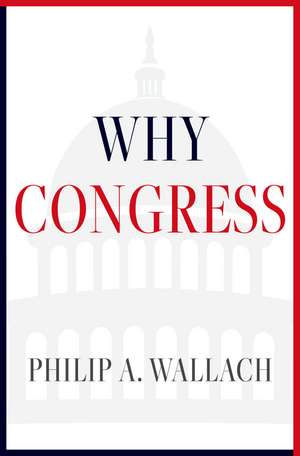
Why Congress
Autor Philip Wallachen Limba Engleză Paperback – 19 noi 2026
Preț: 152.94 lei
Nou
Puncte Express: 229
Carte disponibilă
Livrare economică 16-30 noiembrie
Livrare prin curier în România Termenul estimat este afișat lângă disponibilitate.
Transport gratuit de la 400.00 lei Plată online sau ramburs, în funcție de opțiunile comenzii.
Retur gratuit în 14 zile Comandă securizată și suport în română.
Specificații
ISBN-13: 9780197814697
ISBN-10: 0197814697
Pagini: 336
Dimensiuni: 160 x 233 x 25 mm
Greutate: 0.45 kg
Editura: Oxford University Press
Colecția OUP USA
Locul publicării:New York, United States
ISBN-10: 0197814697
Pagini: 336
Dimensiuni: 160 x 233 x 25 mm
Greutate: 0.45 kg
Editura: Oxford University Press
Colecția OUP USA
Locul publicării:New York, United States
Recenzii
Timely." - David D. Kirkpatrick, The New Yorker
'Why Congress'
Nuanced and persuasive, this is a valuable reminder that Congress has risen to the moment before and can do so again.
...a well-researched, readable examination of Congress's ability and inability to deal with important policy issues, ranging from 1960s civil rights successes to more recent immigration failures.
Provides a compelling argument for the importance of our legislative branch and how it can reassert its relevance in the 21st century.
Why Congress is an excellent book that argues persuasively for the necessity of a thriving Congress in a diverse republic.
With its historical analysis of Congress and insight into its potential future, this book will appeal to political science and public policy majors. A recommended purchase for academic libraries.
Wallach's primary aim in this book is to reassess Congress's role in the political and policymaking process over the past several decades...Wallach is rightly concerned with the political relevance of a Congress that is both quick to centralize policymaking and deliberation within the leadership, while simultaneously delegating significant policymaking autonomy to the executive branch.
'Why Congress'
Nuanced and persuasive, this is a valuable reminder that Congress has risen to the moment before and can do so again.
...a well-researched, readable examination of Congress's ability and inability to deal with important policy issues, ranging from 1960s civil rights successes to more recent immigration failures.
Provides a compelling argument for the importance of our legislative branch and how it can reassert its relevance in the 21st century.
Why Congress is an excellent book that argues persuasively for the necessity of a thriving Congress in a diverse republic.
With its historical analysis of Congress and insight into its potential future, this book will appeal to political science and public policy majors. A recommended purchase for academic libraries.
Wallach's primary aim in this book is to reassess Congress's role in the political and policymaking process over the past several decades...Wallach is rightly concerned with the political relevance of a Congress that is both quick to centralize policymaking and deliberation within the leadership, while simultaneously delegating significant policymaking autonomy to the executive branch.
Notă biografică
Philip A. Wallach is a senior fellow at the American Enterprise Institute (AEI), where he studies America's separation of powers, with a focus on regulatory policy issues and the relationship between Congress and the administrative state.
Cuprins
- Preface
- 1. What Congress Alone Can Do
- Part I: When Congress Worked
- 2. Congress and World War II
- 3. The Achievement of Civil Rights
- Part II: Congress Transformed
- 4. Cacophony - The Reforms of the 1970s
- 5. Conservatives against Congress
- 6. The Triumph of Partisan Posturing over Politics
- Part III: The Costs of a Failing Congress
- 7. Failing to Compromise on Immigration
- 8. Congress and COVID: We Needed Leadership, They Gave us Cash
- Part IV: Three Futures for Congress
- 9. Decrepitude
- 10. Rubber Stamp
- 11. Revival
- Postscript: An Open Letter to America's Legislators