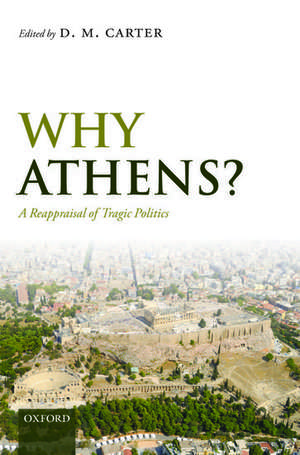
Why Athens?: A Reappraisal of Tragic Politics
Editat de D. M. Carteren Limba Engleză Hardback – 7 apr 2011
Preț: 827.47 lei
Preț vechi: 1196.87 lei
-31%
Puncte Express: 1241
Carte tipărită la comandă
Livrare economică 20 noiembrie-01 decembrie
Livrare prin curier în România Termenul estimat este afișat lângă disponibilitate.
Transport gratuit pentru acest produs Plată online sau ramburs, în funcție de opțiunile comenzii.
Retur gratuit în 14 zile Comandă securizată și suport în română.
Specificații
ISBN-13: 9780199562329
ISBN-10: 0199562326
Pagini: 494
Dimensiuni: 162 x 241 x 34 mm
Greutate: 0.9 kg
Editura: OUP OXFORD
Colecția OUP Oxford
Locul publicării:Oxford, United Kingdom
ISBN-10: 0199562326
Pagini: 494
Dimensiuni: 162 x 241 x 34 mm
Greutate: 0.9 kg
Editura: OUP OXFORD
Colecția OUP Oxford
Locul publicării:Oxford, United Kingdom
V-ar putea interesa
-
 -32%Preț: 5351.11 lei7859.12 lei
 -
 Roman HomosexualityCraig A. Williams-10%Preț: 336.57 lei375.45 lei
 -
 Taken at the Flood: The Roman Conquest of GreeceRobin Waterfield-18%Preț: 82.56 lei100.48 lei
 -
 XenophonVivienne J. Gray-32%Preț: 631.89 lei933.02 lei
 -
 The Oxford Handbook of Jewish Daily Life in Roman PalestineCatherine Hezser-32%Preț: 1024.77 lei1512.57 lei
 -
 The Jewish WarJosephus-17%Preț: 78.31 lei94.86 lei
 -
 -31%Preț: 741.06 lei1076.54 lei
 -
 Aristotle as Poet: The Song for Hermias and Its ContextsAndrew L. Ford-29%Preț: 503.27 lei704.83 lei
 -
 Early Mesopotamia: Society and Economy at the Dawn of HistoryNicholas PostgatePreț: 447.05 lei
 -
 The Archaeology of Mesopotamia: Theories and ApproachesRoger MatthewsPreț: 403.46 lei
 -
 Life and Letters from the Roman FrontierAlan K. BowmanPreț: 408.62 lei
 -
 Camb Comp Greek MythologyRoger D. WoodardPreț: 364.73 lei
 -
 Preț: 304.32 lei
 -
 AugustusJonathan Edmondson-15%Preț: 242.04 lei285.54 lei
 -
 Imperial Rome AD 193 to 284Clifford Ando-17%Preț: 238.08 lei285.53 lei
 -
 Imperial Rome AD 284 to 363Jill Harries-15%Preț: 247.92 lei293.01 lei
 -
 Greek ArchaeologyChristopher MeePreț: 311.77 lei
 -
 Classical CivilizationNigel Spivey-27%Preț: 86.48 lei119.17 lei
Recenzii
There is much too commend in this volume... a significant contribution to an important and controversial topic.
The essays here remind us that, as far as the politics of tragedy are concerned, there is much more to be discussed about tragedy than whether, and how, it was democratic ... all the contributions are of high quality.
The essays here remind us that, as far as the politics of tragedy are concerned, there is much more to be discussed about tragedy than whether, and how, it was democratic ... all the contributions are of high quality.
Cuprins
- Introduction
- I. Context
- 1: Peter Wilson: The glue of democracy? Tragedy, structure and finance
- 2: D. M. Carter: Plato, drama, and rhetoric
- 3: Anne Duncan: Nothing to do with Athens? Tragedians at the courts of tyrants
- Response
- II. Discourse
- 4: Peter Burian: Athenian tragedy as democratic discourse
- 5: Jon Hesk: Euripidean euboulia and the problem of 'tragic politics'
- 6: Elton T. E. Barker: 'Possessing an unbridled tongue': frank speech and speaking back in Euripides' Orestes
- Response
- III. Families
- 7: Mark Griffith: Extended families, marriage, and inter-city relations in (later) Athenian tragedy: Dynasts II
- 8: Eleanor OKell: Inheritance and the Athenian nature of Sophoclean tragedy
- Response
- IV. Choruses
- 9: Sheila Murnaghan: Choroi achoroi: the Athenian politics of tragic choral identity
- 10: Eirene Visvardi: Pity and panhellenic politics: choral emotion in Euripides' Hecuba and Trojan Women
- Response
- V. Suppliants
- 11: Angeliki Tzanetou: Supplication and empire in Athenian tragedy
- 12: Graziella Vinh: Athens in Euripides' Suppliants: ritual, politics, and theatre
- Response
- VI. Athens and Greece
- 13: David Rosenbloom: The panhellenism of Athenian tragedy
- 14: John Gibert: Hellenicity in later Euripidean tragedy
- Response